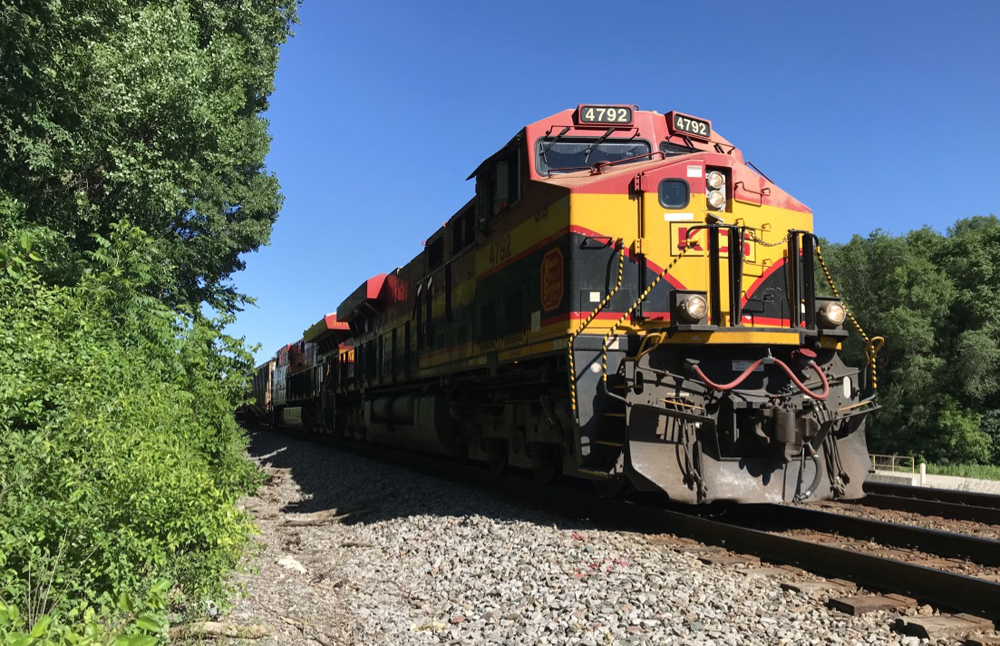
WASHINGTON — Canadian Pacific and Kansas City Southern — responding to critics, skeptics, and opponents — told federal regulators this week that their proposed merger is in the public interest and should be approved.
The railroads, in a three-volume, 4,374-page filing, argued that the first merger of Class I railroads in two decades should sail through the regulatory process without conditions being imposed, aside from commitments they have already made to shippers, communities, and other railroads.
Their $31 billion deal to create the first railroad linking Canada, the U.S., and Mexico has the support of shippers, rail labor, shortline railroads, CP and KCS told the Surface Transportation Board. Amtrak is on board, and the Federal Railroad Administration has approved the railroads’ safety plans.
“For an industry characterized by shippers alienated and embittered by railroad performance, the lack of any meaningful shipper opposition, to me, speaks volumes,” CP CEO Keith Creel wrote. “The many hundreds of shippers who have supported the Transaction recognize it for what it is — a once-in-a-lifetime opportunity to make competition stronger without the need for new regulation. CPKC will be a catalyst for a more competitive rail industry, with more capacity to serve shipper needs, and a commitment to bring a customer-first mindset to the marketplace.”
“What opposition there is comes principally from the five Class I railroads,” CP and KCS said in their filing. “The protection these Class I railroads seek is itself evidence that they see the CP/KCS Transaction as injecting new competition into the North American rail network.”
BNSF Railway, Canadian National, CSX Transportation, Norfolk Southern, and Union Pacific have raised concerns that Canadian Pacific Kansas City would squeeze them out at key gateways, particularly the Mexico border crossing at Laredo, Texas.
CP and KCS have pledged to keep all interchanges open as they are today, and say their combination will increase competition, take trucks off the highway, and promote trade. The railroads called the other Class I railroads’ requests for conditions self-serving efforts to protect themselves from change. “The Board should reject their efforts,” CP and KCS wrote, saying that they are an abuse of the merger process.
Competitors’ requests ‘don’t meet legal standards’
The other railroads’ requests for conditions, CP and KCS said, don’t meet legal standards under the STB’s pre-2001 merger rules and are unjustified. And CN’s request that CPKC be forced to divest KCS’s former Gateway Western routes linking Springfield, Ill., with Kansas City and St. Louis would be unprecedented, CP and KCS said. CN says creating a new single-line route from Kansas City to Chicago, Detroit, and Eastern Canada would enable it to take 80,000 trucks off the road annually.
“There is no competitive reason for why such a drastic remedy is necessary, especially since divestiture of a line in the merger context has never been ordered, at least not since the Staggers Act,” CP and KCS said. “That line is not an active parallel route.”
Creel said a divestiture to CN would dismember KCS. “I understand why CN might be unhappy that CP prevailed in our effort to acquire KCS,” he wrote. “CN’s effort to force a divestiture of KCS’s Kansas City-Springfield/St. Louis line strikes me as a sour-grapes response aimed at undermining CPKC’s future while simultaneously achieving a partial acquisition of KCS that CN could not accomplish in the marketplace.”
Creel also said the former Gateway Western lines wouldn’t be competitive with other routes. “During my time in CN’s operating department, I never thought of CN’s connection with KCS at Springfield as creating a through route for any traffic, much less one that was competitive with the UP and BNSF single-line routes between these cities, or with NS’s single-line route between Kansas City and Detroit,” he wrote.
Nonetheless, Creel said he has discussed with CN CEO Tracy Robinson CP’s willingness to consider jointly investing in the Springfield-Kansas City route if it could actually shift more trucks from highway to rail.
Operational concerns unfounded, filing argues
Operationally, CP and KCS pledged their merger would unfold without disruption and that traffic growth won’t cause congestion, particularly in Texas. The railroads said the addition of CPKC traffic growth wouldn’t push Houston or Beaumont train counts above peak levels of 2016, when both terminals functioned smoothly.
BNSF and UP have asked the board to require CPKC to fund and build new capacity on its trackage rights routes in the Lone Star State before adding new traffic. CP and KCS say that isn’t necessary.
“Such a condition has never before been imposed in any merger, and it ignores the many existing trackage-rights provisions that already govern when, how, and who pays for capacity required by increased traffic volumes on the shared lines,” CP and KCS wrote.
CP and KCS also said their merger would not harm Metra commuter service in the Chicago area. The only place where daily train counts will increase is on the Milwaukee District West line, which has the capacity to handle the additional eight trains per day, CP and KCS say, citing new traffic modeling.
The railroads also said NIMBY opposition in the Chicago area was “outrageous.”
“The Coalition to Stop CPKC’s demand for more than nine billion dollars in infrastructure investments to address the addition of only eight additional freight to lines that daily host upwards of 70 total trains (including Metra passenger trains), and have historically hosted more freight trains than CPKC will operate, is particularly egregious,” the railroads told the board. “They are happy to have CPKC’s anticipated freight traffic foisted on other communities but not in their backyards.”
Share this article