



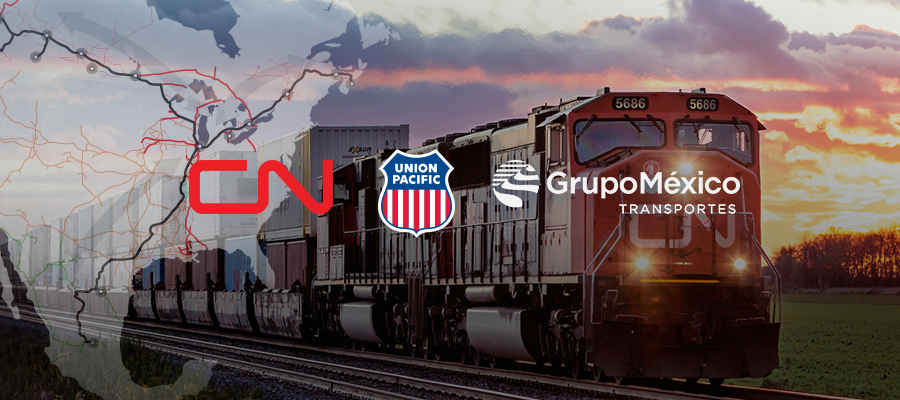
MONTREAL — Canadian National, Union Pacific, and Ferromex have significantly tightened the schedules for the new intermodal service they will launch on May 15 to link Canada and Detroit with Mexico.
The changes to the Falcon Premium service, announced in customer advisories on Monday, take 40 hours out of the Detroit-Monterrey transit time and trim the Toronto-Monterrey schedule by 41 hours, for example.
“Working as an integrated team, we continue to enhance and improve our service offering,” CN’s customer advisory said. “Our latest Falcon Premium service plan is now available with enhanced transit times for delivery to market that is as much as two days faster than any other available intermodal solution.”
UP’s advisory said the new schedules “improve delivery to market by an additional day more reliably than any other available intermodal solution.”
The Falcon Premium service was unveiled on April 24, just 10 days after Canadian Pacific and Kansas City Southern merged to create the first railroad able to offer single-line service connecting Canada, the U.S., and Mexico.
CPKC on May 11 will launch its premium Chicago-Mexico intermodal train pair, 180/181. With third-day service to Laredo, fourth day to Monterrey, and fifth day to Mexico City, the trains will offer transit times that are competitive with over the road trucks and be the fastest cross-border intermodal service, executives said.
“CPKC is targeting trucks moving primarily from the U.S. Midwest to Mexico, and in reverse. We stand behind our single-line best in class service versus a three-line offering,” CPKC spokesman Patrick Waldron says. “Competition makes us all get better. Our single-line best in class service has inspired the three railroads to sharpen their pencils to build an improved schedule. In the end our customers will vote with their business and choose the service they value. That’s what healthy competition is all about.”
Falcon Premium will connect a dozen CN terminals with the Ferromex terminals in Monterrey and Silao via the Eagle Pass, Texas, gateway. CN and UP will use steelwheel interchange to exchange the traffic in Chicago via CN’s former Elgin, Joliet & Eastern Chicago bypass route.
“CN will now have the shortest route and fastest service to all of its key markets. Layering this new service with our new EMP product with the UP and NS, CN’s customers will have new options to convert truck volumes to rail,” Doug MacDonald, CN’s chief marketing officer, told investors and analysts on the railway’s earnings call last week.
CN will essentially be tying its intermodal network to existing Chicago-Mexico service that UP and Ferromex currently offer. CN believes there are two trains’ worth of volume moving in each direction every day via truck, based on market research conducted as part of its ill-fated attempt to acquire Kansas City Southern. The potential traffic includes automotive parts, food, freight all kinds, home appliances, and temperature-controlled products, the railroads said.
In October, CN became a full partner in the UP-Norfolk Southern EMP container pool, which MacDonald says will benefit the Falcon Premium service by providing equipment that intermodal marketing companies can use. UP in October booted Canadian Pacific out of the EMP program in advance of the CP-KCS merger.
Last month CPKC landed a multi-year contract to handle Schneider National’s intermodal traffic between the U.S. and Mexico. It also will handle some of Knight-Swift’s cross-border intermodal traffic. Schneider and Knight-Swift currently move their Chicago-Mexico traffic via UP.
CPKC’s ability to provide single-line service is a “pretty dramatic opportunity,” Jim Filter, Schneider’s group president of transportation and logistics, said on the company’s earnings call last week.
Each interchange, he says, is a potential point of failure. “What the CPKC has created is a single rail delivery going from our three ramps in Mexico directly up to the Midwest,” Filter says.
He also expects CPKC to improve service on the former KCS portion of the route from Kansas City to Laredo and down into Mexico. “This is an area that has struggled with service,” Filter says.
“We’d expect to see a pretty dramatic improvement on the former KCS,” he says.
–Updated at 9:50 a.m. CDT with comment from CPKC.
Share this article