The industry would never admit it, but the Federal Railroad Administration has given the Class I railroads a gift in the form of its proposed two-person train crew rule.
Debate over the controversial rule has been framed almost entirely in safety terms. Having two people in the locomotive cab, the rule’s advocates say, is vital for the safety of the public, communities, and crew members, particularly in an era of ever-longer freight trains.
Yet it seems to me that if the SMART-TD union were ever to agree to taking conductors out of the cab — something the Class I railroads sought during the last round of national contract negotiations — it would quickly cause chaos out on main lines.
We don’t know whether two-person crews are safer than one-person crews, or vice versa. There’s just no conclusive data either way.
What we do know is that today’s massive freight trains tend to pull knuckles and encounter brake issues more frequently than shorter trains. This is simply due to the law of averages. The more cars you put in a train, the more troublemakers you’re likely to get in a consist that might stretch 15,000 feet.
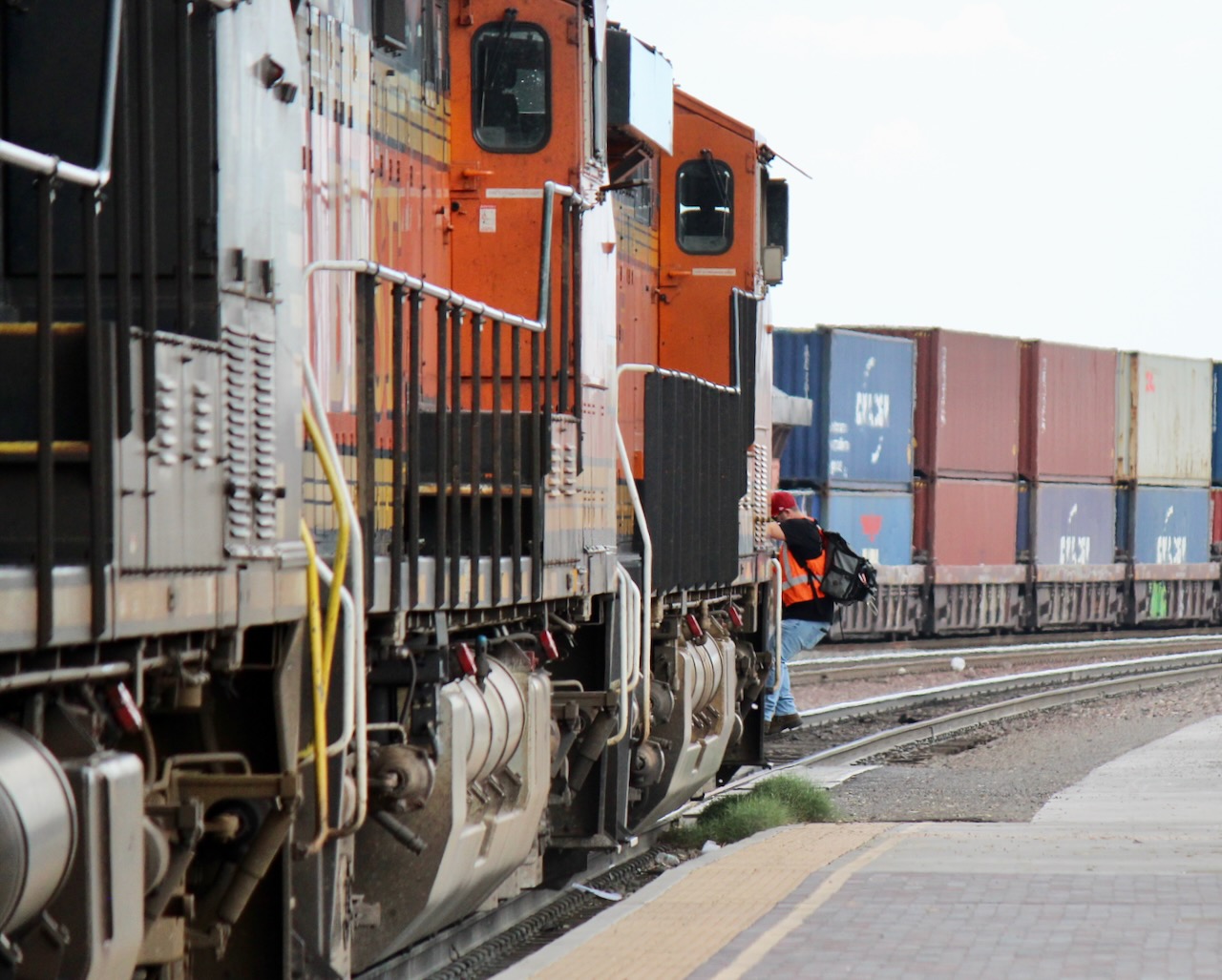
Today when a freight train goes into emergency, the crew generally has no idea why. So the conductor hits the ground and walks the train to find the culprit. Then he or she has to fix the problem before walking back to the head end. It’s a process that can take hours.
Railroads want to create ground-based conductor positions, which would leave engineers alone in the cab. Putting conductors in pickup trucks, assigning them a territory, and having them respond to problems out on the main line may sound good to penny-pinching railroad executives — at least on paper. But out in the real world your mileage may vary.
Murphy’s Law being what it is, it wouldn’t take long for an engineer-only train to encounter a knuckle or brake-related problem on single track in the most isolated, godforsaken, hard to reach area on a subdivision.

Engineers can’t leave the cab. With no conductor to walk the train, and help from a ground-based conductor miles and even hours away, delays would mount. First to the waylaid train, then to the trains behind it and to oncoming traffic. Before long, the delays would cascade across the whole subdivision. And then the railroad grinds to a halt.
Although the scenario’s a bit better on a double-track main line, a disabled train eventually creates a single-track bottleneck, which also creates congestion and delays.
Umpteen million dollars’ worth of freight is stuck — and won’t arrive on time –— all because the railroad wants to save a buck or two on crew costs. It’s almost guaranteed that at least some of the delayed trains will require unplanned recrews, which only increases costs. And the late arrivals could be the last straw for some shippers, who would give up on rail and shift their freight to trucks.
If this sounds shortsighted, that’s because it is.
There may or may not be a safety case to make for two-person crews. But there sure is a railroad business case for keeping two people in the cab: It’s called service, which is the only thing that railroads sell to their customers. Until rail equipment becomes far more reliable, and failures on the line of road become extremely rare, engineer-only operation is a fool’s errand.
You can reach Bill Stephens at bybillstephens@gmail.com and follow him on LinkedIn and X @bybillstephens
Share this article