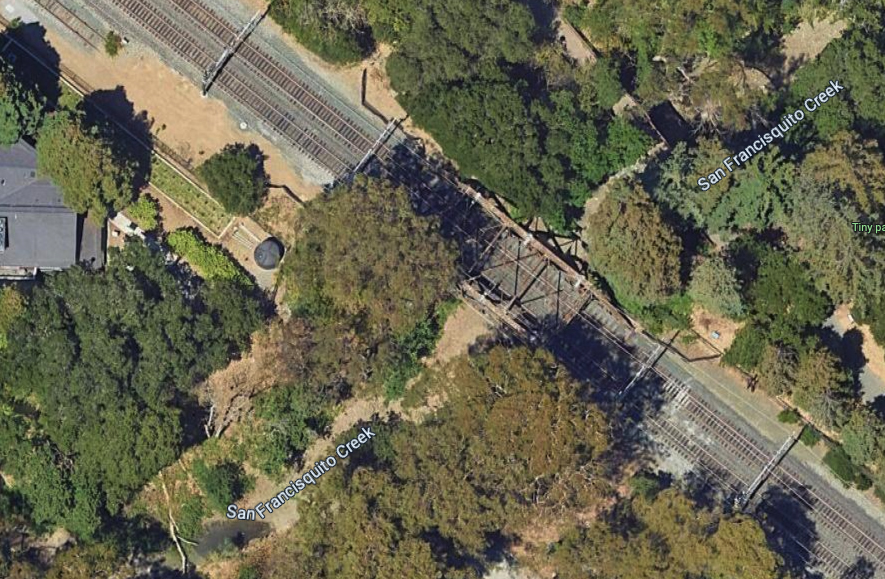
MENLO PARK, Calif. — Efforts by Caltrain to shore up a bridge on the commuter rail line threatened by erosion along a creek have been stalled by the complex gauntlet of governmental agencies that must approve the work, meaning repairs will not occur before another rainy season arrives with the potential of further erosion that could threaten the stability of the bridge.
A weekly newspaper on the San Francisco Peninsula, the Almanac, reports the issues with erosion along San Francisquito Creek were discovered lsat spring. Caltrain and the communities of Menlo Park and Palo Alto subsequently agreed on the division of costs for a $6.5 million project to stabilize the creek’s north bank to support Caltrain’s bridge, as well as one for an adjacent bike path, and Caltrain hired a contractor to do the work while also applying for permission to act from a variety of state and federal agencies.
However, with the work ready to begin, the U.S. Army Corps of Engineers told Caltrain it wanted the state’s preservation office to also give its approval, and — because the presence of endangered species means the work will not be allowed during winter months — the resulting delay means the repairs now can’t take place until June 2024.
Robert Barnard, Caltrain’s deputy chief for rail development, called the delay “disheartening” at a meeting of the meeting earlier this month of Caltrain’s parent agency, the Peninsula Joint Powers Board. And it means that the commuter rail operator will have to be ready with emergency measures to stabilize the bridge this winter if further erosion occurs during heavy rains. “The team will be ready to act to implement a temporary bank stabilization solution,” Barnard said, ‘and we’re working with the Army Corps of Engineers and regulators as to what that might be.”
Board members, while agreeing that Caltrain needs to come up with a plan that can be enacted without further board approval, made it clear they were unhappy with the regulatory delay. “It puts our ridership, our organization, our staff, and the operations of Caltrain at risk,” said board member Jeff Gee.
Share this article