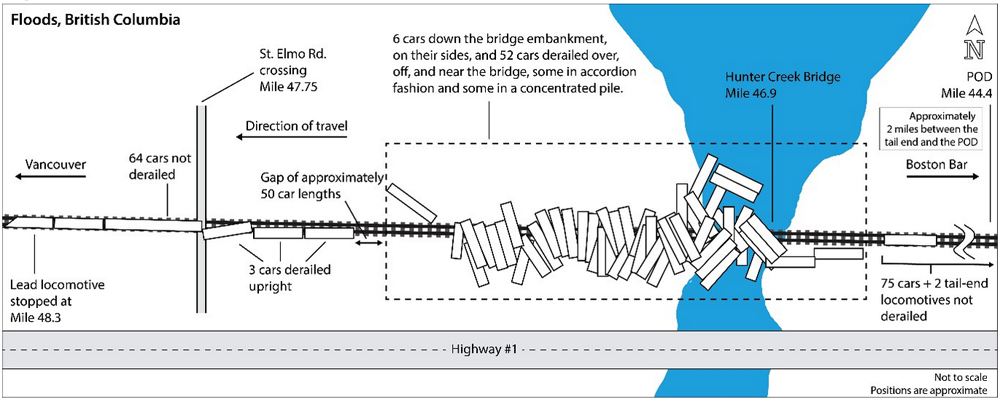
VANCOUVER, British Columbia — A broken wheel led to the derailment of 61 cars of a Canadian National potash train near Floods, B.C., in the Fraser River Canyon in a 2020 incident, the Transportation Safety Board of Canada determined in its final accident report.
The report on the Sept. 14, 2020, derailment of the Vancouver-bound train was released Tuesday, Feb. 27. No injuries occurred and no hazardous materials were involved. The derailment resulted in a spill of about 6 million kilograms (more than 6,600 tons) of potash from 58 of the 61 derailed cars.
The train was traveling at about 50 mph on CN’s Yale Subdivision at about 4:33 a.m. when a train-initiated emergency brake application occurred around milepost 47.7; subsequent crew inspection determined the 65th through 125th cars of the 200-car train, which had two head-end locomotives, and two distributed-power units at the rear. The first car to derail, CNPX 3373, was found to have one wheel missing 1.75 inches of rim width on its entire circumference. This car had been the subject of a warm wheel warning from a wheel temperature detector at Komo (mile 13.8); the crew had been directed to make a 10 psi brake pipe reduction to release a possible stuck air brake; temperatures were lower, but still above normal, at two subsequent detectors.
The TSB subsequently determined that the elevated wheel temperatures were likely because of a hand brake that had inadvertently been left fully applied from the train’s stop in Boston Bar, B.C.. This likely led to the growth of existing cracks on the wheel that failed, leading to a vertical split rim failure. This led to the car dropping inside the track gauge, causing rail brakes at four weld locations and leading to the derailment of the subsequent cars. (The report gives a far more detailed description of this sequence.)
The board also found that CN procedures for dealing with warm wheels allowed the train to continue without inspection after alerts from three consecutive warm wheel detectors, and notes that Canadian Pacific’s more restrictive procedures requires a train to stop for inspection after a second alert.
Share this article