WASHINGTON – BNSF Railway has urged federal regulators to reject Navajo Transitional Energy Co.’s requests for an emergency service order, arguing that the Powder River Basin mining company’s desire to take advantage of the hot export coal market does not constitute an emergency.
“NTEC’s claim is not about failure of service, but instead about getting extra service allocated in a constrained market,” BNSF said in a filing with the Surface Transportation Board on Thursday.
NTEC, in a complaint filed with the STB last week, says BNSF has failed to provide adequate service from the Spring Creek Mine in Montana to the Westshore Terminals at Roberts Bank in Delta, British Columbia, Canada. The coal company also seeks an emergency service order that would require BNSF to handle 29 loaded trains per month beginning May 1, up from 22 in March and well above the 16 per month BNSF agreed to handle beginning June 1.
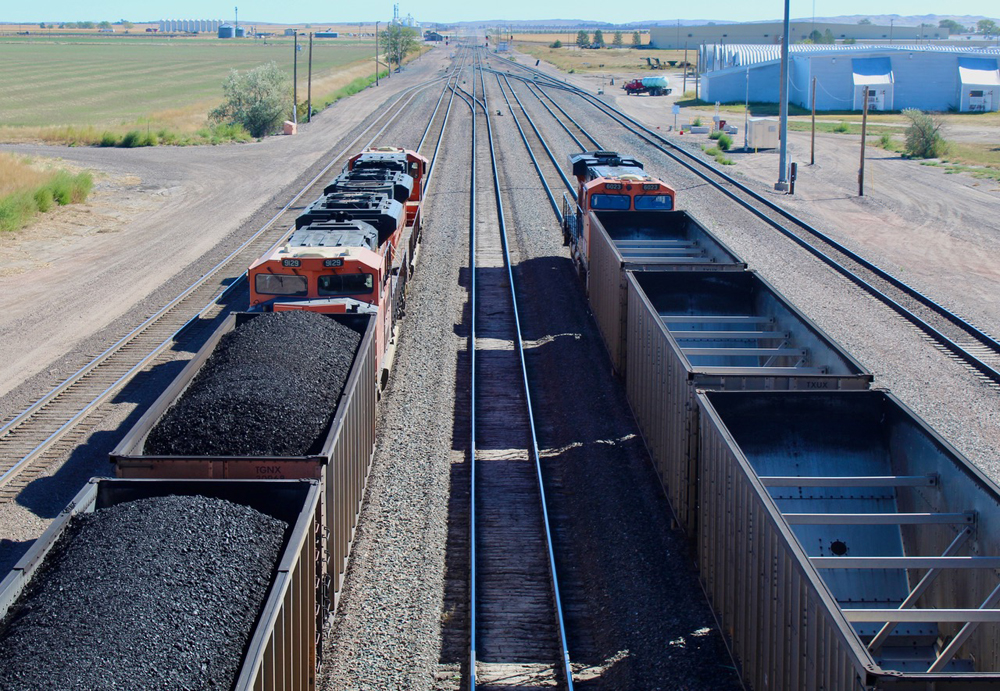
Prices for thermal coal exported to Asia began to spike in the fall of 2020, prompting NTEC and other Powder River Basin coal producers to ramp up shipments to Roberts Bank. BNSF was able to handle a record amount of coal from the Spring Creek Mine to the Westshore Terminals in 2021. But the railroad says it was unable to meet demand when crew shortages cropped up and service faltered in late 2021 and into 2022.
BNSF told the STB it’s still experiencing capacity constraints in the Pacific Northwest. Ordering BNSF to increase service to NTEC’s Spring Creek Mine would require the railroad to decrease service to other Powder River Basin customers.
“The purpose of an emergency service order should not be to put a finger on the scale of competition to favor one competitor over others,” BNSF said.
“The Board should not allow NTEC to use the extraordinary remedy of an emergency service order to disadvantage its competitors by depriving them of service they would otherwise receive,” BNSF argues.
BNSF also said an injunction ordering BNSF to increase service would be unprecedented.
“Injunctions are often used to preserve the status quo, but NTEC wants the Board to order BNSF to dramatically increase its service, not to preserve its existing service levels,” BNSF said.
NTEC backed out of contract negotiations last year. The Navajo-owned mining company now ships via BNSF’s common carrier pricing authority, which does not include volume commitments. NTEC argues that BNSF is violating its common carrier obligations by failing to provide adequate service.
“NTEC wants the flexibility of no minimum volume commitments under a common carrier pricing authority while placing an obligation on BNSF to guarantee extra service and a fixed schedule, and be placed in front of the line compared to others that negotiated contracts,” BNSF said.
In addition, increasing NTEC’s monthly train count would jeopardize service to a wide range of shippers who also use BNSF’s routes to the Pacific Northwest, the railroad said.
“BNSF has been transparent and forthcoming with NTEC about the constraints on BNSF’s capacity, the constraints created by the Westshore terminal’s limited capacity, the complexities of international shipping arrangements, the need to juggle service requests of others, and its efforts to increase service,” the railroad told the board. “BNSF intends to continue working to improve and expand its service to the Westshore terminal and meet the needs of all of the shippers seeking to use that facility.”
Share this article