





Until Texas Central became a zombie company over the past couple of years, its plan to link Dallas and Houston with a fleet of Japanese bullet trains was the country’s best shot at finally getting true high-speed passenger rail.
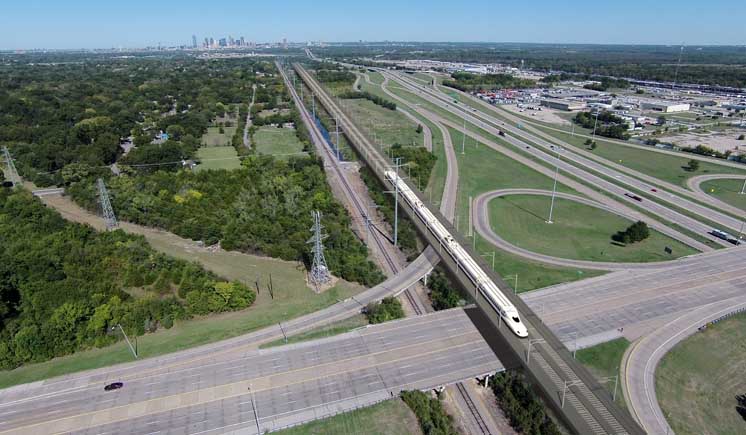
Texas Central’s concept — operate proven 205-mph Shinkansen trains on a dedicated right-of-way with no grade crossings — would have been the first world-class passenger operation in North America. And at 240 miles, Dallas-Houston is a perfect market.
You had to cheer when Texas Central overcame NIMBY opposition and nearly every roadblock that unfriendly lawmakers and the airline lobby could put in its way. But when funding collapsed during the pandemic, so too did dreams that Texas Central would be the star of the high speed show.
Now Amtrak has shown up to revive Texas Central’s plans. On the one hand, it’s great that someone is willing to pick up the ball and run with it. On the other, “Amtrak” and “world class” usually don’t go together.
Amtrak has two specialties: Operating a skeleton network on a shoestring budget and producing pretty maps of potential new passenger routes. What it has never done in its 52 years is build a railroad from scratch or develop a true high-speed rail line. (The spurts of 150-mph Acela Express operation on the Northeast Corridor don’t count.)
Thanks to the Bipartisan Infrastructure Law, Amtrak finally has a pot of gold at the end of the rainbow. Amtrak has proposals to reequip Northeast Corridor, regional, and long distance trains; launch new service as part of its ambitious ConnectUS plan; and begin much-needed major tunnel projects on the Northeast Corridor.
You have to wonder where Texas Central would rank on the priority list and if Amtrak has too many balls in the air to effectively juggle them all. Plus, Texas Central has lost its management team, still faces funding challenges, and would have to build through some heavily populated areas in a state that’s downright hostile to passenger rail.
Which brings us to Brightline. The privately run passenger railroad has had a singular focus on linking Miami and Orlando via a combination of the Florida East Coast Railway and a brand new 35-mile stretch of railroad between Cocoa and the Orlando International Airport. The new trackage is set to carry its first revenue passengers next month, and Brightline has its sights set on an expansion to Tampa.
Brightline — which tops out at 125 mph between Cocoa and Orlando, and 110 mph elsewhere — never was intended to be true high-speed rail. But as a passenger operation sharing most of its route with freight traffic, it’s impressive. And it’s impossible to overstate the significance of what Brightline has accomplished by building a new passenger railroad, even if it was through relatively undeveloped areas.
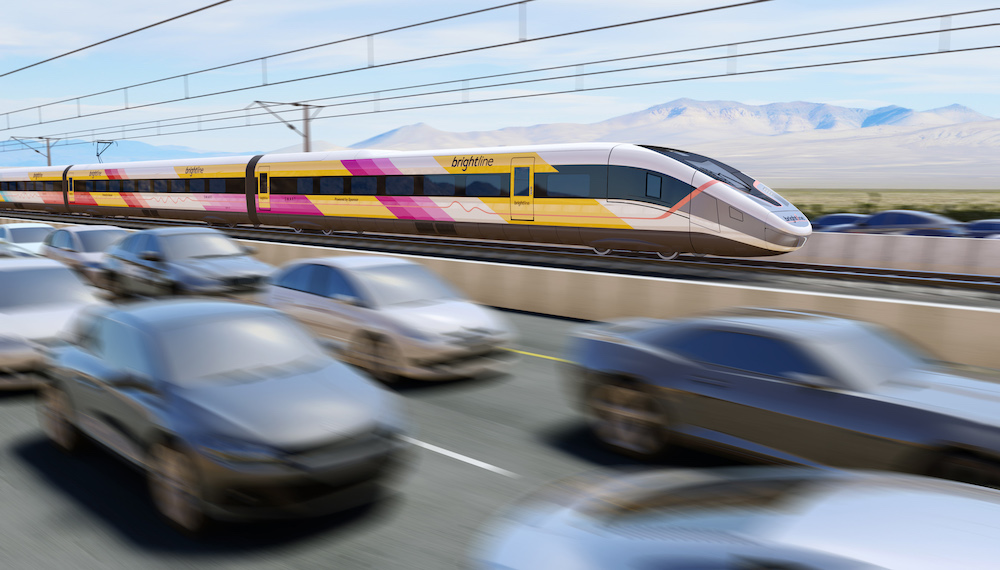
Which brings us to Brightline West, the $10 billion plan to link the Los Angeles Basin with Las Vegas by putting a railroad down the median of Interstate 15. The 218-mile electric railroad, with top speeds of 186 mph, would if built bring true high speed rail to the U.S.
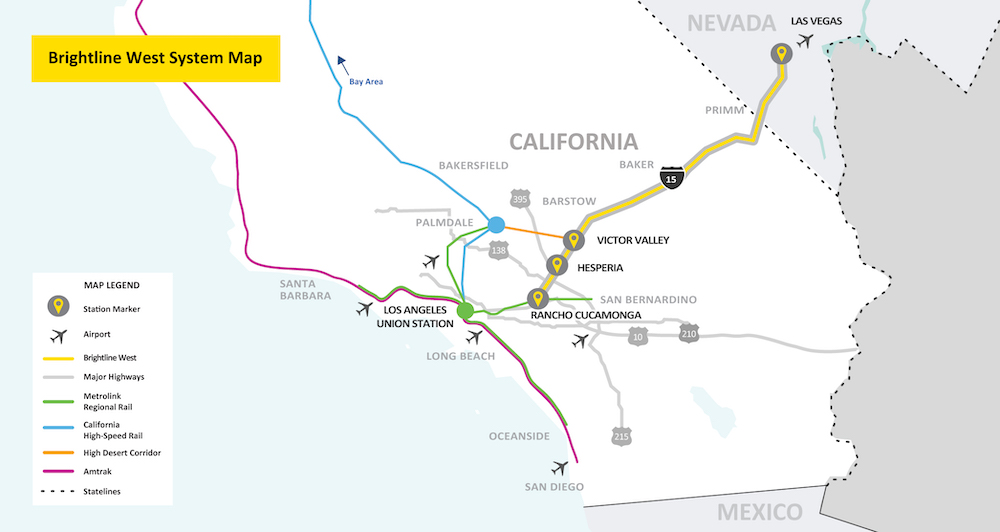
Plans call for the trains to whisk passengers between Vegas and Rancho Cucamonga, Calif., in 2 hours, 10 minutes, which is twice as fast as driving. At Rancho Cucamonga, passengers would be able to connect to existing Metrolink service.
Like Texas Central, Brightline West aims to build a dedicated right-of-way in a market that has the right population density, travel patterns, and length of haul for high speed rail.
Unlike Texas Central and Amtrak, Brightline has credibility that comes from successfully building a railroad. Plus, Brightline West seems to have political support in California and Nevada and has smartly chosen a median-strip route that should limit local opposition.

Assuming Brightline West can secure funding, you can bet that before the end of the decade you’ll be able to see the Mojave Desert blur by at 186 mph from a coach seat. That’s exciting, as anyone who has traveled on a high-speed line in Europe can attest.
There’s talk of one day linking Brightline West with the California high speed rail project via a new High Desert Corridor between Victor Valley and Palmdale. The state-run high speed rail project is way behind schedule and massively over budget. The latest plan calls for it to be operational between 2030 and 2033 between Merced and Bakersfield. It’s fair to ask: Will the privately run Brightline West carry its millionth passenger before the troubled California high speed rail project even turns a wheel?
Brightline aims to break ground later this year for Brightline West and very well may be creating the blueprint for how to bring high-speed rail to the U.S. Step aside, Texas Central. Brightline West is the project to watch.
You can reach Bill Stephens at bybillstephens@gmail.com and follow him on LinkedIn and on X @bybillstephens




Other than pleasing the vast number of consultants and lobbyists looking for another money pot after draining the funding intended for California’s proposed HSR, how does the proposed marriage between Amtrak-Texas Central make sense in any serious effort at conducting due diligence?
Other than Southwest Airlines cheering from the sidelines, who in Congress, if even painfully aware of Amtrak’s vast foibles, would think the two firms working together would be the answer to their prayers? How is Amtrak expected to be a good steward over equipment, schedules, and maintenance for Texas Central, when it has yet to put its own house in order since it committed Hari Kari in the pandemic by destroying its key asset-a seasoned work force in maintenance, as well as OBS and operations?
As Amtrak is still breaking in its own non-rail experienced leadership, with the primary focus on the NEC, how is Amtrak to juggle the priorities if it is expected to lend its own “expertise” to Texas Central? Just as Amtrak’s leadership failed with their absurd, costly decisions in the pandemic due to their inexperience in rail operations (which also proved the penalty for Amtrak not having a Board experienced in passenger rail), the best we can hope is for common sense to prevail–put Brightline and Texas Central together to determine the viability of a Dallas-Houston HSR corridor.
For Amtrak to claim it has expertise for sale in the marketplace is merely a diversionary tactic from the facts depicting a series of fatal decisions Amtrak apparently shrugs off as it seeks to spend as much as it can before Congress turns off the spigot.
But here’s the thing…IF Brightline is successful in building this high speed desert railway down I-15 interstate, it MIGHT turn on some light bulbs that what we should be doing to build a high-speed rail system in the U.S. is build in existing federal highway median right of ways.
We should look at the land currently occupied by federal interstates as “transportation corridors” that can be used for high(er)-speed rail infrastructure.
The only land to be obtained is when the high speed rail would need to veer off the interstate to get to city station sites. Not totally perfect, but seems like it would avoid the hassles of obtaining huge swatches of currently privately owned land.
Of course, there are always the challenges of funding, environmental studies, etc., but Brightline West might serve as the model for future way to develop more high-speed rail.
Sorry to deflate your hope. There is no room on urban/ suburban Interstate Highway r/w’s for a train track, and if there were room for a train track, where would you put the station. Even in rural areas, putting a train beside an Interstate Highway is a whole lot more involved than laying down crossties and ballast. That rendering at the top of this article is a fairy tale. The reality of what a railroad viaduct would look like on most highway segments would be entirely different.
I’m all for trains. But sorry, there are few places in the urbanized or suburbanized areas with room for a new rail r/w.
I see some other possibilities for BL West, and even Texas, that probably would not work in BL Florida, which is getting shipping contracts from USPS, UPS, Fedex, etc., a modern day REA, but without distributing and manhandling individual parcels and packages. A high speed freight car that wouldn’t have to be switched, (or like an Amtrak baggage car), would have to be designed or adapted to accommodate certain types of modular shipments, or perhaps detachable, end-of-train, upgraded, hi-speed roadrailers, all in order to be a more profitable operation. Florida BL might not be applicable for modular parcel shipments, but the idea of successfully and efficiently using existing freight RoW is inspiring, perhaps something BL West and TX should also consider on their dedicated RoW???
I think Southwest airlines has yet to train its PR people against Brightline. Stay tuned.
Pun intended?
Also, RE Amtrak managing a project. If Amtrak and the “caretaker” of Texas Central can “re-up” the management team Texas Central had lined up (Fluor to manage engineering and design, Kewit and Sons to construct, and Amtrak to seriously work with RENFE to manage operation) it should happen.
What everyone has to remember is that Brightline has the huge advantage of not having to acquire the land, parcel by parcel. Instead they have land easements with Caltrans and Bureau of Land Management. So much easier. They also have the advantage of all of the political entities between Las Vegas and SoCal are fully in support of it. Something CHSRA has never had.
RE Texas Central, the critical factor was how someone convinced the Texas Supreme Court to reconsider the eminent domain case that they had ruled in favor of Texas Central. It is odd that the court would reconsider a case they had ruled on the previous session. Once they had ruled again in favor of Texas Central, the company had been bled out of money…..all because a couple of ranchers would not allow Texas Central surveyors on their land.
“Assuming Brightline West can secure funding…” And that’s the $10 billion question.
High-speed trains and conventional fast trains have been operating in Europe and Asia for years with compatible connections. It has become a well-established tradition there, but not yet in America.
Dr. Güntürk Üstün
Thank you! Dr. Obvious.
Forza Brightline West!
Dr. Güntürk Üstün
I think what Bill leaves unstated is that it’s vastly easier to build high-speed rail when the government gives you the right of way (most of Brightline across the Mojave) than when you have to piece the whole route together one parcel at a time (Texas Central, California HSR).
Running along the Interstate, mostly in the median, does reduce cost. A lot. Doesn’t eliminate it, because it’s not a sale; it’s effectively a lease. The highway depts still own the property. But yes, because it’s not fresh, new real estate being bought for transportation purposes it’ll be finalized faster and cheaper. Interesting though that BW has redesigned from what DesertExpress was looking at to largely eliminate tunneling. That’s going to reduce speeds because of the grades. The overall trip speed should still be competitive with driving, at least when the rest of the world is out doing it too. But at off hours, I’ve seen the light vehicle (<10K lb.) average speed on I-15 exceeding 100 mph frequently.
HSR is a success in Europe and Asia because they nicely overlay an extensive network of existing slower-speed service, and are complemented by good transit networks at each station, and many slower-speed rail connexions.
Neither the Texas or Las Vegas projects meet these conditions, casting serious doubt on their viability.
Most US airports also lack good transit networks even in New York. It hasn’t stopped air travel.
Most people who take a train drive to the station apart from just a few big cities.
CHRISTOPHE … I was shocked at the Denver Airport how few people take the Light Rail. From limited observation, it appears most Light Rail passengers were airport workers, few people with baggage from an airline flight.
The irony is that access to DEN Airport by car is very difficult, whereas access by car to the next train stop west of the airport is extremely easy. Rather than the person picking me up drive all the way to DEN airport, and fighting that traffic on the freeway, and fighting for a space at the terminal with a zillion other cars pcking up or dropping off passengers, the first Light Rail stop west of the airport has acres of free parking and an entire empty street half a mile long to pick up a passenger.
While this article seems to disparage the California high speed rail project, it is still the ONLY true high speed railway under construction. Brightline west has been delayed twice, and even more times before with Xpress west.
Exactly. Brightline West’s average speed will be 100.6 mph, one of if not the slowest of any high speed rail line. The 2 hour 10 minute travel time will be faster than driving to Las Vegas, from Rancho Cucamonga, but considering most riders will be originating in the LA and OC areas that needs to be added to the overall travel time, plus at least two transfers at Union Station and RC. That makes the total travel time between four and five hours, about as fast or even slower than driving, and nowhere near competitive with flying (without delays).
The drive time can be under four hours without traffic, which if Brightline West’s main goal is to reduce the number of cars on I-15, would be more often. The biggest advantage of the train though is the comfort factor, providing a more pleasant travel experience than flying or driving. Brightline Florida has certainly achieved that aspect, and that should translate to Brightline West as well.
I’ve ridden Brightline in Florida and it’s a brilliant operation. They know how to get things done. I’m willing to bet that they will be the first to operate a truly high speed operation in the US.
Dreams are good but reality sucks. By the end of the decade the environmental studies and all the other governmental red tape won’t be completed. Brightline will get the needed funding from where and how much.
CA state run project is way behind schedule and massively over budget and I’m sure that both will continue to get worse as will the Brightline dream.
For BW, the heavy environmental work is already largely done. The part from Victor Valley to LV was finalized over 10 years ago, though some supplemental work was needed after BW changed things to more closely follow the road. The part from VV to Rancho Cucamonga is new, but still follows the freeway and existing railroad so impacts (and documentation) are minimized. I think it’s a practical and buildable project, and Brightline isn’t known (so far at least) for picking projects that are unbuildable. Compare the projects as LT trim (BW) vs Premier (CAHSR).
Please, I’m not trying to be snarky (for once this year) but was, “Brightline will get the needed funding from where and how much” a statement or a question?