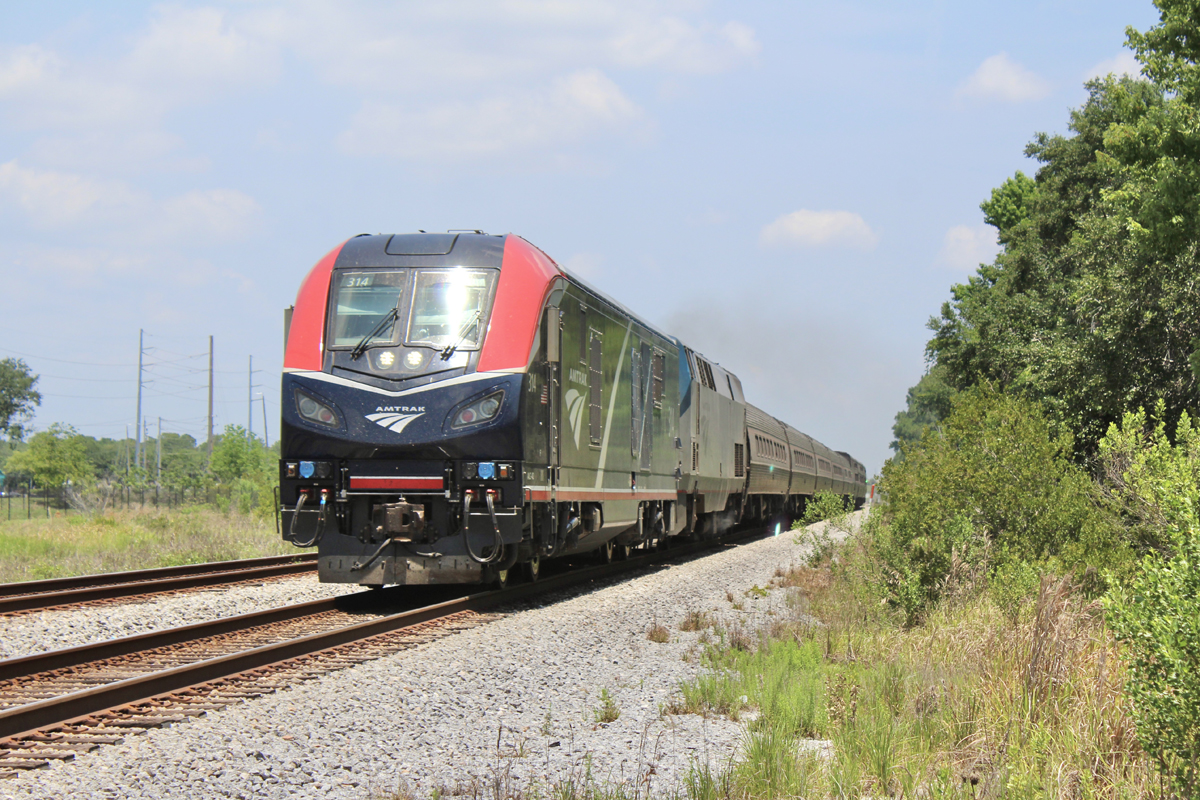
RICHMOND, Va. — Amtrak projects that it will surpass pre-pandemic figures for ridership and revenue in 2024, company officials said Friday as executives joined the board of directors for the company’s second annual public meeting, an event mandated by 2021’s Bipartisan Infrastructure Law held this year at Richmond’s Main Street Station.
This year’s gathering was significantly more informative than the initial meeting last year in St. Louis, in part because top managers and department heads, along with the leaders of North Carolina and Virginia passenger rail programs, were available in a pre-meeting “Expo” to explain various initiatives [see “Hands-on ‘Expo’ …,” Trains News Wire, Dec. 2, 2023].
Amtrak President Roger Harris recapped financial results released a day earlier [see “Amtrak cites major ridership increase …,” News Wire, Nov. 30], primarily comparing fiscal 2023 with the previous year. He noted that long-distance service were successful because “for the second year in a row it beat the half billion dollar benchmark.” The state-supported aggregate suffered because California’s Pacific Surfliner corridor was disrupted by mudslides, while the Acela service line suffered from weakened business travel and reduced frequencies due to four out-of-service trainsets. [Trains News Wire is preparing an in-depth revenue and ridership analysis incorporating a comparison with pre-pandemic 2019 results and a focus on individual routes and corridors.]
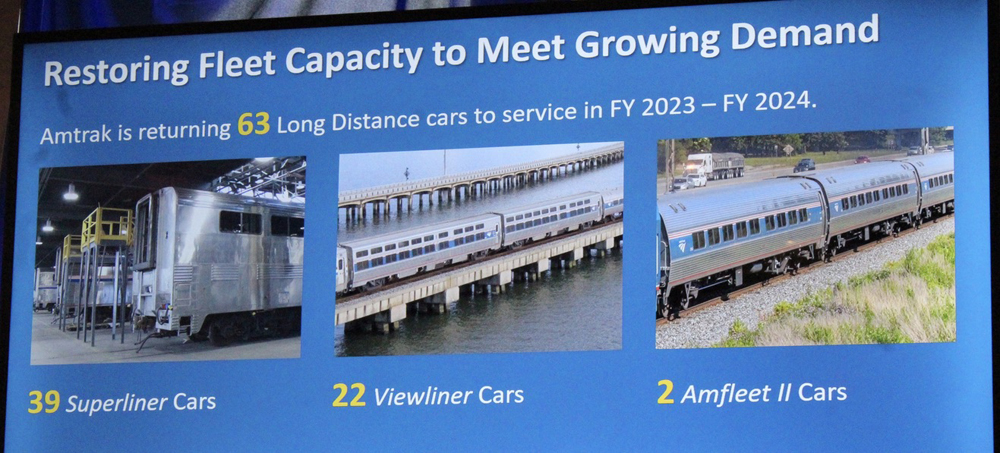
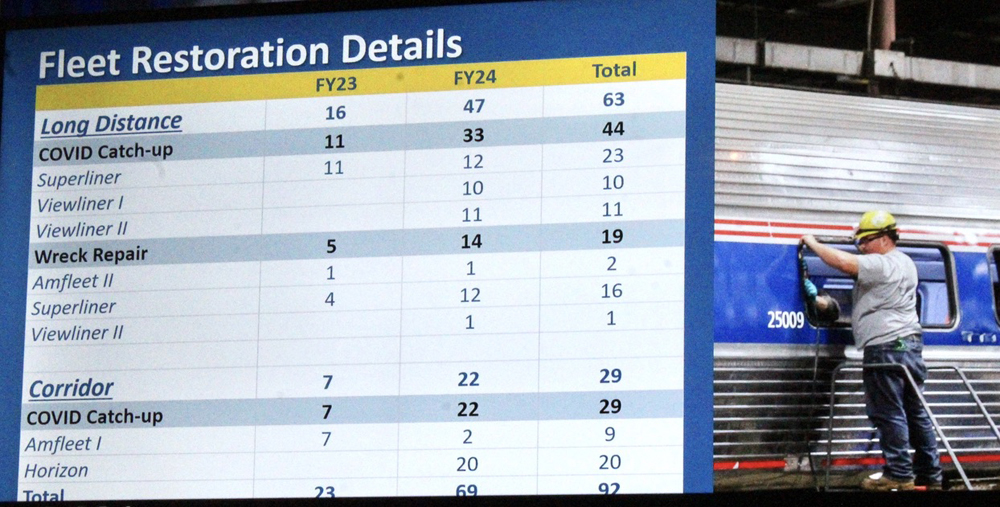
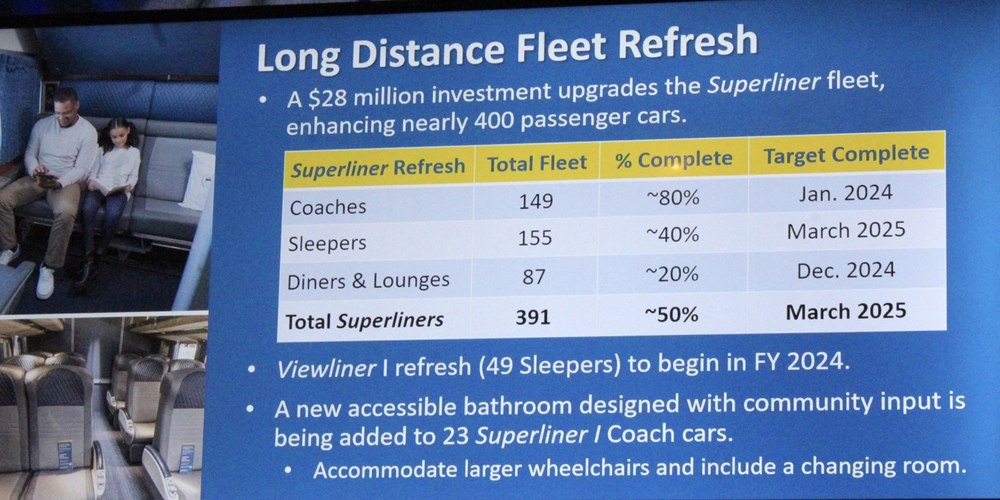
Regarding on-time performance, Harris says there have been challenges on the Northeast Corridor as a result of trackwork, though host railroad metrics have improved. He also presented tables outlining long-distance fleet restoration efforts by equipment type, as well as progress on a “fleet refresh” upgrade initiative. Twenty-three Superliner coaches are being refitted with fully-accessible bathrooms.
“The good news,” Harris says, “is that by the end of fiscal 2024 we will have worked through all of the backlog and will have 2,205 cars in service versus 2,224 pre-Covid.”
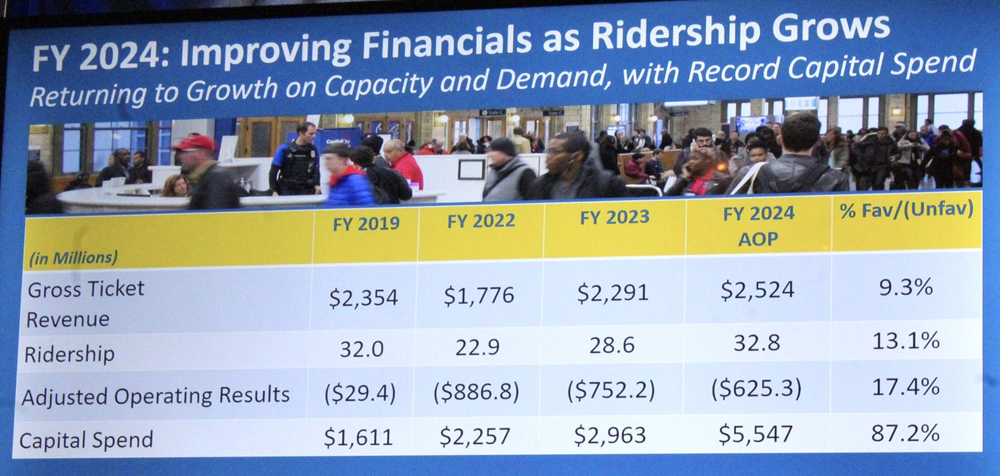
The company’s projections for fiscal 2024, which began in October, are a 13% ridership increase to 32.8 million passengers with a 9% revenue gain to $2.5 billion, surpassing 2019 figures. Operating losses are expected to decline, while capital expenditures are set to grow 87%.
“Our goal is to achieve 66 million riders by 2040 to make a much bigger contribution in mobility,” Amtrak CEO Stephen Gardner says. His top four goals: Expanding partnerships and adding service “particularly to the Top 50 metropolitan areas,” along with “serving the right communities with high-speed rail” while attaining a net-zero emissions goal. “To do this,” he says, “we absolutely need a stable and secure source of long-term capital investment. It’s what is transforming the nature of our business today with five years of dedicated funding to launch projects with money we know we have the ability to finish, not just start.”
Q-and-A session is wide ranging
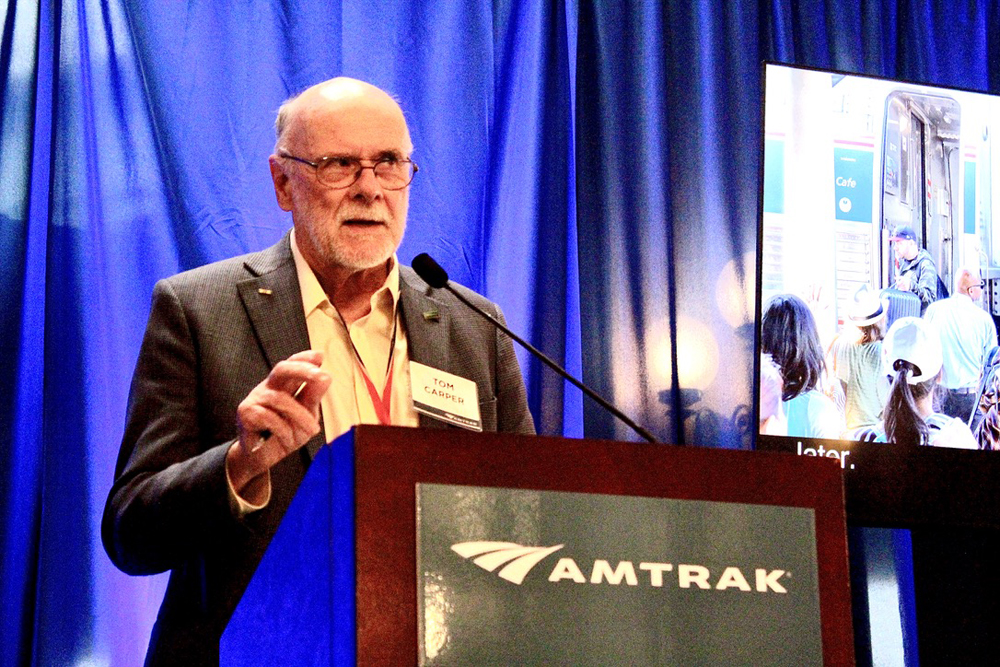
Prior to the officer reports at the beginning of the session, board members Jeffrey Moreland, Yvonne Burke, and Federal Railroad Administration Administrator Amit Bose covered aspects of the year’s financial performance. Coscia said former Amtrak chairman Tom Carper would discuss ridership, but no numbers were forthcoming.
Clearly deciding to go “off script,” Carper — the resident and former mayor of Macomb, Ill. — described how changing workplace norms have created more opportunity for people to seek communities with a slower pace, great environment, and better quality of life. “They also need reliable broadband provided and transportation to nearby urban areas. And that’s us: we’re providing that right now,” Carper said. “Trying to recruit a hospital administrator to a rural area is really difficult, but much less so if you [have the opportunity] to get on a train several times a day and get to the city. That’s part of the package Amtrak has offered since it started. … I thought it was important for you to know what’s going on right now — a lot of positives. We’re doing as good a job as we can, and we need to keep your support.” The crowd applauded.
The meeting also included senior executives answering public questions on topics including:
Service Disruption passenger notification. “With our new system,” Harris said, “we are able to get timely information to customers. We have increased our notifications to customers from one million to 24 million messages during the past year. It’s terrible when there is any kind of delay but it is so much worse when we don’t tell people what’s going on.”
Superliner deployment on state-supported trains. Harris said California has refurbished Superliners on long-term leases and Canadian National requires the long-distance cars for axle count to activate signals on the Chicago-Carbondale route [see “Seeking answers on ‘loss of shunt,’” News Wire, Sept. 6, 2023]. “Absent those situations, we need to get the right equipment in the right places,” he said. Not addressed was whether this need was taken into account when the company was making return-to-service decisions on sidelined equipment.
Dining service and coach customer participation. “As we bring Viewliner diners back into service, next on the [New York-New Orleans] Crescent, we will determine what kind of food service works for that train and those hours of operation,” Harris said. “The question really is how much capacity is there to serve coach passengers. That’s what we worked through [for traditional dining] on our western trains without impacting the quality of service.”
Executive bonuses. Coscia addressed this frequent target of critics, congressional and otherwise. He explained that the company used to have a fixed benefit program — in other words, pensions — but replaced that with a bonus plan “tied directly to the company [performance]. The metrics used to determine bonuses are not just financial metrics, but are metrics related to customer service, on-time performance, and the ability to provide more ridership opportunities. Having said that, financial performance is obviously relevant in demonstrating the company’s ability to be good stewards of the assets we are given.” Exactly how these metrics are applied to mid-level positions has never been spelled out in detail.
Why all board meetings aren’t public. “We have agreements with private parties,” Coscia said. “We would be revealing not only confidential information but giving away most of our bargaining power in the marketplace. No business can operate that way from the standpoint of making critical decisions.” He added that “it is absolutely critical” that the company communicate “where we are operating well, and where we are operating poorly.”
Crews taking up tables in café cars. “One conductor might need to sit in one seat, but they shouldn’t monopolize tables in the area,” Harris said. “It’s something we’re working on from an enforcement perspective.”
Dirty windows. “We have a robust car wash replacement program around the system,” Harris said. “In the meantime, we are working on an interim program at key stations.” News Wire had been advised of this multi-year program earlier in the year; a report is awaiting a schedule of the expected dates and locations new washing facilities will become operational.
Adirondack cancellations because of heat-related track issues. “Our chief track engineer is working with Canadian National to make sure we have the physical plant that can be more robust,” Gardner said.
Lack of national network advertising. “The challenge has been that national media is very expensive,” Harris said. “What we’ve found is advertising online is a far more effective return on investment and use of our pretty limited advertising dollars. Also, regional media and cable is far more important. We don’t spend a lot of money on marketing because we don’t have a lot of money to spend.” Gardner added that budgets and promotions are timed to occur when capacity is available. “We usually sell out our sleeper space months before we hit the summer,” he said.
Board Chairman Coscia concluded the session by noting, “One thing is crystal clear: people want to ride our trains. I wish we had more to offer, but that’s what we are working [on] together toward the future.”
Share this article