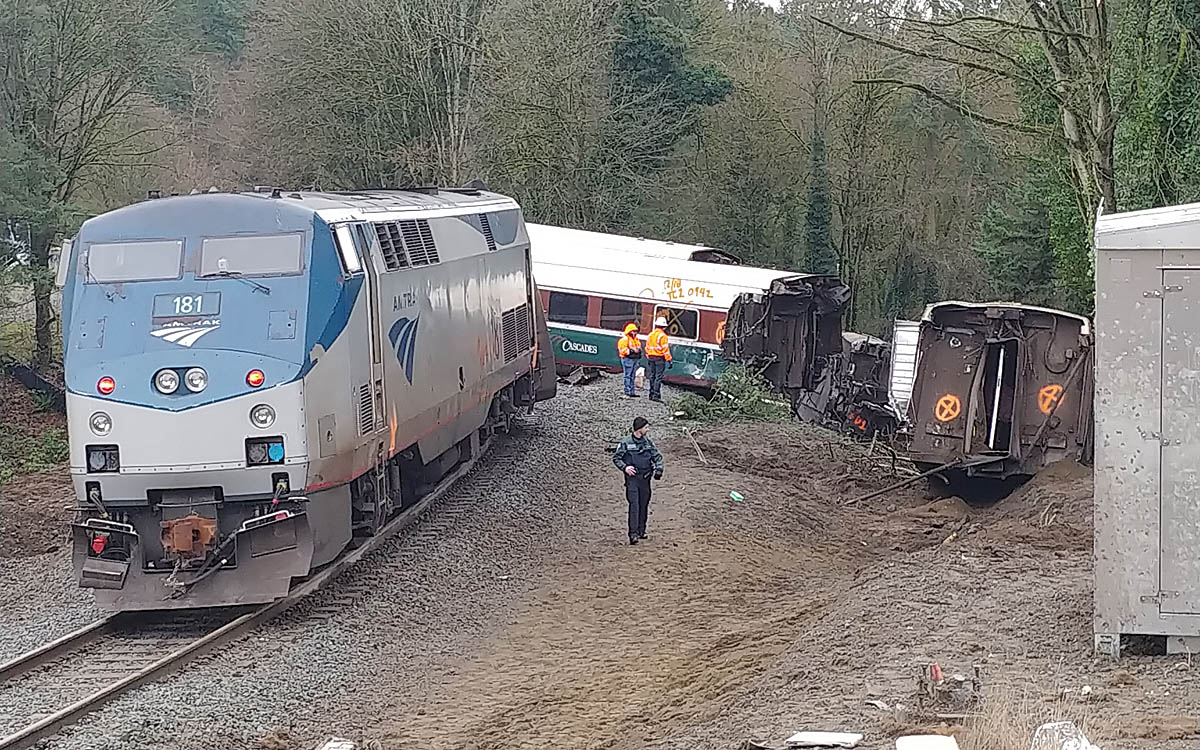
TACOMA, Wash. — The engineer who was at the controls for the fatal Amtrak Cascades derailment in 2017 says he’s still trying to get his operating license back, although admitting that’s unlikely, and says he relives the accident “all day” during his waking hours.
Steven Brown, the 59-year-old engineer who was fired by Amtrak as a result of the crash, spoke to the Seattle Times in his first interview since the Dec. 18, 2017, derailment in DuPont, Wash., that killed three passengers and injured 65 other people. He told the paper that when he realized the train was going to go through a 30-mph curve at 80 mph, he thought “it was going to be uncomfortable” but that the train was going to make it around the curve.
Amtrak said in court that Brown’s firing was “for violating safety rules,” and the Federal Railroad Administration suspended his license for exceeding the curve’s speed limit. Brown says he’d like to return to the cab. “I was satisfied with where I got in life. I was really, truly, happy,” he said, “… In an unbelievable instant, it’s all gone.”
Brown — who had become an engineer in 2013 after nine years as a conductor — suffered broken ribs, a broken jaw and cheekbone, compressed vertebrae, and elbow damage requiring partial replacement.
Because a county judge ruled Amtrak is responsible for his losses because it operated the train in unsafe conditions [see “Digest: Judge rules for ‘Cascades’ engineer in suit against Amtrak,” Trains News Wire, March 25, 2021], Brown could receive back pay — an annual salary of $105,000 plus retirement benefits — at a trial scheduled for October.
The derailment occurred on the first trip of an Amtrak train to use the newly opened Point Defiance bypass, an inland route taking Amtrak traffic off the coastal route shared with BNSF trains. Brown had made one southbound run and two northbound trips as engineer prior to the opening of the bypass, as well as seven to 10 observational trips. When the bypass reopens, engineers will be required to complete at least six practice round trips and a series of 10-hour days mimicking the actual operating schedules.
Crew qualification trips will be held June 1 to July 25, but no date for resumption of service on the bypass has been announced.
Share this article