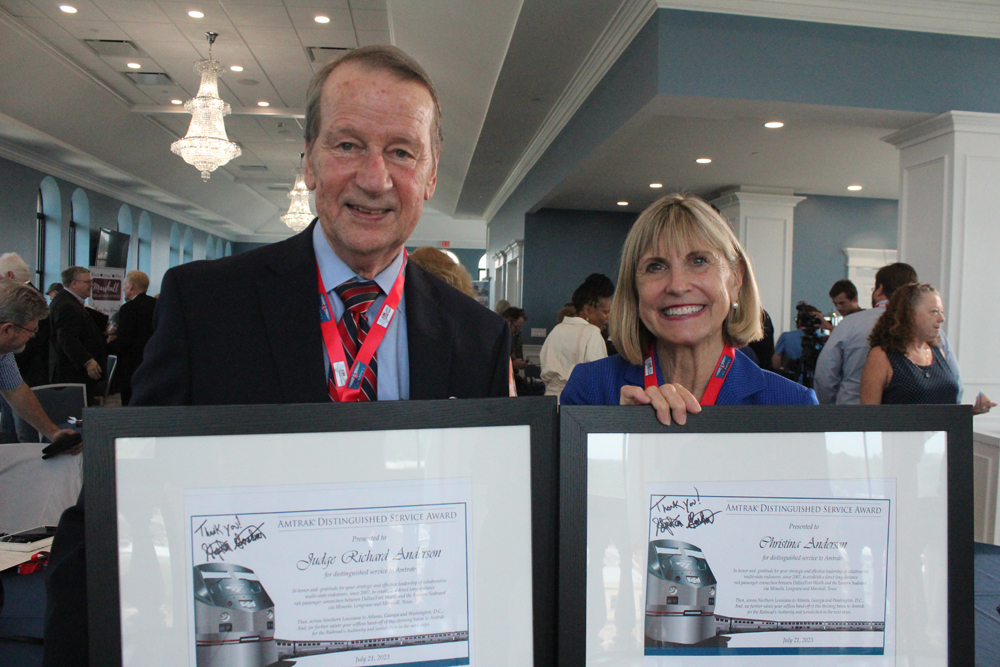
MARSHALL, Texas — A wide variety of state and local officials, as well as current and former representatives of Amtrak and its host railroads, assembled last week to honor two people in large part responsible for keeping alive a proposed extension of Amtrak’s Crescent between Meridian, Miss., and Fort Worth, Texas.
Retired Harrison County Judge Richard Anderson — no relation to the former Amtrak CEO — and his wife Christina are stepping back from their roles as activists promoting the train’s mobility and economic-development potential. The heavy lifting to advance the project is being assumed by Amtrak, which recently submitted applications for two Infrastructure Investment and Jobs Act grants: the Federal-State Partnership for Intercity Passenger Rail and Corridor Identification and Development programs [see “Amtrak seeks expansion of Crescent section …,” Trains News Wire, March 10, 2023].
The “Distinguished Service” awards presented to the Andersons by Amtrak’s Marc Magliari read, “In honor and gratitude for your strategic and effective leadership of collaborative and multi-state endeavors since 2007 to establish a direct long-distance rail passenger connection between Dallas/Fort Worth and the Eastern Seaboard. We further salute your selfless hand-off of this thriving baton to Amtrak for the railroad’s authority and jurisdiction in the next steps.” The awards were signed “Thank you!” by Amtrak President and CEO Stephen Gardner.
Southern Rail Commission Chairman Knox Ross said the Andersons were among the individuals and groups “keeping the flame alive until the right set of facts and circumstances came together.”
Those conditions include the recent federal funding opportunities; Canadian Pacific Kansas City’s willingness to host service between Shreveport, La., and Meridian, Miss., when previous Kansas City Southern management was not; and interest expressed by communities and elected officials in Louisiana and Mississippi. The Southern Rail Commission has partnered with Amtrak in the effort.
Grass-roots connections
The Andersons’ grass-roots cultivation of government councils from Fort Worth to East Texas was instrumental in getting former U.S. Sen. Kay Bailey Hutchison to help obtain a $740,000 federal grant for a 2015 feasibility study. It projected a Crescent extension to Dallas-Fort Worth would generate enough income to offset operating costs. The I-20 Corridor Council sponsored a 2017 capacity study, in conjunction with the Texas Transportation Institute and counterparts in Louisiana and Mississippi, estimated passenger service would require about $82 million to mitigate freight interference [see “Meeting explores prospects for passenger route …,” News Wire, Nov. 4, 2022].
Although those estimates will certainly be updated with new analyses, they potentially give the Crescent extension a competitive advantage for possible funding.
When Christina Anderson recently attended one a Federal Railroad Administration regional long-distance service study session, Administrator Amit Bose told her, “‘The I-20 Corridor is in a position of readiness.’ That comes from 16 years of everyone — not just Richard and me — to express their enthusiasm and letters of support,” she says.
Along with the state transportation officials, mayors, county judges, and economic development directors who were on hand were officials from the Atlanta area’s I-75 Corridor Coalition and Dallas-Fort Worth’s North Central Council of Governments — evidence of engagement from the proposed route’s most populous metropolitan areas.
Texas Eagle group’s efforts noted
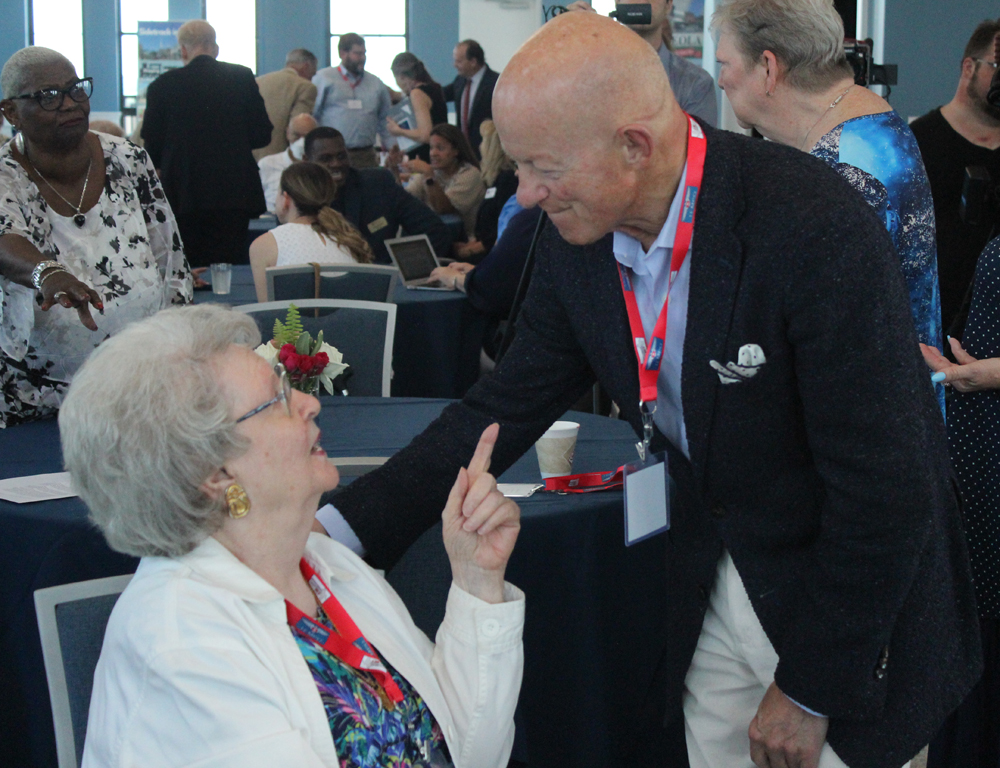
Also present was former Marshall Mayor Audrey Kariel, part of a group of local civic officials who helped save the Texas Eagle in 1997. Magliari pointed out that those grass-roots efforts kept the Eagle alive at the same time the Pioneer and Desert Wind were discontinued in a funding cutback.
“You never had a last train, so now we can talk about going to the lovely Marshall depot, where I’ve been offered office space in that caboose, and see trains in two directions. That is now within reach,” Magliari said to applause.
Tom Mulligan, Union Pacific’s now-retired Amtrak liaison, reconnected with Kariel. His previous counterpart at BNSF Railway also was involved with the Texas Eagle Marketing and Performance Organization, the group created locally after the Eagle’s 1997 near-cancellation.
But former Assistant VP of Passenger Operations, D. J. Mitchell, isn’t ready to sit on the sidelines just yet. He tells Trains News Wire, “I’ve been asked by Amtrak to get involved in this project — it has merit and a story attached to it that I can just feel. There’s a nuts-and-bolts thing about how you run the trains, how you protect the freight interests — they are just as real as how you get the money.” Amtrak realizes Mitchell’s expertise can help when the subject of capacity improvements on UP and CPKC come up.
A new rail passenger route faces challenges including recalcitrant host railroads, indifferent or ideologically opposed politicians, lack of funding, and operator disinterest. Such obstacles are neutralized, though, as Mitchell told the group, with the Andersons’ “tenacity, leadership, and teamwork. That’s how you get things done.”
Share this article