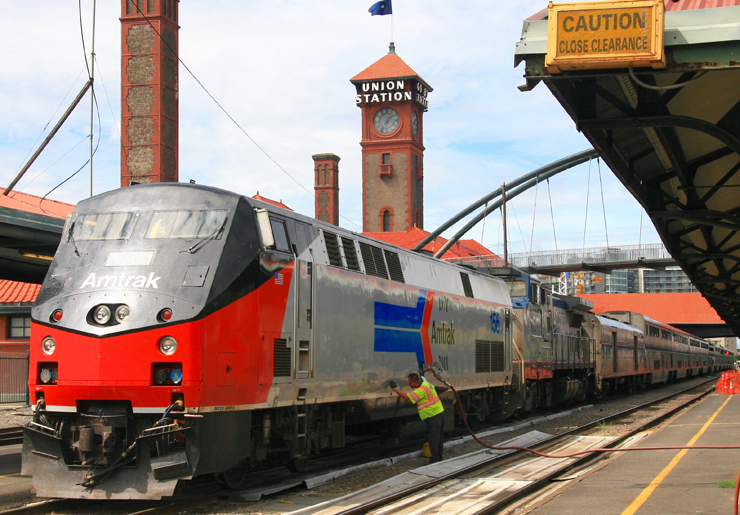
WASHINGTON — Amtrak is once again attempting to attract online bargain hunters by offering advance-purchase fares up to 35% off as part of its “Track Friday” sale, which runs through Monday, Dec. 2.
The saving over the lowest available “saver” prices are good for travel from Dec. 9, 2019, to April 30, 2020, although discounts for Northeast Corridor and state-supported trains don’t begin until Jan. 6, 2020.
Announced Friday and available at this page on Amtrak’s website, the discount is good for all national network trains except Auto Train. However, as in past “flash” sales, if a particular departure does not show a “saver” fare, no discount is available for the higher “value” level in Amtrak’s multi-tiered fare system.
A Trains News Wire analysis on Nov. 29 finds that while the saver fares are “blanked” for many long-distance trains that compete with state-supported trains on the same route during December, that is not always the case. Here are several examples of differences between long-distance and competing state-supported trains between the same city pairs for travel on Dec. 12:
— Washington, D.C.–Richmond, Va.: Palmetto $19; all other trains $33
— Seattle-Portland, Ore.: Coast Starlight $23; all other trains $36
— Emeryville-Sacramento, Calif.: California Zephyr $20; all other trains $31
— Chicago-Princeton, Ill.: Southwest Chief $10 – all other trains $15
Yield management theory, as practiced by Amtrak, dictates that when sellout reaches a certain level, the cheap fares are withdrawn. Revenue managers can control when that threshold occurs.
Yet the assumption that these controls automatically maximize revenue and don’t harm patronage falls apart when capacity is constricted. In the Chicago-Princeton example above, the Southwest Chief can operate “off-peak” with just two Superliner coaches, only one of them fully accessible [see “Vegas to Vegas on the Chief,” “Passenger,” January 2020 Trains].
As of midday on Nov. 29, both the Chief and California Zephyr on Dec. 2 were sold out from Chicago, with the first westbound seats available at Princeton for the Zephyr and Galesburg, Ill., on the Chief. Passengers willing to travel farther west from Chicago or suburban Naperville, Ill. — and spend a lot more money to do so — are out of luck.
Obviously, sellouts on one of Amtrak’s heaviest travel days is understandable, but it happens regularly throughout the year on this and other routes where capacity-starved long distance trains serve as vital conduits for travelers using them to go varying distances. Once less expensive seats are sold, “value” prices on the limited space remaining can be significantly higher.
Perhaps emblematic of Amtrak’s lack of attention to such details with these discounts is a line in the promotional blurb on the promotion’s landing page. It invites prospective passengers to “See the California Rockies.”