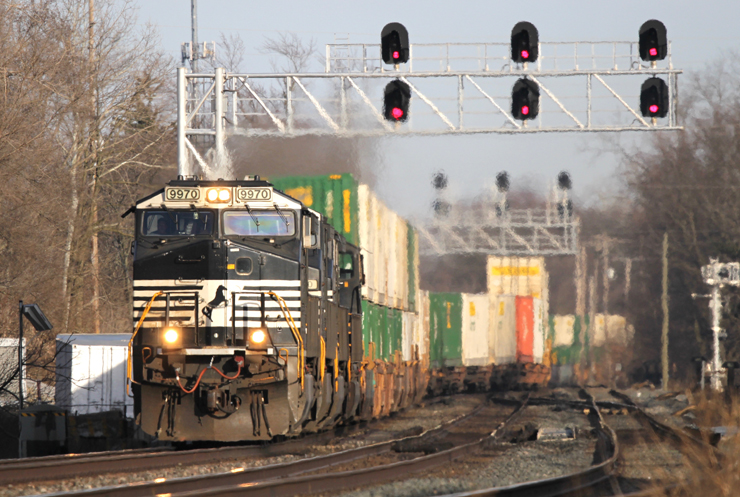
NORFOLK, Va. — Norfolk Southern will slash capital spending 25% this year as traffic and revenue decline sharply due to the economic impact of the COVID-19 pandemic, the railroad said today as it announced lower first-quarter profits.
NS joined most of the other Class I systems in withdrawing its financial outlook for the year in light of economic uncertainty. But the railroad maintained its 2021 target for an operating ratio below 60%.
Executives expect broad traffic declines across the railroad’s merchandise, intermodal, and coal business segments this year and did not hazard a guess as to when volume might begin to rebound.
“We project year-over-year volume declines across all business groups, with large impacts in the second quarter, and future volumes depending on the depth of the downturn and the timing of the reopening of the economy, as well as energy prices,” Chief Marketing Officer Alan Shaw told investors and analysts on the railroad’s earnings call.
First-quarter volumes were down 11% overall as coal sank 31%, intermodal slumped 11%, and merchandise traffic was off 5%.
For the quarter, the railroad’s operating income declined 1%, to $953 million, as revenue fell 8%, to $2.62 billion. Earnings per share, adjusted for the impact of one-time items, rose 3%, to $2.58.
When adjusted for one-time items, NS’s operating ratio improved 2.3 points to a first quarter record 63.7% as the railroad cut expenses more deeply than the decline in revenue.
“Within the context of an 11% volume decline, they are remarkable achievements that demonstrate this team’s urgency to transform our company,” CEO Jim Squires says.
Squires praised NS employees for helping to move the economy and vital supplies during the pandemic. “It is truly inspirational to watch our employees rise to the challenge,” he says.
NS has three aims during the pandemic, Squires says: protect employees, serve customers, and exercise financial discipline.
The railroad has a strong balance sheet with plenty of cash on hand and access to credit that will help it weather the downturn, Chief Financial Officer Mark George says.
The $500 million reduction in capital spending, to $1.5 billion, is across the board, George says. The railroad remains committed to its DC-to-AC locomotive conversion program, however, and will trim maintenance spending by more precisely targeting where new rail, ties, and ballast are installed, Chief Operating Officer Mike Wheeler says.
As the third phase of its TOP21 operating plan was implemented, NS cut train starts more deeply than traffic declined in the quarter, Wheeler says.
Train starts were down 19%, outpacing the 11% volume decline and pushing the railroad’s train and engine service workforce to a record low. With traffic down 30% in April, train starts are down 30% as well, Wheeler says.
Helping to reduce train starts: Combining different types of traffic in the same train, even including shifting merchandise traffic into premium intermodal trains. “We have really blended all the different traffic types into our network. So we’re to the point now where a train is a train,” Wheeler says.
As part of blending traffic types, NS has opened some new lower-volume intermodal lanes by adding container traffic to merchandise trains. “No longer do we need to find enough density for a point-to-point intermodal train,” Shaw says.
NS’s key performance and service metrics all improved for the quarter as it set quarterly records for terminal dwell, train performance, shipment consistency, and intermodal availability.
“Our service is the best in Norfolk Southern history,” Shaw says.