“This facility will make eastern North Carolina even more attractive to businesses looking to grow by offering a logistical solution to industry shipping challenges,” said North Carolina Transportation Department Secretary Jim Trogdon. “We are pleased to help bring this intermodal facility to eastern North Carolina.”
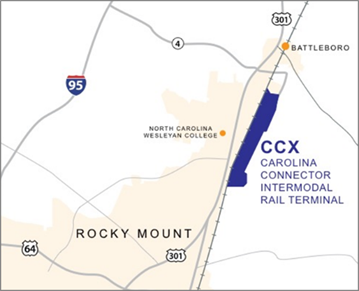
The $160-million Carolina Connector terminal will be a scaled-down version of a massive sorting hub originally envisioned for the 330-acre site. The traditional terminal will have lift capacity of 110,000 containers annually to serve shippers in the “Tarheel” state, including its fast-growing Raleigh-Durham area.
The state will spend $118.1 million for site development and roadway construction. Officials said the facility would help indirectly generate 1,300 jobs in the state.
“CSX is pleased to announce we have reached an agreement with the State of North Carolina to develop an intermodal facility in Rocky Mount that will enhance the region’s transportation infrastructure, create distinct competitive advantages for North Carolina’s businesses and leverage the environmental efficiencies of rail to drive substantial public benefits for the state,” CSX officials said in a statement.
The railroad will contribute $40 million toward the project, much of which has already been spent for land acquisition, engineering, and equipment. CSX also will provide design and construction oversight and operational expertise.
Plans for a massive Carolina Connector sorting hub were shelved last fall as then-CEO E. Hunter Harrison scrapped the railroad’s hub-and-spoke intermodal strategy for serving lower-density markets.
The sorting hub, which would have been modeled after a similar facility in North Baltimore, Ohio, would have had capacity for 260,000 lifts, with up to 500,000 lifts envisioned with subsequent expansions.
Under the hub-and-spoke plan, the terminal would have served the broader Mid-Atlantic market as well as local traffic. But the hub-and-spoke system did not generate enough profit to be worthwhile, Harrison concluded, and also added a day to transit times.
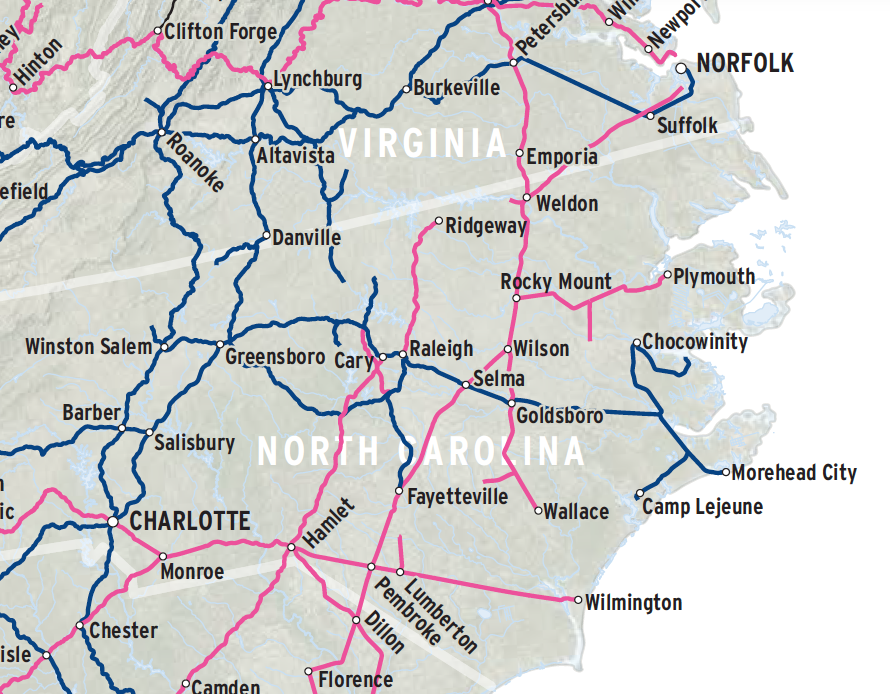
Construction on the smaller terminal will follow roughly the same timeline as the sorting hub, with the facility expected to open in 2020. It will fill a gap in the map on CSX’s Interstate 95 intermodal corridor.
The private-public partnership with North Carolina is an evolution for CSX under CEO Jim Foote, who was named chief executive after Harrison died in December.
Harrison was philosophically opposed to accepting public money, saying that it always came with strings attached.
This was part of the railroad’s rationale for pulling out of the $425 million Howard Street Tunnel project, which would have permitted double-stack service to and from the Port of Baltimore. CSX officials said they could not justify the level of investment required to boost clearances.
The move, announced in November, stunned Maryland officials. After becoming CEO, Foote met with officials from Maryland and promised to take another look at the project. No decision has been made yet on the tunnel project.
In New York State, CSX will welcome a $21 million state grant for the construction of a small inland port intermodal at DeWitt Yard, outside Syracuse. The intermodal terminal, with capacity for 30,000 containers per year, would handle short-haul traffic between Syracuse and the Port of New York and New Jersey.
The grant is currently winding its way through the approval process in Albany, New York State’s capital.