Davis, a member of the House Rail Subcommittee that recently held an Amtrak oversight hearing, added, “At this point, I want to try and solve (the on-time performance) problem without going to litigation. When litigation is involved, it will prolong the final solution.”
Durbin announced a bill the previous day that would allow Amtrak to sue host railroads, “to enforce its statutory preference” over freight trains.
As defined in Section 24308(c) of Title 49, United States Code, railroads are required to give “preference to intercity and commuter passenger transportation over freight transportation in using a rail line, junction, or crossing.” Always sidelining freight trains is not practical, so the Passenger Rail Investment and Improvement Act attempted to quantify the requirement utilizing an on time performance metric.
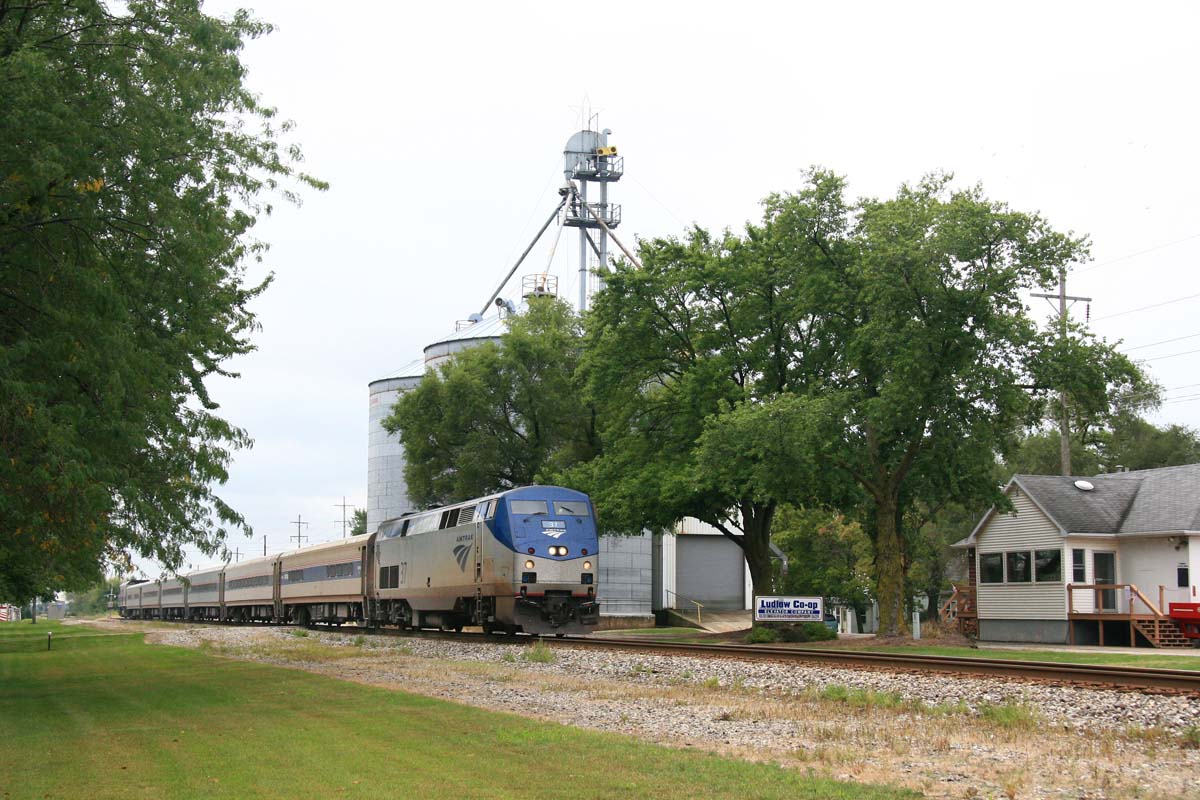
In the case of the Chicago-Carbondale corridor, Amtrak and the state’s relationship with CN has been contentious since 2006, when Canadian National then-CEO, Hunter Harrison, attempted to block the Saluki round-trip’s addition to the schedule after it was agreed to by a lower level railroad manager. Durbin got involved, and Harrison backed down, but delays to the morning trains in each direction have been prevalent ever since.
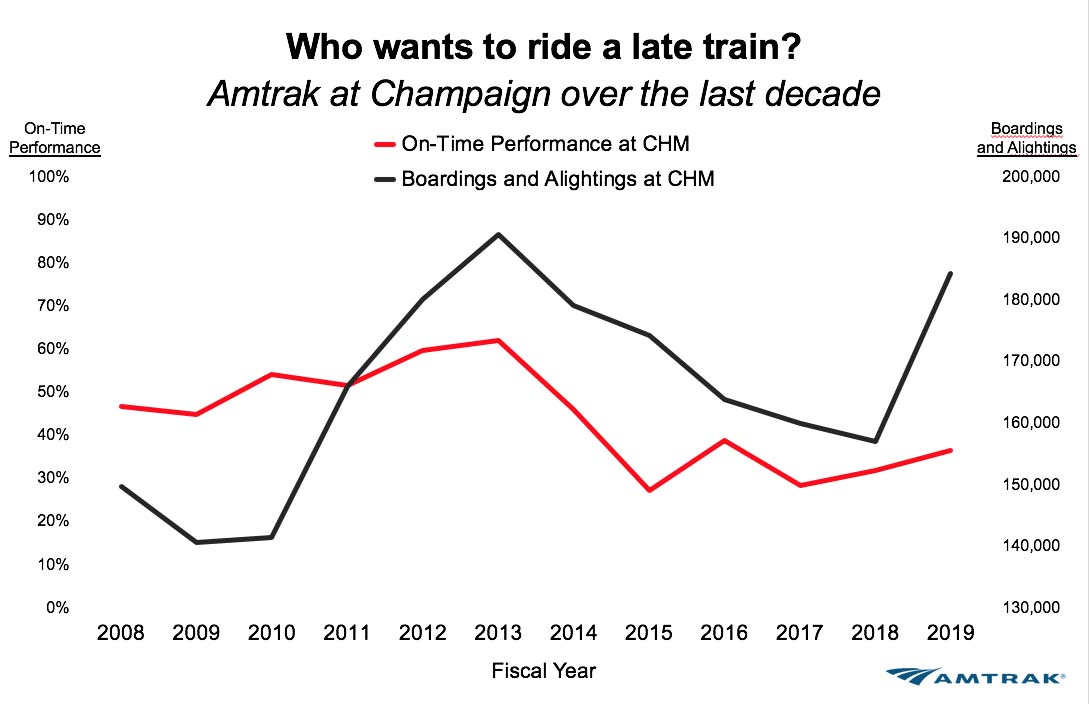
“There is a correlation between poor on time performance and reduced patronage at Champaign, and that affects Illinois taxpayers who help support the service,” Amtrak spokesman Marc Magliari tells Trains News Wire. At the meeting, Amtrak showed a PowerPoint plotting similarities between Champaign delays and ridership ups and downs for all trains over the past decade. For fiscal 2019, the two trains were on-time at their endpoints only 26% of the time (though the table also factors in the City of New Orleans, which has more recovery time built in to its schedule).
“Because the distance from Champaign to Chicago is relatively short, we are much more vulnerable to leak ridership from there when taking the train becomes unreliable,” Magliari says.
One of the contributing factors to ongoing tardiness revealed at the meeting is CN’s insistence on a 60 mph speed limit over any highway crossing protected by electronic warning devices between University Park and Centralia for the Amfleet or Horizon coach-equipped Illini and Saluki. This limit was added in 2014 in addition to a requirement that each of these trains run with at least 32 axles to ensure a proper shunt of signals and crossing gates.
The two Canadian National representatives at the closed door session opted not to participate in the news conference following the meeting. Neither CN nor the Association of American Railroads has responded to Trains News Wire requests for a comment on Sen. Durbin’s proposal and Rep. Davis’ stated belief that giving Amtrak the right to sue a host railroad would prolong a solution to on time performance issues.