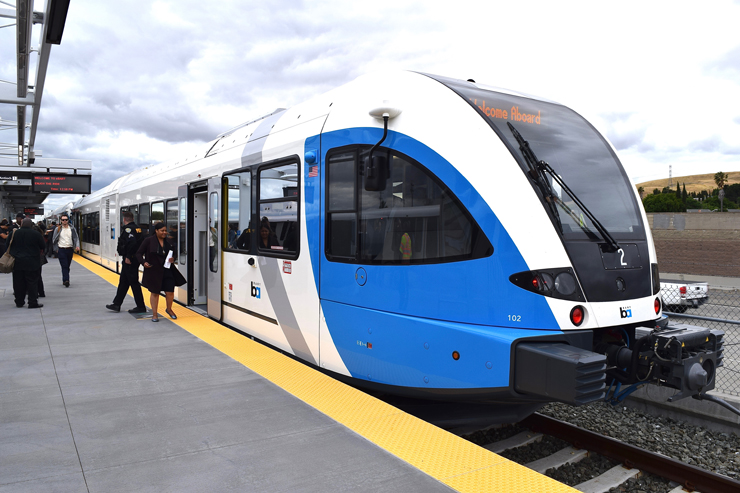
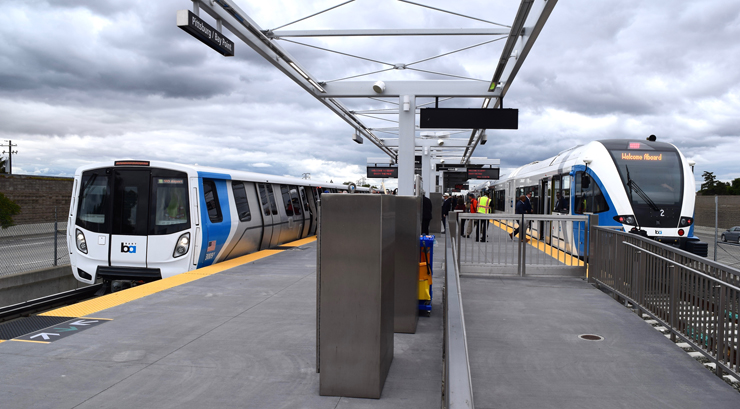
ANTIOCH, Calif. — Bay Area Rapid Transit’s new 10-mile Antioch extension, the transit agency’s first route to use trains other than the familiar third-rail-powered cars, will open Saturday, May 26.
The extension will use eight diesel multiple unit cars, built by the Swiss firm Stadler, which each accommodate up to 200 passengers — 104 seated and 96 standing. That’s about twice the capacity of the “legacy” BART cars, the first of which went into service in 1972.
The line from BART’s Pittsburg/Bay Point station to Antioch, known as eBART, is entirely within the median of State Highway 4. Choosing diesel trains kept the extension price tag to $525 million, less than half the cost of extending the third-rail-equipped tracks, BART spokesman Jim Allison said.
This allowed an extension to Antioch much sooner than would have been the case with the extension of the electrified system. That was important, said former Antioch mayor Joel Keller, given the daily bumper-to-bumper traffic in and out of Antioch and other Contra Costa Cities every day.
“We’d still be chasing money and not building anything,” said Keller, a member of the BART board of directors who worked for more than 20 years to bring BART to Antioch.
The new Antioch Extension DMUs burn fuel made from hydrogenated vegetable oil. They have a top speed of 75 mph, but will generally keep to 60 mph — much faster than Highway 4 traffic during a typical commute, despite a road-widening project that has been underway for eight years. They also are standard gauge, while the rest of the BART system is 5-foot, 6-inch gauge.
“Nothing about the BART-to- Antioch DMU technology precludes the construction of conventional BART service in the future” on the extension, BART’s Allison said.
Construction of the eBART line began in Spring 2011, as part of a Highway 4 widening project. Testing of the cars and tracks has been going on for several weeks. The system was unveiled to the public Friday with a series of free rides.
The Antioch extension’s opening comes during a period of major growth for BART. The 5.4-mile Fremont-Warm Springs extension opened in 2017, and work is supposed to begin soon on a 10-mile line from Warm Springs to San Jose. BART directors on May 24 voted not to pursue a 5.5-mile extension from eastward from the Dublin-Pleasanton station to Livermore, at least for now.
DMUs were one of five options considered for the Livermore project, but they did not offer enough savings to compensate for higher right-of-way acquisition costs needed on that line, BART spokeswoman Alicia Trost said.