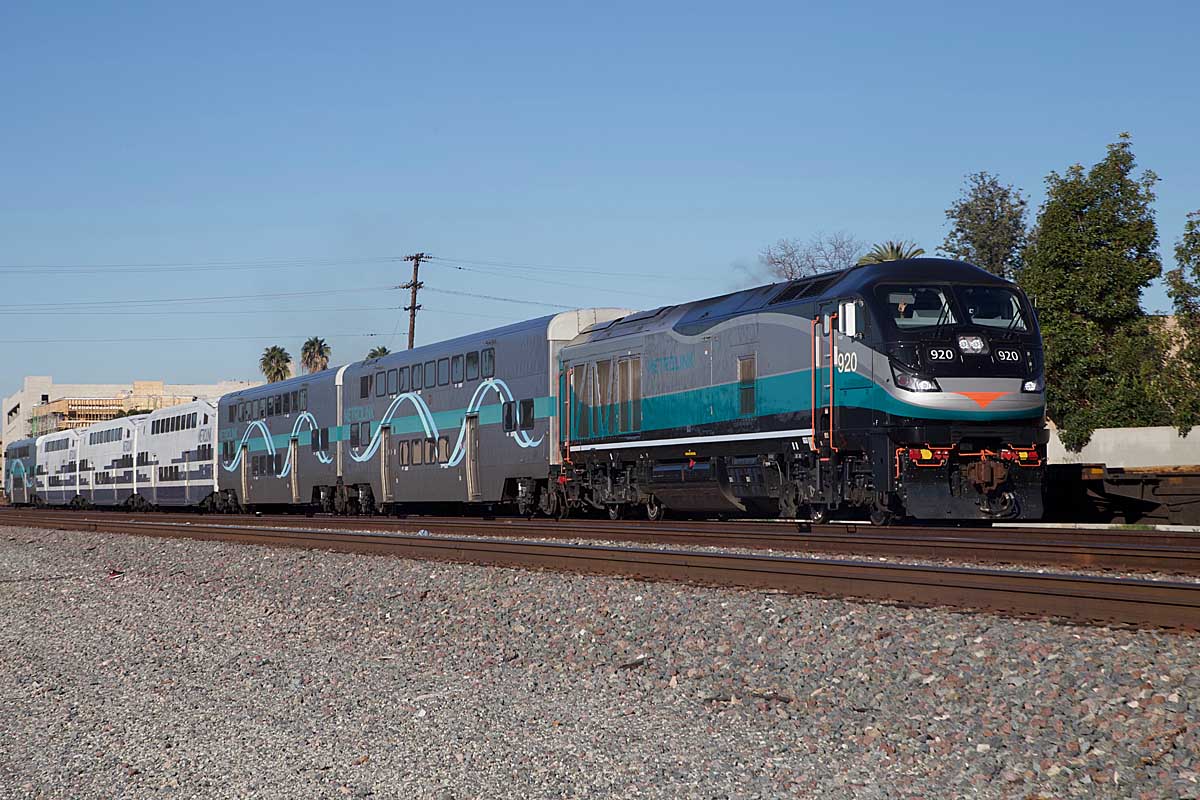
LOS ANGELES – There’s a light at the end of the proverbial tunnel for Metrolink’s new Tier 4 F125 locomotive fleet.
At a Saturday public meeting between railroad officials and residents of neighborhoods surrounding the carrier’s Central Maintenance Facility, Metrolink’s Neil Brown said that 32 of the new F125 locomotives are in service, 28 of those under conditional acceptance and four undergoing “break-in” testing. Three more locomotives were received from builder Progress Rail this week, leaving five more due to fill out the 40-unit order. All are expected in-service by mid-summer. Metrolink reports up to 85% improvement in emissions compared with the now-retired Tier 0 fleet of EMD-built F59s.
Metrolink says the commuter rail system needs 60 locomotives to offer full service, and a study has been commissioned to determine whether the remaining 20 Tier 2 locomotives on the roster should undergo midlife overhaul. Metrolink will explore “all sorts of alternatives” for prime mover and HEP systems. The agency’s Darrell Maxey, head of special projects, said longer-range discussions with BNSF Railway and Metra are exploring battery-electric locomotives and other alternative fuel technology. He called the search for alternative fuels a “full court press.”
Local residents have complained about noise levels from Metrolink’s facility, built in 1990 on the site of the former Southern Pacific Taylor Yard. One source of noise and pollution has been the “load testing” of locomotives at high throttle settings. Maxey said the railroad is looking at “hood technology” for noise and emission control during load testing, as part of a planned overhaul of the entire facility, which could include the purchase of an electric switch engine for yard operations.
Brown said there have been noise concerns with the new F125 locomotives and their 20-cylinder Caterpillar engines, which supply both propulsion and HEP. Engine cooling is tied to the Tier 4 emission control systems, so the new locomotives sound louder on hot days. The as-built cooling fans have been replaced with two-speed fans as an attempt to lessen noise, but the tie-in with the emission control equipment “could get very complicated.”