WASHINGTON — At a weekly “town hall” telephone meeting with employees on Friday afternoon, Amtrak President and CEO Richard Anderson painted a grim picture of the ways in which the Covid-19 coronavirus crisis has impacted demand. He also addressed funding requests to Congress to keep trains running, and how management plans to trim expenses, including unspecified changes to the long-distance network.
Trains News Wire was provided with a recording of the meeting.
Though he is set to shift to an advisory role when his successor, William Flynn, officially takes over as CEO on April 15, Anderson made it clear that policies recently formulated by the existing management team and Amtrak Board Chairman Anthony Coscia would prevail for the foreseeable feature. They include:
— Reducing planned $2 billion in capital spending by $1 billion to focus only on “state-of-good repair” capital projects. As an example, he cited Baltimore’s B&P Tunnel [see “The Overshadowed Tunnel,” February 2020 Trains]. Amtrak will spend the funds required to keep the existing 1873-vintage tunnels functional, but put engineering for their replacements on hold.
— Starting April 1, cutting management salaries from 22% to 7%, with the amount of reductions decreasing with the pay grade. Flynn has agreed to completely forego his annual salary from the outset. The 401K retirement program match is also immediately discontinued.
— Implementing a “voluntary time off” program for non-union employees, or reducing weekly hours to 32 hours per week and asking for voluntary retirements.
“The goal is to keep as many people employed as possible,” Anderson said. “We’re not doing any retirement incentive, but taking retirement now will open up a job for someone else in the company. Because after we get through this, the economy is going to be in recession, and that means our ridership will be down and we will be curtailing capacity to meet demand.”
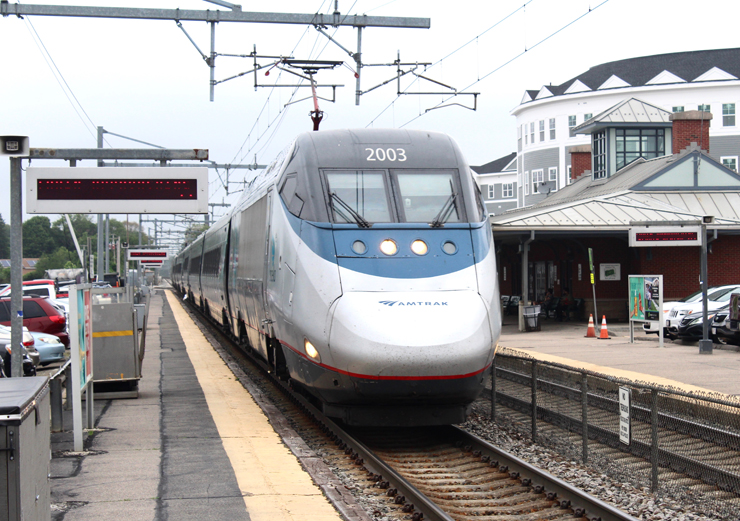
Anderson revealed that on Thursday, March 19, Acela ridership was down 99%, Northeast Regional service was off 94%, and long-distance trains, which have yet to see any frequency cutbacks, were off 64% from the average this time of year. He hinted that Amtrak would soon announce that all Acelas would be temporarily discontinued — a move the passenger railroad made on Monday.
“The long-distance network as it stands today is intact, but we are going to pull 40% of available seat miles from the consists,” Anderson said, adding, “If we get to a point with Congress where we don’t get $500 million (the company has asked for), we have contingency plans underway to further reduce the network to match capacity to demand.”
In response to an emailed employee question later in the session, Anderson said:
“There are pieces of the network that ought to be permanently trimmed; you know, I’ve said that for a very long time. And given the amount of cash burn we have, I’m certain the long-distance network is going to be very different longer term. We’d like to avoid it, but if we can’t get the kind of funding out of Congress that we need, then we need to face that issue and will have a contingency plan to do that. But that will be only a worst-case scenario because we don’t want to furlough employees.”
However, when Anderson stated that “over two and a half years it takes about $2 billion to keep the long-distance network operating,” he again used the largely allocated expense figures the company assigns to imply that these are avoidable costs — that is, they would all disappear if the trains were discontinued. His earlier “cash burn” reference also implied that this was the case, a contention that has been repeatedly challenged by the Rail Passengers Association and elected officials along those routes.
Through February in the 2020 fiscal year that began in October 2019, Anderson reported that Amtrak was “running 91% above plan.” Trains News Wire confirmed that in February, the long distance, state-supported, and Northeast Corridor categories all showed sharp increases, with overall ridership and revenue both up an average of 6.5% compared with February 2019.
Now with the outbreak, Anderson said, full year revenues are projected to be down $1 billion and the company projects a $840 million loss even with expense reductions of $110-$150 million.
Though not explicitly asking for relief from a scheduled July 1, 2020, raise for union employees, Anderson concluded the call with the hope that “we have to do what we have to do to come back strong after the pandemic, and will do our level best to not have anyone at Amtrak involuntarily lose their job.”
— Updated at 7:15 a.m. to include suspension of Acela service.