On Thursday, investigators with the Transportation Safety Board of Canada provided new details about their inquiry into the fatal Feb. 4 derailment on Kicking Horse Pass near Field, B.C., and offered suggestions to regulators on how to prevent future tragedies.
According to TSB investigators, the previous crew aboard CP train 301-349 made an emergency brake application near Partridge — the last station before the train entered the Upper Spiral Tunnel — because the train was exceeding the posted speed limit of 15 miles per hour. The crew tried to use normal brake procedures to slow the train down but was unsuccessful. According to investigators, the train was traveling at 23 miles per hour when the engineer decided to make an emergency application. According to CP operating rules, any time a train is going 5 miles per hour over the speed limit on a descending grade it is considered an “uncontrolled movement and must be stopped immediately by whatever means available,” including an emergency brake application.
After stopping, the train sat on the 2.2% grade with the air brakes applied for nearly three hours. During that time, the air brakes slowly lost their grip on the parked train.
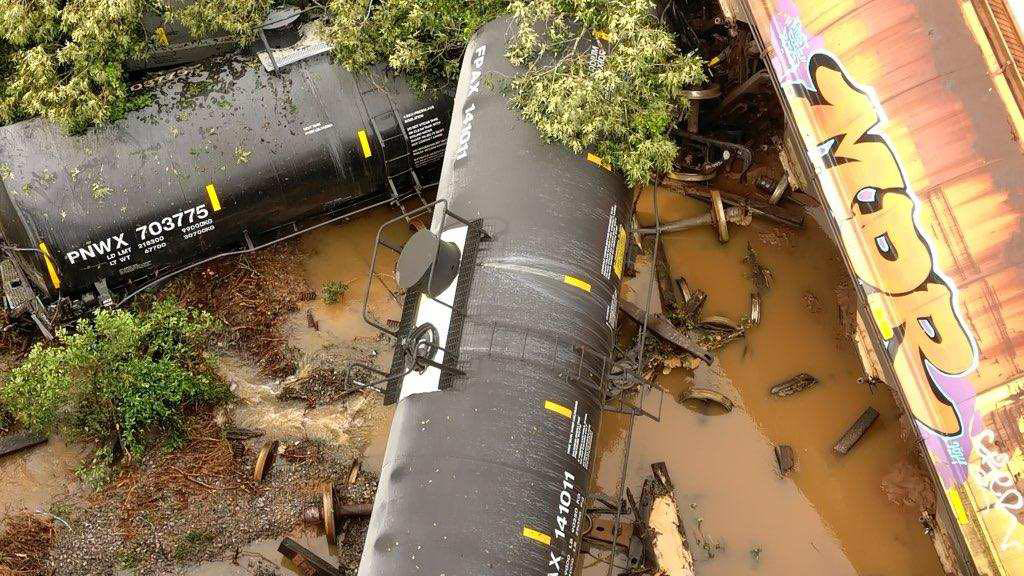
Two hours and 45 minutes after the train was stopped at Partridge, a relief crew came on duty. The new crew was on the train for about 10 minutes when it began to roll downhill. After exiting the Upper Spiral Tunnel, the train derailed and the lead locomotive ended up in the Kicking Horse River. Conductor Dylan Paradis, engineer Andrew Dockrell, and trainee Daniel Waldenberger-Bulmer were all killed.
After the derailment, investigators took the 12 grain cars that did not derail and conducted extensive tests to the air brake systems, with weather conditions similar to the night of the derailment. The tests revealed that the car’s air brake system failed to maintain constant pressure over time. “The air brake system on these cars would not provide adequate braking effectiveness to ensure the safe operation of a loaded unit grain train in a situation where the air brakes are required to remain applied for an extended duration, such as while descending a steep grade,” TSB officials write.
TSB officials have urged government regulators to review its rules regarding air brake maintenance and inspections, especially for railroads operating in mountainous territory.
“A properly functioning air brake system is of the utmost importance in mountain territory from a safety standpoint,” officials write.
The TSB has not indicated when it hopes to complete its investigation.
Kicking Horse Pass, home the CP’s iconic Spiral Tunnels and known to local railroaders as “The Big Hill,” has been the site of numerous derailments and runaways in the past century. In fact, just a month before the fatal derailment near February, a train derailed inside the Upper Spiral Tunnel.