Tourist railroads, rail museums, and rail-themed events are facing the same strategic challenges as Amtrak, commuter rail, and public transit in the wake of the COVID-19 pandemic: how to thrive in what one senior Polar Express production company executive calls an “ever-evolving, one-size-does-not-fit-all environment.”
Trains News Wire spoke with more than a dozen recreational railroad and rail-event production managers to assess the pandemic’s impact. Responses were similar: Operations are currently closed in accordance with varying local and state guidelines; it’s almost impossible to forecast how the patchwork of social distancing and other government directives will impact operations; and a few locations are cautiously planning re-openings with highly modified operating plans.
Polar Express and Day Out With Thomas
“Everyone wants to get back open, but what this will look like is still unknown,” said Mike May, Vice President and Productions Director for Rail Events Productions “Polar Express” shows. With 62 locations in 2019, 44 handled by licensees, the Polar Express program is the biggest U.S. licensee of rail-based performance attractions. Many tourist railroads are highly dependent on revenues generated by the Polar Express, which drew 1.4 million customers in 2015.
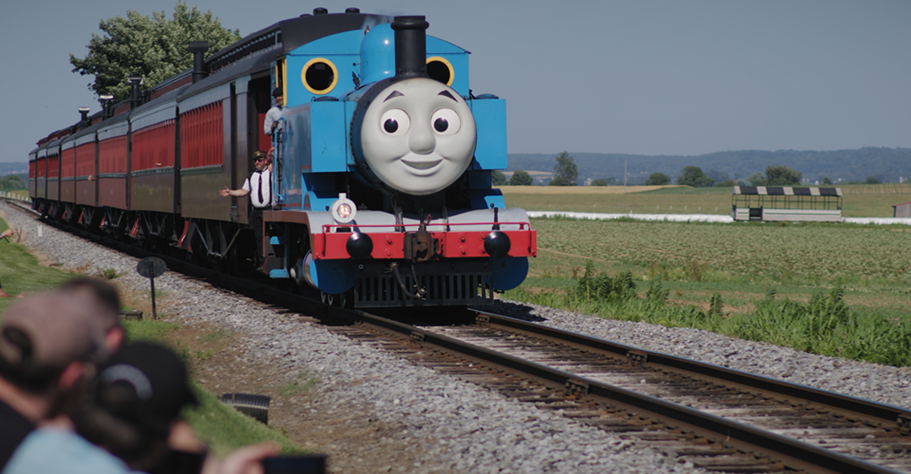
Events like Polar Express and Day Out With Thomas depend on what is sometimes called the “PBIES theory” — i.e., put bodies in every seat. Profitability is tied to the highest possible passenger loads. An empty seat, be it for Polar Express, Day Out With Thomas, or a commercial airliner, cannot be kept for later use, so its revenues are forever lost.
Polar Express faces the same challenges as “arena sports, state fairs, minor league sports and theme parks,” says Jarrette Ireland, Rail Events vice president and general manager. “Everyone wants to implement best safety practices. But how do you accomplish this in a railroad car? The real challenge is achieving [economic] sustainability in light of likely reduced equipment utilization.”
A spokesman for Mattel, Inc., operator of the “Day Out With Thomas franchise,” declined comment for this story. One of the biggest among its reported 29 operators last year is the Strasburg Rail Road, which ran Thomas trains on 21 days. While not addressing Day Out With Thomas directly, Strasburgh spokeswoman Hope Graby says, “Strasburg has totally lost the beginning of the season … and is trying to find the positive in the pandemic’s impact.” It has seen a 68% increase in freight traffic thanks to increased food and pet-product shipments.
Graby says tourist industry colleagues in attraction-intensive Lancaster County, Pa., are all “wondering when can we open, what can we legally do, and when will travelers have the confidence to come back. Those are the million-dollar questions.”
Trains have not operated since March 14 on the Austin (Texas) Steam Train Association’s Austin & Texas Central Railroad. “Our crystal ball is not better than anyone else’s,” says Ben Sargent, Association board chairman. The pandemic “came completely out of the blue.”
With no plans to operate until at least July 1, Sargent says the railroad is trying to answer many strategic questions. “Will passengers feel comfortable? Will they rush back? Or be nervous about (riding) in closed space? … We had expected to board our one millionth passenger sometime this summer but that will be put off for a while.”
In Florida, “Seminole Gulf Railway’s Murder Mystery Dinner Train was on track for a second consecutive record year” before the pandemic struck, railroad vice president Robert Fay says. “The railroad missed a million-plus in revenues … and we’re not planning on reopening until early October.” Freight traffic on the Ft. Myers-based railroad is down 18% “because the world-wide economy is hurting,” but there has been an increase in car storage.
Railroad museums also face uncertainty. “I’m not sure how we will adapt to the new circumstances,” says. Dan Thielen, executive director of the state-owned Nevada State Railroad Museum. His museum is closed in line with Gov. Steve Sisolak’s stay-at-home order. “We’ll need to strike a balance between what government says we can do and how to protect delicate historic artifacts which may need extensive scrubbing down and cleaning.”
Many of the museum’s restoration projects are privately funded, so that work continues. The museum had planned to take its recently restored Glenbrook, a 2-6-0 built in 1875, to the Roundup of Victoria Locomotives at Colorado’s Cumbres & Toltec Scenic Railroad, but its participation is in doubt
Small operations still cautious
“All are eager to return to some sense of normalcy,” says David Brewer, Heart of Dixie Railroad Museum executive director. The Calera, Ala., museum has been closed since mid-March. Its Thomas event in mid-April was cancelled with a significant loss of revenue, and the museum may have to reduce capacity for other important events, such as the Pumpkin Patch Specials and North Pole Express.
“The museum has an operating fund that has allowed us to carry on,” Brewer says, “so we’re not in as bad of shape as some of our other colleagues. And grant-funded restoration work has continued” with a dedicated group of volunteers. The museum does not neatly fit into a specific category, he says. It is “not adopting a one-size-fits-all reopening strategy… and the demand remains to be seen.”
At the Connecticut Eastern Railroad Museum in Willimantic, Conn., treasurer Mark Granville says, “Everything is up in the air. … We are ready to reopen when state and local health department officials give permission.” He says the museum will be “in big trouble next year” if it is unable to open this year, and “with 95% of our volunteers in the high risk over-65 age group, we may not be able to open if state recommendations continue stay-at-home instructions” for that group.
The museum features the reconstructed 19th-century New York, New Haven & Hartford Railroad’s Columbia Junction roundhouse. It has two main events: Opening Day in early May and Railroad Day on Labor Day weekend. “Opening Day has been cancelled but we might be able to do Railroad Day,” Granville says.
Connecticut Eastern is also sorely missing three weekends of volunteer work from students at Eastern Connecticut State University, which was closed in March. Up to 20 of its students annually meet their community-service requirements helping the museum with site cleanup. “We have lots of leaves from oak trees that have to be removed before opening day,” Granville says. “Losing the students was a big hit.”
Planned reopenings
Bucking national trend is the Big South Fork Scenic Railroad, which plans to reopen June 3. The history-intense operation located in southeastern Kentucky’s coal country, it runs over the former Kentucky & Tennessee Railroad out of Stearns, Ky. The railroad has added platform length and increased its normal four-car train by two coaches to accommodate social distancing requirements, says J. C. Egnew, a long-time railroad board member.
“The railroad is now open all the way to Blue Heron (National Historic Park). We have been able to complete track repairs using grants totaling $3.3 million,” Egnew says. “We are more fortunate than most.”
Also planning an early June reopening is the Colorado Railroad Museum in Golden, which closed in mid-April. Paul Hammond, executive director, says the museum has been cutting expenses in the wake of reduced revenues: “We are stepping back on repair projects because we don’t know what to expect for next year.”
The museum operates both Polar Express and Thomas events, and Hammond says the staff is “rethinking all of its operations so people are safe … but it’s hard to predict what the future holds.”
One of the best assessments came from Mark Ray, HeritageRail Alliance president: “It’s too early to tell how bad it’s going to be.”
Ray explains Alliance members were once dependent on revenues from summer operations. That’s changed in the past 20 years.
“If there is a second [virus] wave,” Ray said, “then we’re talking about a whole different situation because of the loss of fourth-quarter income.”