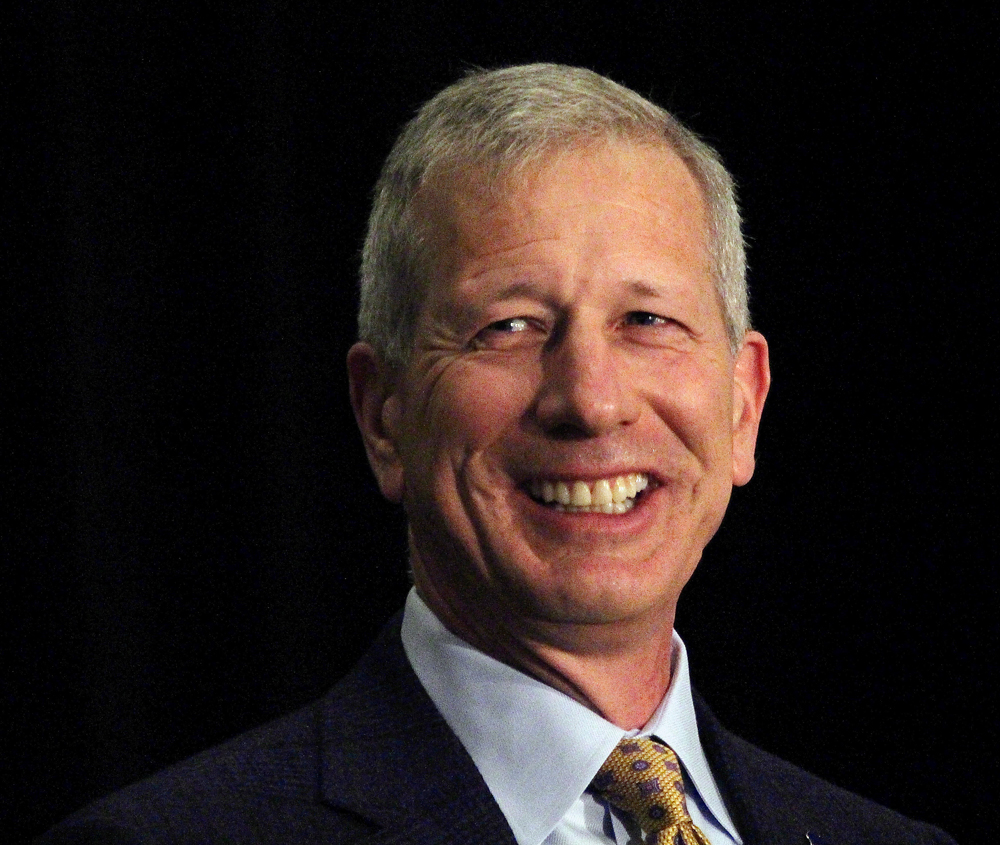
That was one of several points emphasized by UP President and CEO Lance Fritz on Wednesday morning as he addressed the Midwest Association of Rail Shippers on the railroad’s efforts to improve its customers’ experience.
The move away from unit trains is part of a “fundamentally changed service that is opening up markets,” he said.
“By co-mingling services and not being so dogmatic about unit-train, boutique service,” Fritz said, “we’ve been able to take frac sand from stops in Minnesota and Illinois and ship it up into the [Powder River Basin] in carload quantity, by tacking it onto the back of empty PRB coal trains. That service product is awesome. We’re giving local producers seven-day-a-week service, and then able to tack on whatever is loaded, and give it reliable, consistent runs in our coal network up to the PRB.”
“In the old days, product that wanted to go to northeast Iowa probably intermodaled to Chicago and then drayed back, at about $1,000 or $1,200 a truck, if you could get it,” Fritz said. “… What we’ve done is created a product where we intermodal to Council Bluffs — it’s an existing service — then it gets on existing manifest service up into Mason City, and interchanges with a short line to get to the intermodal ramp.
“It’s less costly; it’s faster; and it’s highly reliable, because all those services exist, and in general, they’re seven-day-a-week services. That’s awesome. There’s more of that to be had.”
From a volume standpoint, Fritz said, that frac sand business has been “brutal.”
“At one point last year, our year-over-year comps were down 70% or 80%,” he said. “That’s a brutal shift in our reality, and the reality for everyone participating in that market. That’s because local sand was replacing that Northern White, and it was also because the exploration and production companies were pulling in their horns.”
Fritz touted several statistics which he said reflected improved performance under UP’s PSR plan:
— First-mile, last-mile performance, up 11 points; “at historically high levels now;”
— Car trip-plan compliance, up 9 points; “that’s running at about 75% right now, historically high levels;”
— Car dwell is now at 22 hours, down 3 to 4 hours, “and we think we can drive this down to 20, plus or minus;”
— Car velocity, at about 220 miles per day, up 11 miles per day; “if you go from start [of UP’s Unified Plan] to today, that number’s more like 30 or 35 miles;”
— Train velocity, up one-half mile.
That last number, Fritz said, is less important in UP’s current approach.
“In the old world, we used to worship at the altar of train velocity,” Fritz said, “thinking that translated into better service. It doesn’t. Car velocity has a better record of translating into what we say we’re going to do. Car velocity is important because it keeps your network decongested.”
With UP continuing to eliminate hump operations at yards throughout its system, Fritz also offered one example of how it will repurpose the space created by those idled humps.
At Chicago’s Proviso Yard, the land occupied by the hump will be used to expand the adjacent Global 2 Intermodal facility.
“It’s literally on the same footprint as Proviso,” Fritz said. “We’re going to take part of the Proviso hump, part of the bowl, and turn it into an intermodal ramp.
“So we’re going to get a better intermodal ramp. It’s going to get a $75 to $100 million investment; it’s going to be state of the art, and it’s going to be right in the heart of the city, where you want it. We’ve got other opportunities to do that. I think we’ve got an opportunity to try to do that in LA, and in Houston.”