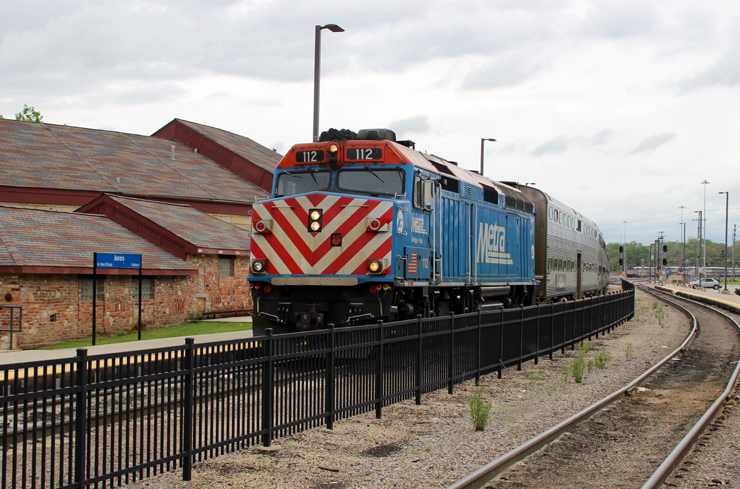
CHICAGO — Representatives from two counties vying for expanded Metra service appeared before the commuter rail agency’s board of directors to plead their cases, but it appears unlikely that any expansion will occur any time soon.
Representatives from the Kendall County village of Oswego and from the village of Sugar Grove in neighboring Kane County both urged Metra officials Wednesday to extend service beyond the BNSF Line’s termination in Aurora to their communities, separated by only a few miles but located on different rail routes. Oswego is on BNSF’s Mendota Subdivision, its route to Galesburg, Ill.; Sugar Grove is on the Aurora Subdivision, part of the route north to Minneapolis-St. Paul.
Metra officials reiterated that the agency’s first priority is to maintain its existing system and repair and replace aging rolling stock and infrastructure.
Metra Chairman Norman Carlson says Metra was grateful to the General Assembly for recently approving a capital bill that may bring Metra as much as $1.6 billion in state bond-backed revenue for capital needs over the next five years. The agency, however, has a five-year, $5 billion list of needs.
“Thus Metra’s principal focus is a commitment and an investment to achieve a state of good repair on its existing system” and not on expansion, Carlson says.
He called on the Regional Transportation Authority, which oversees Metra, to formulate a policy on expanding service beyond the RTA’s six-county territory.
The capital bill included $100 million for Metra expansion to Oswego and other Kendall communities. The earmark was obtained through the efforts of a coalition of state legislators, according to Oswego Village Administrator Daniel Di Santo.
Last month, Metra’s board approved spending $4.5 million in federal funds for an engineering study of the extension. Officials pointed out that the money wasn’t from Metra itself but rather came from a $7.5 million earmark dating back to the 2000s when local U.S. Rep. Dennis Hastert was then House speaker.
Di Santo told Metra that Kendall County has been fighting for the extension for decades and that current members of Congress, Lauren Underwood and Bill Foster, continue to support the Kendall extension.
Di Santo acknowledged that the $100 million was “only about a quarter” of the cost of the project, but that the Kendall communities were committed to “identify funding” for the extension.
Metra says a preliminary cost-benefit analysis estimates that a BNSF extension would cost $440 million to construct and $5.1 million per year to operate and maintain the service (in 2016 dollars).
Still, Kendall vows to continue. “This is a long time coming,” Di Santo says. “We’ve been doing this for 20 years and it will take many more years in order for this to become a reality.”
Speaking on behalf of Kane County were Ted Koch, an official from the village of Sugar Grove, a few miles north of Oswego, and Kane County Chairman Chris Lauzen. Kane County opposes an extension to Kendall. It would be cheaper and more efficient to extend Metra to the Kane County via Sugar Grove, they say. Furthermore, the village is only 10 minutes away from the Kendall County communities, Koch says.
And unlike Kane, Koch says, Kendall County is not a part of the Regional Transportation Authority. Kane has been paying RTA taxes since 1974, amounting to some $500 million.
Metra’s cost-benefit analysis estimates that a proposed Sugar Grove BNSF Extension would cost $370 million to construct and another $4.5 million per year to operate and maintain the service (in 2016 dollars).
Lauzen said Kane County wants Metra to reaffirm that its first priority is safety and maintaining equipment in a state of good repair, rather than expansion. “If this is no longer the case, then at least expand efficiently into RTA territory in Kane County, where we’ve paid in hundreds of millions of dollars, rather than Kendall County … where they haven’t paid one penny,” Lauzen said.
Echoing him was board member Steven Messerli, who represents Kane County. “Metra needs to take care of its own financial health first” before expanding service, he says.
Metra CEO/Executive Director Jim Derwinski says building any extension is a long process that is “many years off.”
“Our priorities are to work on the system that we have here,” Derwinski says.