Washington Gov. Jay Inslee signed the bill, ESSB 5579, into law May 9, setting up a confrontation with North Dakota officials.
“It is deeply disappointing that another state would attempt to impose restrictions that are both unreasonable and unsupported by science to block the transport of a legal product being shipped in a manner that is even safer than what federal standards require,” North Dakota Gov. Doug Burgum said in a statement. “We will now consult with the attorney general on appropriate legal action to defend our state’s constitutionally protected right to interstate commerce.”
Washington’s law, effective July 28, differentiates between new and existing facilities for unloading oil. Those built or permitted after Jan. 1, 2019, “may not load into or unload from a rail tank car crude oil with a vapor pressure greater than 9 [per square inch],” according to a final-bill report published by the Legislature. For existing facilities, the new rule goes into effect “two years after the volume of crude oil transported to the facility has increased more than 10 percent above the volume reported for calendar year 2018.
“A railroad car carrying crude oil is not prohibited from entering the state, required to stop, or have the vapor pressure checked before entering the state,” the bill report says.
The state’s Department of Ecology can impose penalties of up to $2,500 per day, per rail tank car or equivalent volume of oil, for violations.
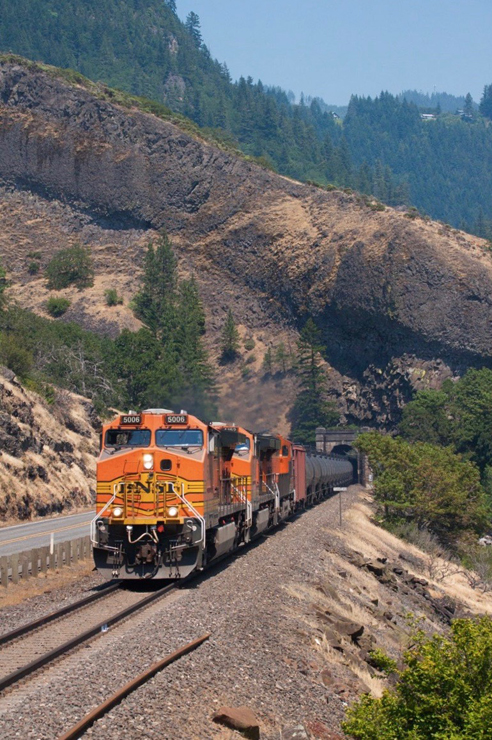
State Sen. Andy Billig, D-Spokane and the bill’s primary sponsor, says his concern is the safety of communities along the route, sparked by the volatility of Bakken oil combined with a potential surge of shipments of oil to the state’s five major refineries. He notes that 17 unit crude oil trains per week travel to Washington.
Billig says he was motivated by safety concerns and recent high-profile accidents and fires, involving crude oil shipments, most notably in Lac-Megantic, Quebec, and Mosier, Ore. He picked the standard of 9 psi because, according to a release from his office, in the Lac-Megantic derailment and fire “the only tank car that did not explode was carrying oil with a vapor pressure of 9 psi.”
North Dakota officials, however, contend that the standard is arbitrary, and that Washington state doesn’t have the authority to impose it anyway.
A letter from North Dakota’s three-member congressional delegation asking Inslee to veto the bill described the bill as “a de facto ban of crude-by-rail traffic from North Dakota to refineries throughout the Pacific Northwest and would do little to advance the sponsor’s intended goal of reducing risk along the rail network.”
The letter noted that “current North Dakota regulations require companies to extract the most volatile gases from Bakken crude oil to guarantee the vapor pressure does not surpass 13.7 psi. North Dakota state officials established that threshold based on a national standard for stable crude oil, which is 14.7 psi.”
“The Federal Government maintains field preemption over the State of Washington for the operating practices and movement of hazardous materials by rail through the Federal Railroad Administration,” the letter added. “While the state of Washington does have certain authority to legislate on health and safety issues, this bill does not offer a sound basis for doing so.”