But CN also is keeping an eye on its longer-term growth opportunities, CEO JJ Ruest said at investor conferences this week, and will forge ahead with capacity projects that were planned before COVID-19 hit.
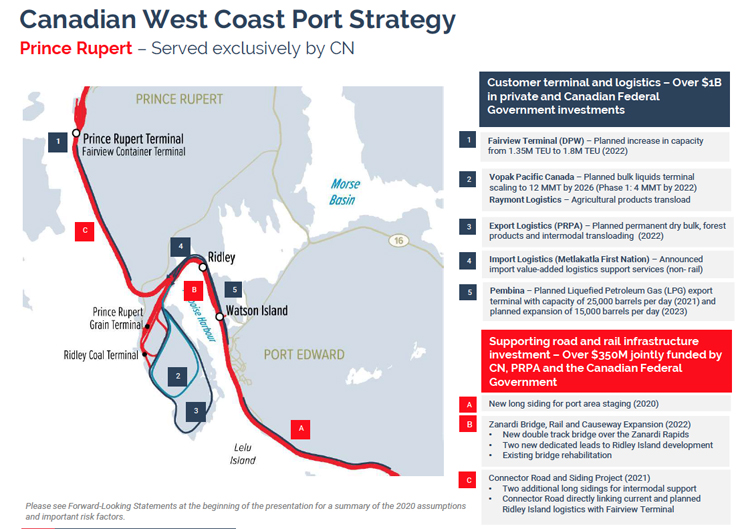
CN will build three new sidings this year between Edmonton, Alberta, and the Port of Prince Rupert, British Columbia, to support ongoing expansions that will enable the port to handle more container traffic as well as rising volumes of coal and propane exports over the next three years.
“You should see that as a sign of confidence that this is a long-term gateway for CN to serve North America,” Ruest says.
CN has added or extended five sidings and built two sections of second main on its single-track route to Prince Rupert over the past two years, and facilities in and around the port are in the midst of a $350 million capacity expansion jointly funded by CN, the Prince Rupert Port Authority, and the Canadian federal government.
In Vancouver, the largest port on Canada’s West Coast, CN will continue to participate in $400 million of expansion projects jointly funded by the railway, the port, and Ottawa.
CN also is proceeding with plans to build a new deepwater container terminal at Quebec City to handle containers moving from Asia to North America via the Suez Canal. The Quebec terminal, a partnership involving CN, Hutchinson Ports, and the Port of Quebec, is expected to open in 2024.
Overall, CN has scaled back its capital budget slightly this year due to the pandemic, to $2.9 billion from $3 billion.
But Ruest noted that CN spends 20% of its revenue on capital expenses, putting it at the high end of the railroad industry. Other railroads, he notes, have reduced capital spending to 14% of their revenue.
“That’s not what we want to do,” Ruest says. “We believe the pandemic will change the world, but there is a world beyond the pandemic.”
CN will not get caught short of capacity like it did in 2017 and 2018, Ruest says.
The railway paused expansion projects during the traffic downturn in 2016, then lacked the track, crew, and locomotive capacity required to handle an unexpected surge of traffic in Western Canada that began in 2017 and continued into 2018. CN then spent record amounts to add capacity west of Chicago and Winnipeg, Manitoba, in 2018 and 2019.
“Having learned from that, that’s why we continue to expand some capacity … right now,” Ruest says.
Ruest spoke at the Bank of America and RBC investor conferences this week.