



Tuesday morning rail news:
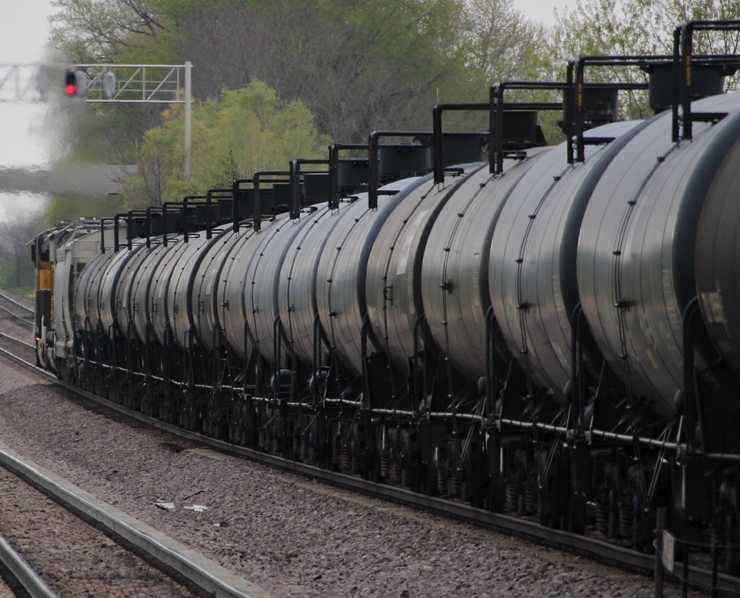
— The U.S. Department of Transportation has sided with North Dakota and Montana in a dispute with Washington state over the transport of crude oil by rail, ruling that federal law preempts a Washington state statute that sought to limit oil movements for safety reasons. A decision issued Monday by the DOT’s Pipeline and Hazardous Materials Safety Administration found that Washington’s law, which sought to regulate crude oil movement based on vapor pressure, “amounts to a de facto ban” on the Bakken crude produced by fracking in North Dakota and Montana. Washington passed the law setting a vapor-pressure standard last year over concerns about volatility of Bakken crude [see “North Dakota, Washington state spar over crude-by-rail law,” Trains News Wire, May 14, 2019], leading North Dakota and Montana to petition the hazardous materials agency for a ruling. U.S. Sens. Kevin Cramer and John Hoeven (both R-N.D.) issued a statement on Twitter calling the decision “much-needed good news for North Dakota’s oil producers” and saying “Washington’s legislation was an obvious example of overreach, not scientifically founded, and could have ultimately driven their state refineries to foreigh sources of crude oil.”
— Two Maine rail museums have settled a lawsuit over the use of a narrow gauge steam locomotive. Lawyers for the Sandy River & Rangeley Lakes Railroad of Phillips, Me., and the Maine Narrow Gauge Railroad Co. & Museum of Portland told the Lewiston Sun Journal that the two sides had settled their differences in the dispute over Monson Railroad No. 3, a 1912 Vulcan 0-4-4, but were not authorized to provide details. The case was dismissed in late January. The Sandy River & Rangeley Lakes sued last year, saying it invested $114,000 it spent to retube and repair the locomotive and had an agreement to operate it, while Maine Narrow Gauge said it terminated the agreement over improper care by the Sandy River [see “Monson 3 in the middle of a legal dispute between Maine museums,” Trains News Wire, Sept. 12, 2019].
— One-quarter of Toronto residents who have stopped using public transit say they won’t ride again until they have been vaccinated against COVID-19, according to preliminary results of a University of Toronto study — a finding which suggests transit agencies could face long-term loss of some riders, given that manyexperts believe a vaccine is at least a year away. OurWindsor.com reports the preliminary findings are based on more than 2,700 responses to a survey of transit users, which also found 82% of those responding support strict limits on the number of passengers in a vehicle, and 72% favor a mandatory face-covering requirement for passengers.