
BOSTON — A highly critical report commissioned in the wake of a series of incidents earlier this year says “safety is not the priority” at the Massachusetts Bay Transportation Authority.
The report released Monday, by a panel brought in by the MBTA’s Fiscal and Management Control Board, found that MBTA staff believes “fiscal controls over the years may have gone too far, which coupled with staff cutting has resulted in the inability to accomplish required maintenance and inspections, or has hampered work keeping legacy system assets fully functional.”
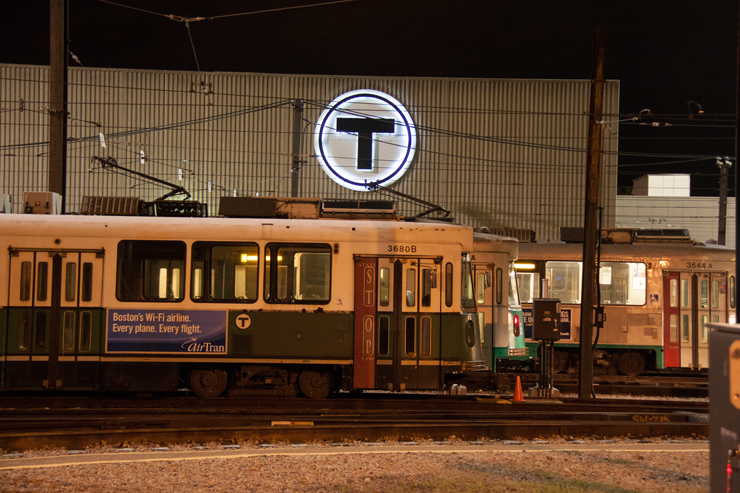
The three-member panel included former U.S. Transportation Secretary Ray LaHood; Carolyn Flowers, former acting administrator of the Federal Transportation Agency, and Carmen Bianco, former president of MTA’s New York City Transit. They were asked to assess MBTA operations in the wake of incidents including two derailments in a four-day span in June: a light-rail accident on the Green Line [see “Ten injured in MBTA light rail derailment,” Trains News Wire, June 9, 2019] and a Red Line derailment that caused signal-system damage that delayed operations for months [see “MBTA Red Line subway derailment injures one, disrupts morning commute,” Trains News Wire, June 11, 2019].
The group interviewed more than 100 executives, employees, and other individuals involved with the MBTA, contract commuter rail operator Keolis, the FTA, Federal Railroad Administration and other organizations. They said the agency “performs the necessary core functions to be considered a relatively safe system,” but some items “need immediate attention.”
Its report states that “the T’s approach to safety is questionable, which results in safety culture concerns. In almost every area we examined, deficiencies in policies, application of safety standards or industry best practices, and accountability were apparent.”
Critical preventative maintenance and inspections are not taking place, the report states, and “there is no meaningful [quality assurance/quality control] strategy or system in place.” It also found that the frequent meetings of the Fiscal and Management Control Board, required to by law to meet 36 times a year, eat up staff time “and leave staff little if any time to tend to the operation or maintenance of the system.”
It also noted that the commuter rail operation is “performing well and does not face many of the challenges that were identified on the transit side of the house.” It attributed this in part to well-defined FRA regulations with fiscal consequences.
In all, the 69-page report includes 34 recommendations covering 61 corrective actions. The full report is available here.
The Boston Globe reports that Massachusetts Gov. Charlie Baker said at a Monday news conference that his administration was “glad to have” the report and “anxious to implement it.” He acknowledged the agency will need more money and manpower to act on the recommendations.
MBTA General Manager Steve Poftak called the panel’s findings “a very sobering report.” He said he will ask the board at its next meeting to reallocate roughly $10 million to hire safety and quality-control workers.
“We understood the gravity of this report,” Poftak said, according to the Globe report, “and everyone understands the need to change the culture at the T.”