SACRAMENTO, Calif. — Half-a-billion dollars in unanswered questions remain now that California officials are working with a new builder on a floundering, years-old passenger car order.
California Department of Transportation — Caltrans — officials say in a Wednesday news release that German railroad equipment manufacturer Siemens will build 137 single-level coaches in its Sacramento shops at a cost of $371 million. The announcement seems to officially replace a $551-million bilevel order to Nippon-Sharyo from 2012. Illinois’ Department of Transportation will receive 88 cars in the revised order. California will take 49 cars. Officials say production will begin in the next year.
But the announcement downplays production problems that had put an original order into question for years. Among the biggest of the unanswered questions is, “Who pays?” after a Sept. 30 deadline came and went for a consortium of states to spend $551 million in American Recovery and Reinvestment Act of 2009 funds. The money — or a portion of it — by law, has to be re-paid to the Federal government.
Nippon-Sharyo’s woes
California’s transportation department became the lead agency for a coalition of states that want to run new passenger cars on Amtrak trains. That group ordered bilevel cars, designed by the all-volunteer Next Generation Equipment Committee, from Sumitomo Corp. of America in 2012. States including Illinois and California had ordered a total of 130 bilevels. The first prototype of that design failed a crucial safety test at Sumitomo contractor Nippon-Sharyo’s Rochelle, Ill., plant in September 2015. A prototype shell buckled under the compression of the required 800,000-pound test. Nippon-Sharyo never publicly disclosed the cause of the failure, though the company immediately suspended work on the order, laying off 98 workers in its fabrication and welding shop.
During the past two years, the company repeatedly declined to answer Trains News Wire questions about the order. In January, a California official who was slated to speak before the Transportation Research Board on the bilevel order and project progress cancelled his presentation. When reached for comment, that official’s replacement said the state was in negotiations and couldn’t speak further.
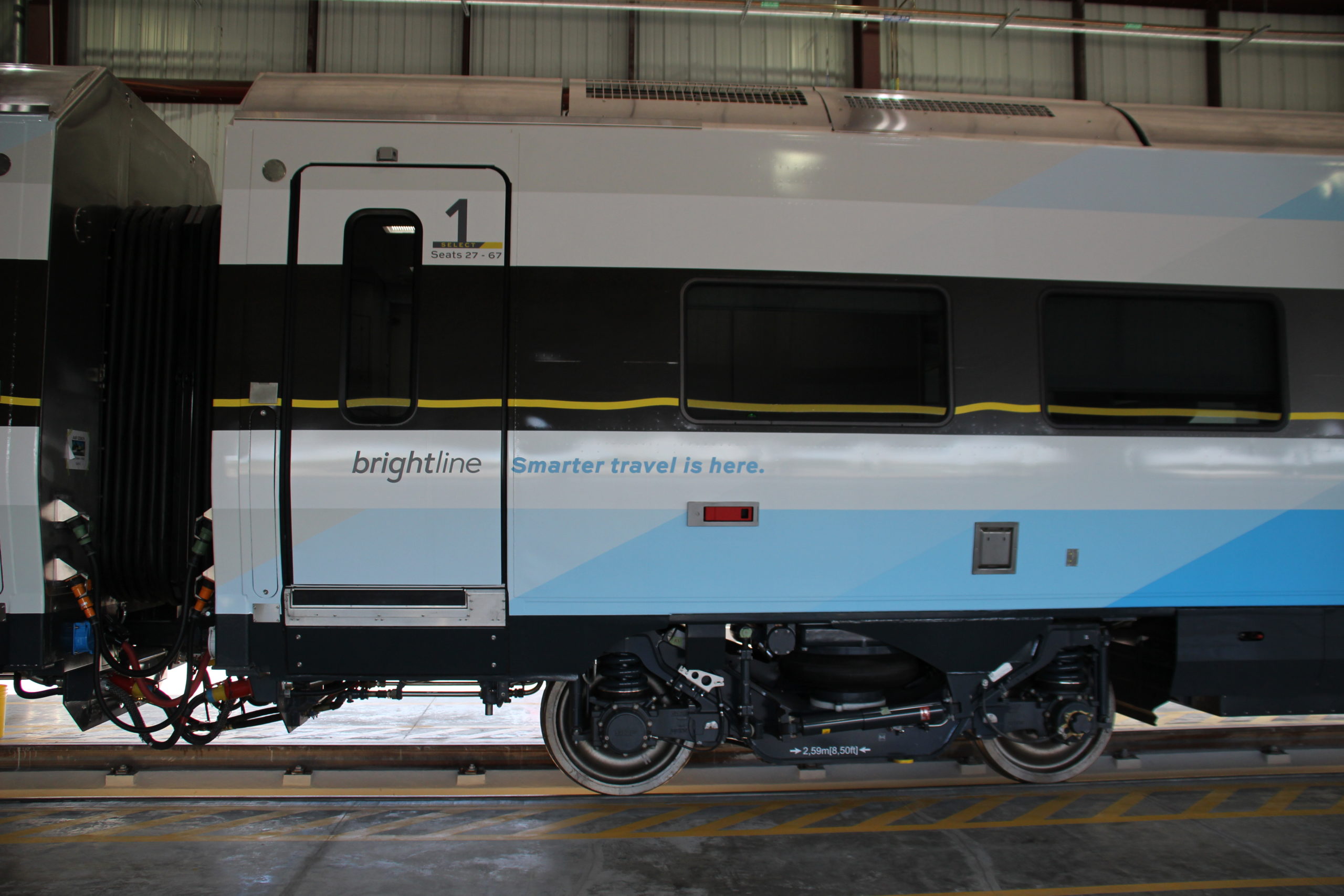
Despite Caltrans’ absence at the research board conference in Washington, panelists who helped develop or manage design work spoke about the bilevels. According to these experts, there had been 243 design changes, at that time, on the bilevel cars. Each change may require months to process or as little as two weeks for urgent production needs. Bilevel designs were also the first produced by the next generation committee. Designs now include locomotives, diesel multiple units, and single-level passenger cars. Single-level passenger cars Siemens built for Brightline passenger service reportedly follow the next generation committee’s basic designs.
Old money returned
Much of the order was funded by grants from the Federal government as part of the economic stimulus embodied in the American Recovery and Reinvestment Act of 2009. By law, the state consortium needed to spend the money, or at least begin receiving completed passenger cars, by Sept. 30, 2017 — or return unspent amounts to the U.S. Treasury.
According to a 2012 Caltrans news release, Federal officials earmarked $808 million for the Federal Railroad Administration to use on new passenger equipment of which $551 million was set aside specifically for bilevel cars.
“California’s share ($168 million) of the grants is supplemented by $42 million from Proposition 1B, a transportation bond approved by California voters in 2006,” according to the news release.
A California representative tells News Wire that Caltrans only had to repay about $1.2 million and that the state spent $17 million on the project that the agency will not have to return. That representative says the remaining balance due on California cars will be paid for with the bonding measure. News Wire has asked for confirmation from other states in the Midwest coalition — Illinois, Michigan, and Missouri — for details regarding their understanding of the funding.
In a statement to News Wire, an FRA representative confirmed that California and Illinois had replaced Nippon-Sharyo with Siemens.
“Since the ARRA funding deadline has passed FRA is unable to confirm the funding sources each state intends to use to complete the passenger car procurement,” the FRA representative wrote in an email.
Despite the problems, California officials insist Wednesday’s announcement was good news.
“This contract is moving full speed ahead and that is good news for Californians, both in terms of job creation and better passenger rail service,” Caltrans Director Malcolm Dougherty says in the California news release. “Caltrans and IDOT are ready for these new railcars to provide additional seating capacity for our busy trains and support planned improvements to passenger service.”
UPDATED: Full story write-through, Nov. 9, 2017, 3:05 p.m CT; FRA comment on funding. 3:41 p.m. CT