The governor did veto a provision declaring the act effective immediately.
“Given the complexity of this legislation, the Utilities and Transportation Commission [which has rail-safety oversight duties in Washington] needs time to engage stakeholders in a rule making process, which is necessary in order to implement the safety requirements of the bill,” Inslee wrote.
In delving into the two-crewmember-minimum issue, the Washington Legislature took on two controversies.
One of those is the issue of crew size and whether that makes a difference for safety.
State House Bill 1841 does offer exemptions to the minimum rule, for Class III railroads, or short lines, “operating on their roads while at a speed of twenty-five miles per hour or less.”
But it also says the utilities commission can order additional crew members “if it is determined that such an increase in staffing or the placement of additional crewmembers is necessary to protect the safety, health, and welfare of the public, passengers, or railroad employees, to prevent harm to the environment or to address site specific safety or security hazards.”
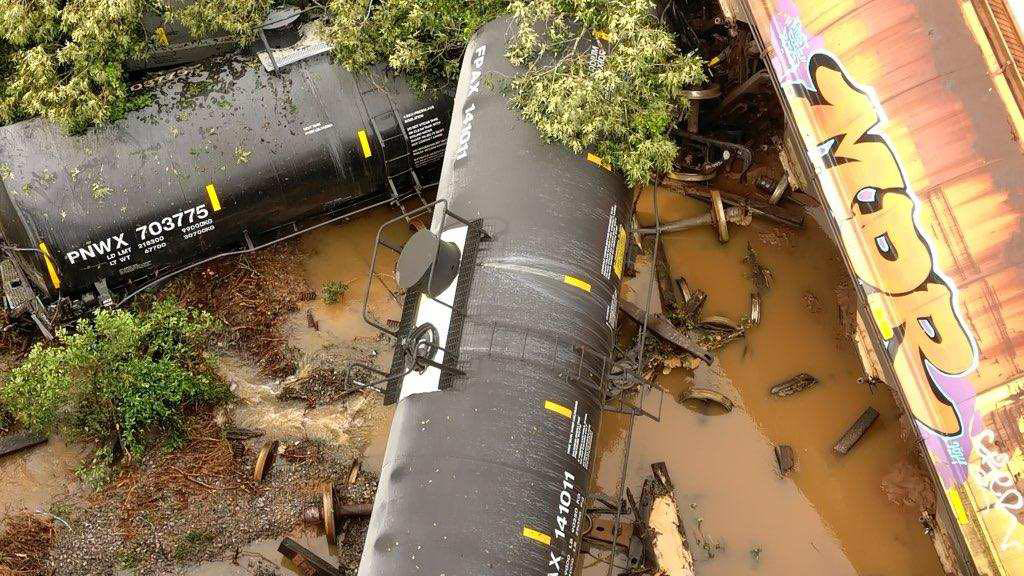
Of particular concern in Washington is crude oil by rail. The state has five oil refineries.
“Since 2009, Washington State has seen a dramatic in-crease in hazardous material trains (e.g., highly flammable crude oil and compressed gases),” the Brotherhood of Locomotive Engineers & Trainmen reported last year. “U.S. oil production is expected to increase 25 percent by 2025, and it is expected that much of this oil will be transported by trains.”
Train length is another concern.
“Class I railroads are regularly running freight trains in excess of 10,000 feet in the Western Washington corridor,” BLET said. “Recently a train in excess of 12,000 feet traversed the Columbia Gorge; 15,000-to 18,000-foot long trains regularly run in some areas. Longer trains mean longer waits at crossings for the public as well as emergency responders seeking to reach locations of calls for help. Ensuring a minimum crew size would help ensure workers could separate trains at crossings in the event of an emergency.”
The other issue is whether states like Washington have the legal authority to set train crew sizes.
A legislative report on House Bill 1841 notes that federal law requires “laws, regulations, and orders related to railroad safety must be nationally uniform to the extent practicable.”
States can enact rail safety regulations unless the U.S. Secretary of Transportation adopts a rule or issues an order on the subject, which pre-empts the state-level rule.
States can adopt a more stringent rule, the report adds, to cover a local safety hazard, so long as it doesn’t conflict with federal policy and doesn’t “unreasonably burden interstate commerce.”
Further muddying the regulatory waters on the subject of crew size, in May 2019 the Federal Railroad Administration issued a ruling that “all state laws attempting to regulate train crew staffing in any manner” are preempted. In December 2019 Washington’s attorney general filed suit against the FRA, arguing that the final rule should be vacated because the FRA did not follow procedural requirements and the rule is contrary to the law allowing for exceptions to preemption.
Railroads opposed the legislation; representatives of BNSF Railway, Union Pacific and Genesee & Wyoming, which operates several short lines in the state, testified at legislative hearings.