



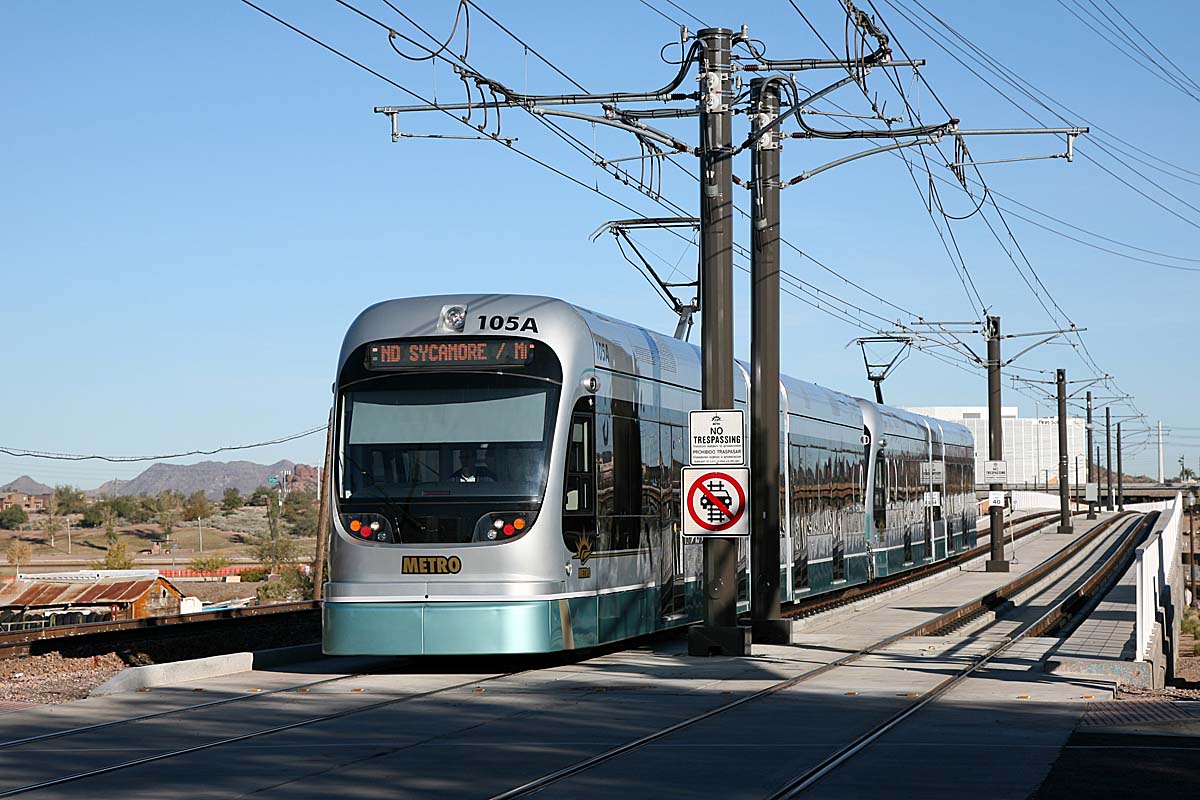
Among the projects at risk are the South Central extension and downtown transit hub, which recently received a $100 million grant from the Federal Transit Administration. Phase two of the Northwest extension and the Capitol/I-10 West extension would lose city funding as well, effectively killing both projects.
The measure, as worded, also prohibits funding “for the construction, development, extension or expansion of, or improvement to any light rail or any other fixed rail line transit system.” Plans for commuter rail and a proposed Phoenix-to-Tucson intercity service would die. Any possible return of Amtrak to Phoenix would be impossible if city funding were involved, as for a new or renovated station.
Transit advocates point out that the language of the ballot measure could even prevent replacing existing light rail cars as they age, which might be contested as an “improvement” to the system.
“Voters were wise when they voted not once, not twice, but three times to support light rail in Phoenix,” said Mayor Kate Gallego in her state of the city address on June 13. “But a small ideological group wants us to throw out years of economic development and reverse course with Proposition 105.”
Gallego says that light rail has created 35,000 permanent jobs and spurred $11 billion of investment along its line. Valley Metro carried nearly 16 million light rail riders in 2018.
The anti-rail measure began in reaction to the loss of two roadway lanes on Central Avenue, which were given over to the South Central extension. Some local business owners objected but failed to prevent the project from going forward.
Jeff Sherman, chair of the Downtown Voices Coalition, tells Trains News Wire that opponents “joined with anti-transit groups to oppose that line and then attacked all rail-based transportation in the city of Phoenix.”
Sean Sweat, president of the Urban Phoenix Project, says that a few wealthy landowners and some car dealerships provided money or support and were able to put Proposition 105 on the ballot. He claims they were also behind the demise of the planned West Phoenix extension.
A long list of light rail supporters in Phoenix is led by groups including AARP Arizona, the Arizona AFL-CIO, United Phoenix Firefighters, and the Greater Phoenix Chamber of Commerce.
“If Prop 105 were to pass, our region would lose roughly $5 billion in federal and regional funds to other cities,” writes David Skinner, co-chair of the Chamber. “If we want to continue to move forward and advance our region, we must support increased mobility and a robust transit system that encompasses a vibrant light rail system.”
The roster of rail opponents is far shorter. Fronting the fight for Proposition 105 is Building a Better Phoenix, registered as a political action committee with the city. Its website states that it is seeking to “stop the destructive $7 billion dollar expansion of light rail throughout the city of Phoenix.”
Susan Gudino, treasurer of the PAC, writing in the Sonoran Alliance, a self-described conservative political blog, states, “All we are trying to do is save our community from a stagnant permanent fixture that will increase crime, traffic congestion and bankrupt countless small businesses, many of which have been around for decades.”
Rail opponents argue that funds are better spent on roads and buses.
A campaign finance report filed with the city of Phoenix shows the PAC taking in $68,095 in contributions for the election cycle through June 30. Those opposing Proposition 105 may have a larger pool of money available, Sweat believes.
No polling is available at present, and the sources contacted say they have not seen any polls indicating voter sentiment on Proposition 105.
But neither polls nor money can foretell the outcome, as transit advocates in Nashville learned last year. Just a month prior to a vote on a referendum for a $5.4 billion transit plan, a Vanderbilt University poll showed most voters looking favorably on the proposal. It went down to a resounding two-to-one defeat.
For its part, Valley Metro says it is continuing work on all approved projects, which it notes is critical to meeting FTA requirements.
Sweat, of the Urban Phoenix Project, says, “Prop 105 is a direct attack even on the idea that we can turn Phoenix into a place that is much more sustainable and much more livable.”
The editorial board of the Arizona Republic, the state’s largest newspaper, urges a “no” vote on the proposition, calling light rail “a necessary cog in the public transit system.”