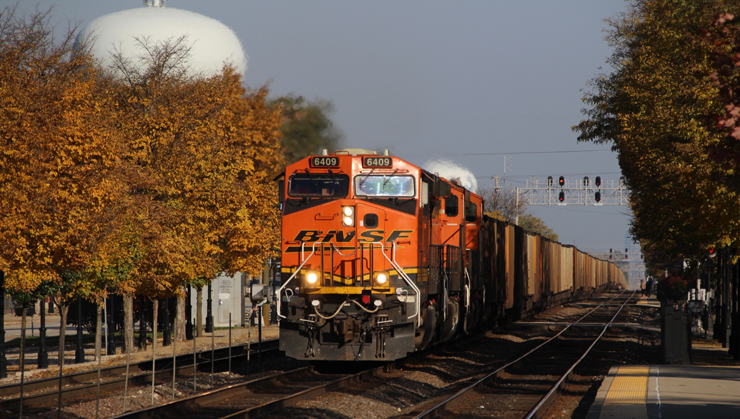
FORT WORTH, Texas — BNSF Railway reported higher third-quarter profits despite lower traffic volume and revenue.
BNSF’s operating income rose 3.3%, to $1.9 billion, even though revenue declined 2%, to $6 billion, according to a Nov. 1 regulatory filing by its corporate parent, Berkshire Hathaway.
The railroad’s operating ratio improved 1.9 points to 63.3% for the quarter despite the impact of flooding on some parts of its network.
All four of BNSF’s business segments experienced volume declines in the quarter as overall traffic slumped 2.6%.
Revenues from consumer products, which includes intermodal and automotive traffic, decreased 1.4% as volume sank 1.2%.
“Consumer Products volumes decreased primarily due to lower intermodal volumes, which were driven by overall lower demand and the availability of truck capacity as well as lower international intermodal market share,” BNSF said in its regulatory filing.
Revenues from industrial products were $1.6 billion, an 0.8% increase driven by higher revenue per carload. Industrial products volume was down 2.9%.
“Industrial Products volumes decreased primarily due to overall softness in the industrial sector, lower sand volumes, and reduced car loadings due to the aforementioned challenging weather conditions,” BNSF said. “This decrease was partially offset by higher demand for petroleum products and liquefied petroleum gas.”
Revenues from agricultural products increased 0.1% in the quarter, reflecting higher revenue per unit and a volume decline of 5.7%.
“Agricultural Products volumes decreased primarily due to export competition from non-U.S. sources, the impacts of changes in international trade policies, and the aforementioned challenging weather conditions,” BNSF said.
Revenues from coal decreased 6.8% due to lower revenue per unit and a 4% volume decline.
“Volumes were impacted by adverse weather conditions as well as from the effects of lower natural gas prices,” Berkshire Hathaway reported.
BNSF said its operating expenses declined 4.9% in the quarter due “lower volume-related costs, the effects of several cost-control initiatives, and a retirement plan curtailment gain, partially offset by the unfavorable impact of adverse weather conditions.”
BNSF said this year’s capital expense budget will be around $3.67 billion, or $100 million higher than previously disclosed.