BOSTON — To see what commuter rail in Boston might look like in the year 2040, you could look over the shoulders of those at the Massachusetts Department of Transportation who are at their computers, running sophisticated simulations that will soon reveal a picture of that future.
The project is known as Rail Vision, and it’s headed by Scott Hamwey, manager of transit planning for MassDOT. “By the end of this spring, we’ll be coming back to our advisory committee, our board, and the public to show the results of these analyses,” he says.
The two-year project comes when the commuter lines of Boston’s Massachusetts Bay Transportation Authority are losing ridership even as the region’s economy is booming, its population growing, and its traffic congestion is rated as the worst in the U.S. “Commuter rail is an asset that we can be better leveraging,” Hamwey tells Trains News Wire. “It’s a vast network of infrastructure and service, yet it only carries about nine percent of our passenger trips.”
The agency’s planning is also driven by the upcoming expiration of the MBTA’s operating contract with Keolis Commuter Services in 2022. The state’s procurement process will begin next year, and Hamwey explains that the next contractor will have to operate trains around a lot of changes and construction. The study will help inform the contract bidders.
One of the first steps in the Rail Vision process was to conduct a peer review of 16 U.S. and international commuter rail systems, ranging from New York to California and Paris to Singapore. Of those, only two other systems operate solely with diesel-powered trains, and one of those — Caltrain — is in the process of electrifying its system. No Boston commuter rail line is electrified, although that option is open.
Most other systems provide more frequent train service and operate in higher-density areas. “One of the big things we learned is that our network is unique in its geographic scope relative to how big the urban environment is that it serves,” says Hamwey.
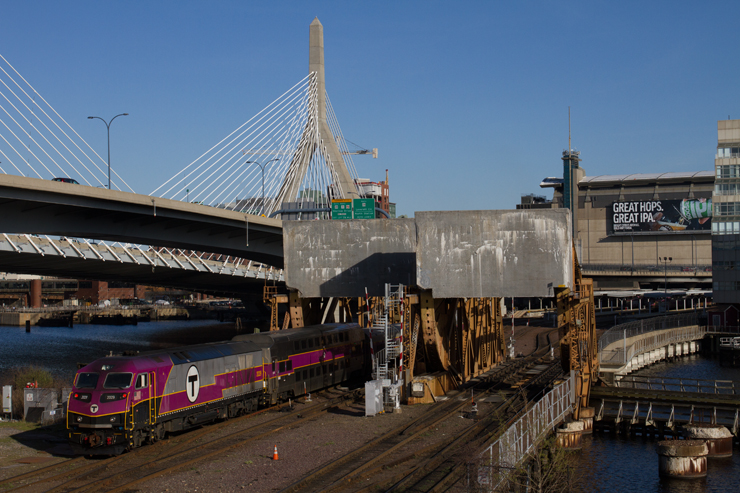
Commuter rail in Boston runs from two major terminals, North Station and South Station, radiating out along 14 rail lines. The system covers 388 route-miles and serves 138 stations, cobbled together from the remains of railroads past: the New York, New Haven & Hartford; Boston & Maine; Boston & Albany; New York Central; and Penn Central.
Recently, Hamwey’s team provided seven alternatives for public comment and review by the advisory board. The simplest seeks only to optimize the existing system with more frequent service at 30 or 60 minute intervals in both directions, bringing some order to the randomness of current schedules.
Two plans are referred to as regional rail alternatives, which would provide serve key stations such as Fitchburg, Lowell, Route 128, and Braintree at 15-minute intervals, while intermediate stations would see trains every 30 or 60 minutes. Of these two options, one envisions full electrification of the commuter rail system with service provided by electric multiple-unit (EMU) equipment.
A different pair of options are the urban rail alternatives. They are designed to provide frequent, all-day service to inner-core stations. Those stations would be served by either diesel multiple-unit (DMU) or EMU trains. Those plans also require adding track capacity to South Station to handle the additional train frequency.
The most expensive plan includes full system electrification, combines both urban rail and regional rail, and construction of the North-South Rail Link to allow run-through service between the city’s two terminals. Finally, a seventh alternative treats each line independently, tailoring service to match specific needs for those commuters, and includes South Station expansion.
This is where the computer simulation comes in: to put more detail and analysis into each option. A first pass looks at each plan against the existing infrastructure. Will stretches of single track limit train frequency? How will current station capacity, signal systems, and interlockings affect proposed operations? The answers will reveal, as Hamwey phrases it, whether these plans will work “in the real world.”
A second model incorporates projected population and employment growth by 2040, detailed down to thousands of small zones. Then, a forward-looking simulation, which Hamwey calls the Regional Dynamic Model, “will give us some sense of how economic activity in the region might shift in response to transportation investment.” Understanding how one affects the other will reveal a more complete picture of what 2040 will look like.
The results of these model runs will also show the estimated costs for needed infrastructure development and predict how each would effect changes in ridership.
These simulations are already running and will continue through the spring. “Then we need to have a conversation over the second half of the year to figure out what the vision is that the authority and the Board will move towards,” Hamwey explains. He says the most likely outcome will be some combination of elements from the seven alternatives.