Becoming acquainted with Robert Sherman, the talented and kind-hearted artist affiliated with Lionel and Diorama Studios, stands as a highlight of my career at Classic Toy Trains. Though frail when we met in the early 1990s, Bob eagerly shared stories of his contributions to the postwar consumer catalogs as well as his involvement with the design and construction of the 16 x 32-foot O gauge empire that opened at the Lionel showroom in New York City in the spring of 1949.
Bob told Editor Dick Christianson, Associate Editor Jim Bunte, and me about his contributions to what Lionel enthusiasts generally consider the greatest and most influential public display layout of the postwar era. We asked him if he could summon his recollections and skills to create a brand-new, highly detailed color illustration of the 1949 Showroom Layout. Bob quickly agreed to do so.
Shortly thereafter, Bob presented us with three pieces of new artwork in which he posed a trio of iconic locomotives in nostalgic scenes. We were thrilled to see how this esteemed illustrator had glorified the Nos. 773 4-6-4 Hudson steam engine, 2332 Pennsylvania RR GG1 electric, and 2333 Santa Fe F3 diesel.
But what was a prewar station doing on the watercolor showing the 773? Bob understood the paintings were supposed to salute the trains and accessories of the early part of the postwar period. Yet he had placed a No. 137 Station next to the main line. Then I realized his affinity for that little structure had surfaced long before. His track plan and some vintage photographs show what I had discovered.
Old-timer ducks in
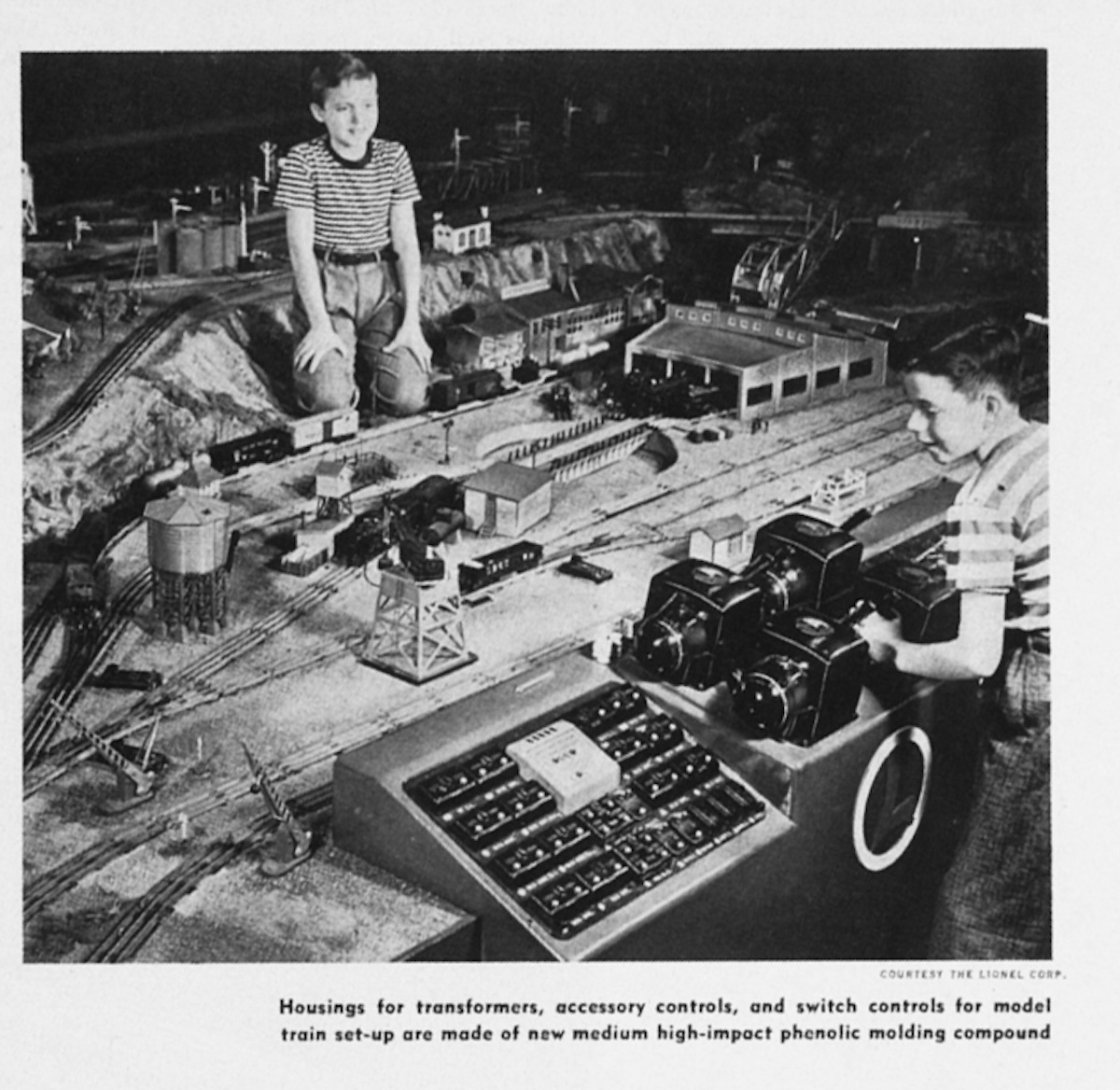
The May 1950 issue of Modern Plastics included an article about the use of phenolic plastics in model train equipment. The essay, bursting with technical terms and product numbers and names, led off with a black-and-white photograph intended to show how “medium high-impact phenolic molding compound” was being used by Lionel for transformers and the controllers of assorted accessories.
A pair of youngsters posed for the photograph taken in the Lionel office in New York. Studying the scene on the eastern side of the new showroom layout helped me make an important discovery. Next to the left arm of the little boy perched on the model railroad, just as plain as day, I could see a 137 Station.
I was puzzled by the presence of the white-painted sheet-metal structure with a red-painted roof. I checked reference guides on Lionel accessories, and they confirmed the 137 had not been cataloged after 1942. There was no reason for Bob Sherman or his colleague, Art Zirul, to have put a 137 on the new layout.
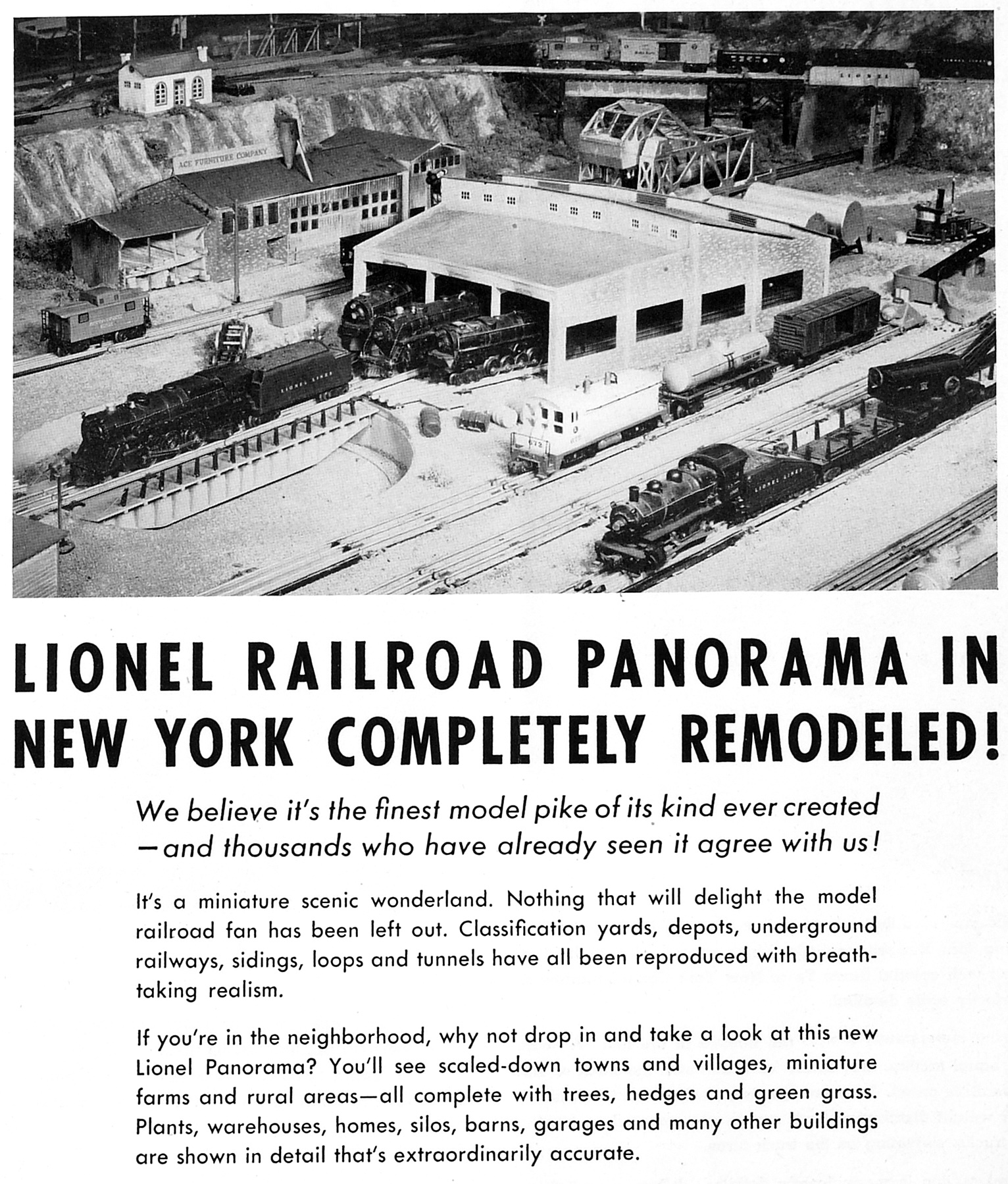
To corroborate what I had spied, I dug up a few other photographs taken by William Vollheim of the 1949 Showroom Layout during its first few years. Each of them, in particular the shot included in the April 1949 issue of Model Builder (a magazine published by Lionel to promote its products and the whole hobby of model railroading), left no doubt that there was a 137 smack in the middle, high on the elevated section, where few viewers could have missed it.
Further confirmation of what I was looking at came when I went over the track plan Bob had finished for the February 1992 CTT. What he illustrated was a 137, despite the fact that it wasn’t listed among the items installed on the layout.
Automatic Train Control
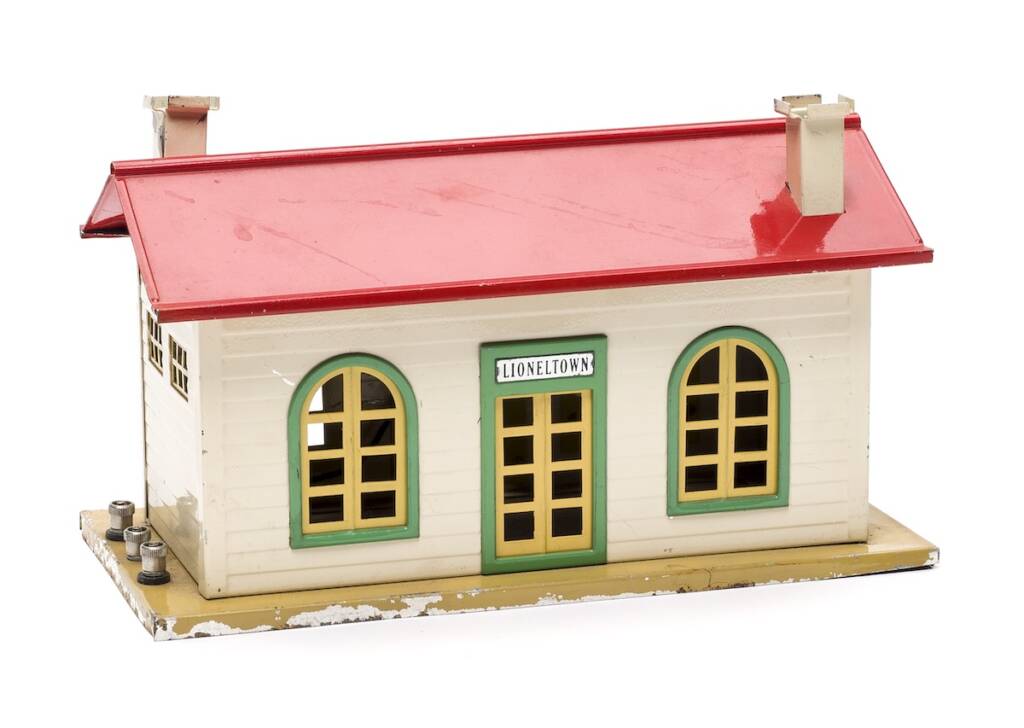
Was the 137 something special to Bob? Unfortunately, I never had the foresight to ask him about the curious choice of a prewar station on a postwar display. But I recalled how for the watercolor executed for CTT he intentionally depicted the 773 Hudson coupled to streamlined passenger cars parked by what was unquestionably a 137 rather than either of the two stations (Nos. 115 and 132) cataloged in the years around Lionel’s golden anniversary year of 1950.
Something about the 137 must have struck a chord with Bob. Trusting his judgment, I set out to learn more about the small structure with a whimsical look.
To begin, the 137 was one among several stations cataloged by Lionel in the last years of the prewar era to be equipped with “Automatic Train Control.” That feature, standard on Lionel stations since 1935, controlled the movement of a train. Specifically, it caused a train to come to a halt without any manipulation of a transformer. After about 30 seconds, the train suddenly and magically took off.
The key, as toy train historian Peter Riddle explains, was a flexible thin bar composed of two strips of metal having different expansion qualities. When heat created by track power was applied to what he called “a bimetallic strip” wrapped in resistance wire, the greater expansion of one side caused it to bend.
Bending the bimetallic strip, in turn, closed a set of contacts. That change directed electrical current to the “dead” center rail of an insulated track section. Live again, the block sent current to the locomotive of the train. Newly energized, the train left the station. The bimetallic strip, meanwhile, having lost the heat it required for energizing, straightened out and redirected power from the third rail.
Updating a favorite
The 137 represented an updated version of the No. 127 Station, which had joined the Lionel roster in 1923 and been cataloged through 1936. That structure featured walls embossed to look like clapboard siding, two chimneys, two arched windows, two rectangular windows, and a round vent window under each gable. Over each of its two door frames appeared a sign neatly lettered “Lioneltown.” Along the way, the 127 was modified with the parts for Automatic Train Control.
Decision makers at the firm elected to drop the 127 from the line after 1936. They substituted a minimally altered version in 1937 designated as the 137 Station. The virtually identical structure remained in the catalog through 1942. Then came a mandate from the federal government halting toy train production.
Consumers had liked Automatic Train Control before the war, so leaders at Lionel likely wished to revive it once all governmental restrictions had been removed. Consequently, though the abbreviated list of products offered for sale in 1945 had no stations, the full-scale line announced for 1946 had the 115 and 137.
In a surprise, after showing the latter station in the new consumer catalog, top executives decided not to produce it. A price sheet for Lionel trains released later in the autumn of 1946 stated of the 137: “will not be made in 1946.”
But a different document, issued with a date of 3-46, supported the idea that Lionel did plan to market the 137 in 1946. The instruction sheet packed inside each box holding a 115 Station noted it was applicable as well to the 137.
What happened?
This information leads to two conclusions. First, either Lionel originally decided to manufacture the 137, only to reject that choice much later in the year. Or leftover inventory of the station remained at the Lionel factory in northern New Jersey, enough to justify listing the 137 in the new consumer catalog and instruction sheet. Producing brand-new inventory was not, however, feasible.
Another reason Lionel’s leaders might have abandoned the 137 related to the possible release of a replacement. Sources from 1946 suggest they had hoped to have the No. 132 Station ready to produce and market. If such a development had occurred, then Lionel would have had a logical successor to the old 137.
Yet 132 did not join the line until 1949. Maybe production supervisors at the plant found out there were issues with using newly created injection-molded plastics to mass-produce the new station. They might have been forced to delay it for several months, long after the new layout in the showroom had to be ready.
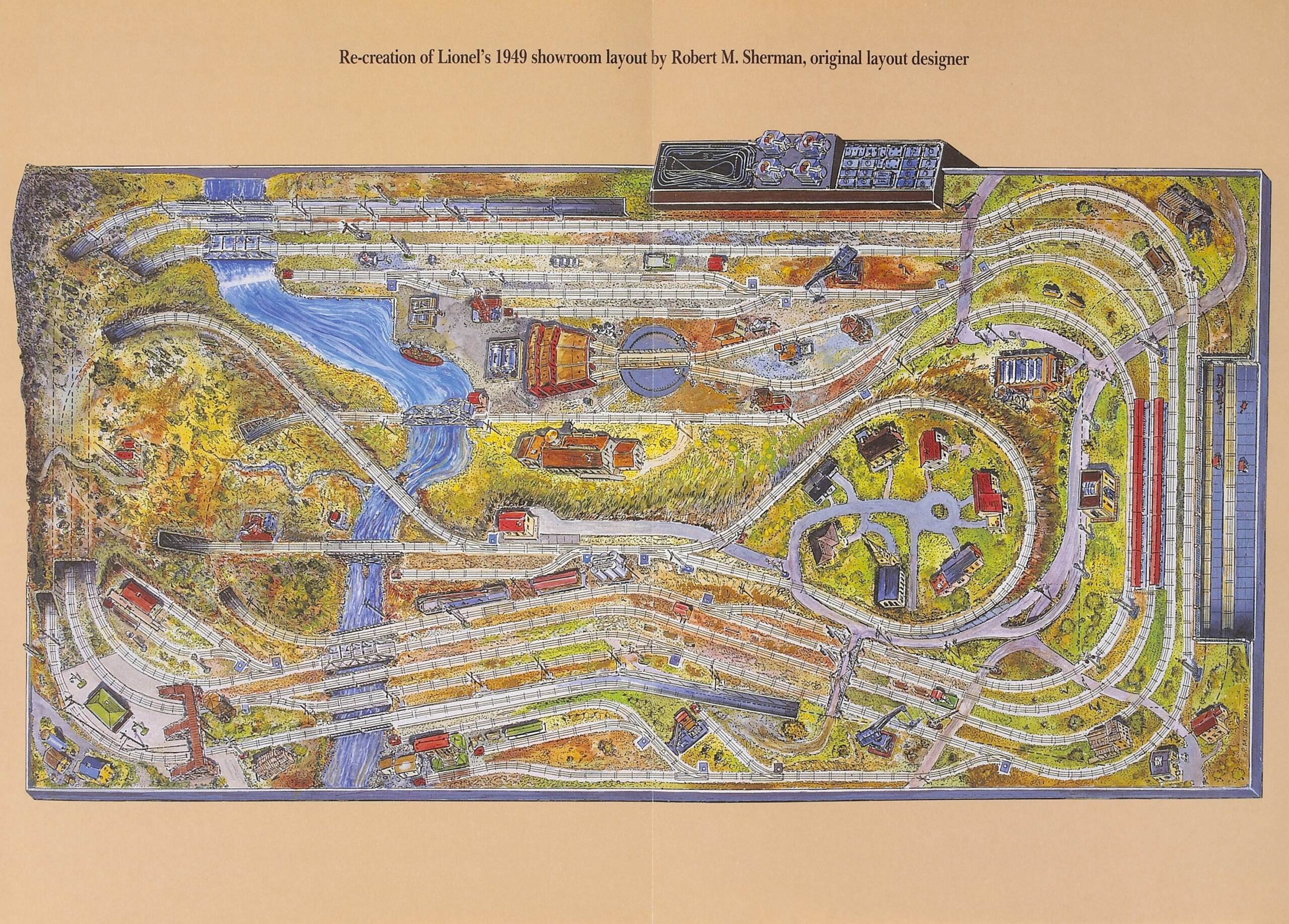
In need of something small and colorful to place on the hill overlooking the rail yard and roundhouse dominating the eastern side of the layout, Bob Sherman remembered how much he liked the 137 and decided to put one there. The choice made good sense, and visitors were sure to enjoy seeing the familiar structure. One more case in which Bob Sherman knew what Lionel truly needed.
Like this article? Read more stories like this one in our special issue, Display Layouts & Showrooms.