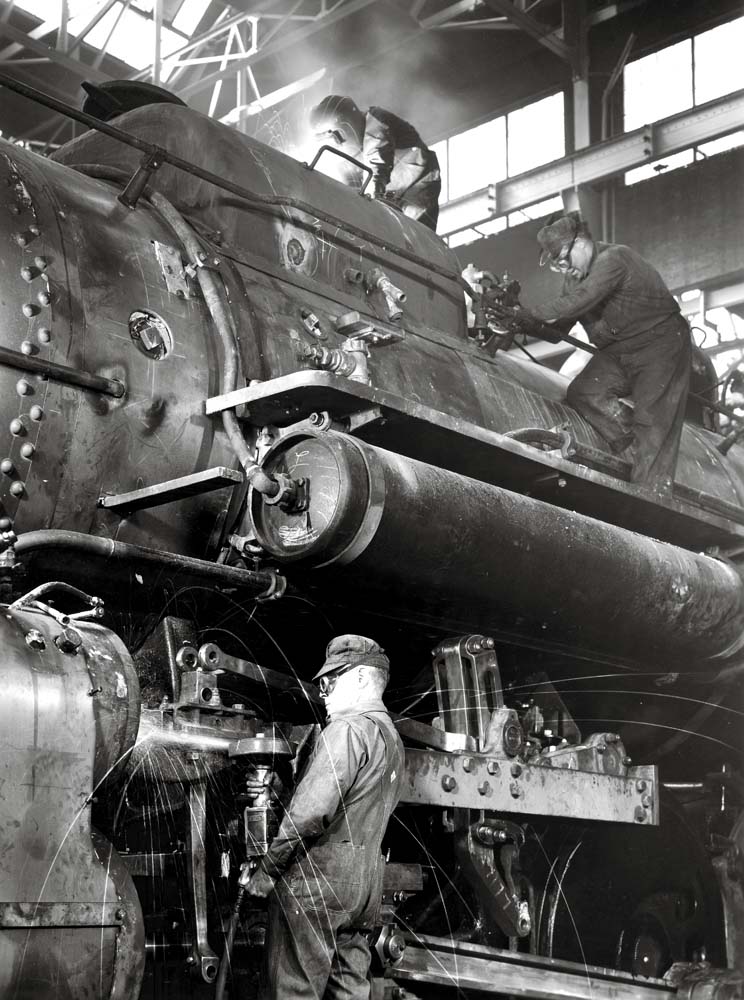
Way back in 1940, I took a fling at railroading. After ditching art school, I went to work for the Alton Railroad at its roundhouse at Glenn Yard in southwest Chicago. My job was mechanic’s helper.
One of my duties was to tighten the bolts on locomotive cylinder heads. I attacked the task with vim and vigor and a large wrench, all the time dreaming of my future as a railroader. I applied full torque on a bolt, and crack!—the doggone thing broke off flush with the cylinder head.
What to do? I decided to confess my error to my boss, the mechanic. He looked at my achievement and turned to me, saying, “Get the old man.”
I was aghast at the possibilities of what he ordered me to do, so I ventured, “Are you telling me to get the old man?”
His reply seemed rather offhand, “Yes, go get the old man, boy.”
Better I should not question him further, I thought. I walked to the roundhouse foreman’s office, fearing that I might be fired, or worse. Here I was, a new helper, holding up the progress of getting a locomotive back on the road, and I had to get the old man. And I was sure he wouldn’t want me to address him as the “old man.”
I knocked on the office door and was called in.
“Sir,” I said, “the mechanic wants to see you.” I don’t exactly recall what he answered, but it was something like, “What does he want me for?”
Putting off the inevitable as long as I could, I replied, “He just told me he wanted you to come see him.”
Using certain words I didn’t understand too well, the foreman marched to the scene of my disaster and asked, “What do you want?”
“I don’t want anything,” the mechanic replied.
“The kid said you wanted to see me,” the foreman retorted.
The reply astounded me: “I don’t want to see you.”
Both men turned to me, and the mechanic asked, “What did I tell you to do?”
I gulped, and in a rather subdued voice answered, “You told me to get the roundhouse foreman.”
“That wasn’t what I told you. Now what did I tell you?”
This wasn’t going well at all. “You told me to . . . get . . . the . . . old . . . man.”
Both men howled with laughter. After the laughs subsided, I was introduced to a revelation. The “old man” was a tool used to drill out broken bolts. After drilling into the body of the bolt, a reverse thread was cut and a left-handed-threaded bolt was used to thread out the offending bolt.
Such was my introduction to the vernacular of railroaders.
Get the old man. I got it!
Learn more about railroad history by signing up for the Classic Trains e-mail newsletter. It’s a free monthly e-mail devoted to the golden years of railroading.