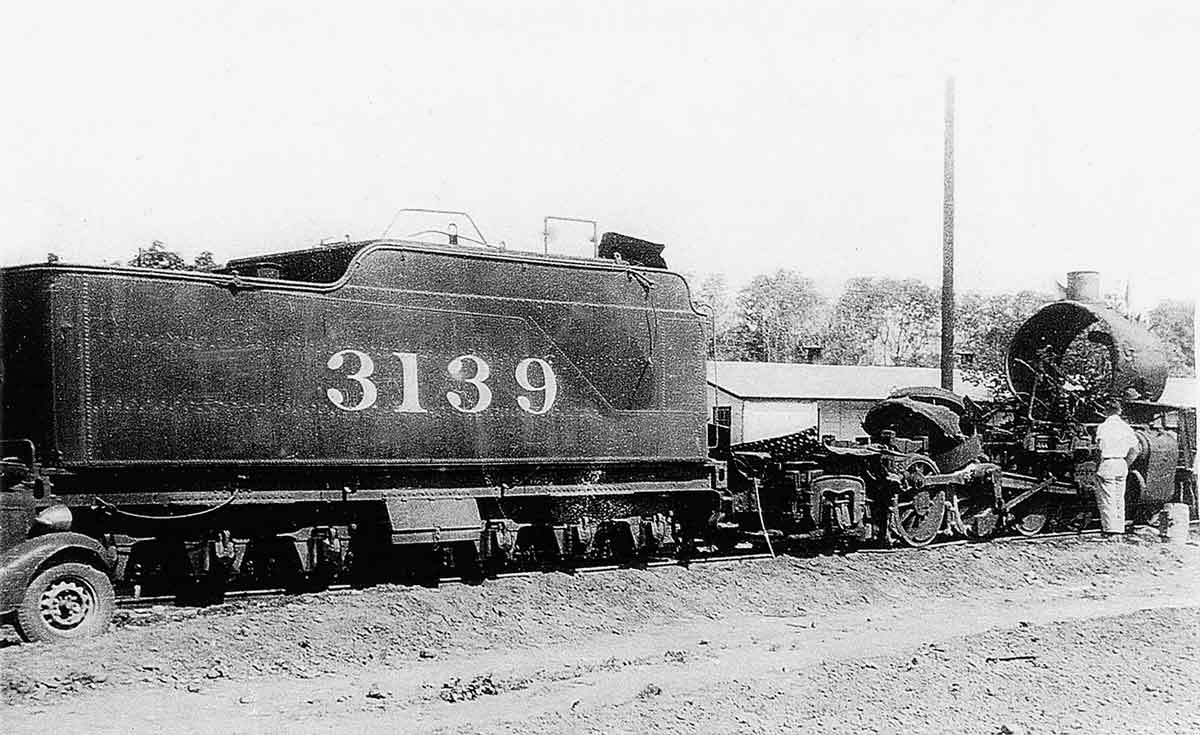
The boiler explosion at Serra, Calif., that destroyed Mikado 3199 and killed its watchman took the classic form of such incidents, with the boiler being catapulted hundreds of yards from the running gear.
Jack O. Elwood coll.
During the era of steam locomotives, many of us in engine service loved those gallant machines, but we were also very aware of the inherent dangers associated with them. They required constant attention, always keeping in mind the destructive forces held at bay. Prudent adherence to safety practices at all times was essential.
This story takes place at a small station named Serra on the Santa Fe Railway’s Los Angeles–San Diego line. One Saturday in the early 1950s, a work train, its work done for the day, was parked on an auxiliary track at the station. As a steam locomotive—oil-fired Mikado No. 3139—was the power for the work train, it was necessary to have an engine watchman present to keep steam pressure up during the time the work train was not working and the crew was getting their rest. The engine watchman’s job was not very desirable, and consequently fell to the lowest fireman on the seniority list.
The station at Serra was a picturesque little structure of white stucco with a red clay tile roof, located on the west end of a sweeping 50-mph curve, with the first panoramic view of the Pacific Ocean that one gets from the train as the railroad joins the surf on its way to San Diego.
The young engine watchman, sent down from Los Angeles, arrived at Serra on Saturday evening to watch the work train engine for Saturday night and Sunday. The engine had to be ready to go to work early Monday morning. The watchman’s duties were minimal, keeping pressure at a workable level, water in the boiler, and supplying the engine with sand and lubricating oil. Steam pressure was maintained by periodically starting up the fire, building up steam pressure so that the water injectors would work to supply water to the boiler, then putting the fire out. The engine then needed little attention for two or three hours as its steam pressure and boiler-water level slowly dropped. Then the procedure would be repeated to build up steam and boiler-water level again. (Unlike coal-fired engines, oil-burners can have their fires started or extinguished quickly.)
The job was boring. A young man might be tempted to briefly slip away from his post in search of some diversion, yet there surely was not much going on at Serra on a Saturday night. However, on the big Marine Corps Air Base at Irvine, a station about seven miles west of Serra, there was a USO dance on Saturday nights.
The young fireman at this point apparently decided—contrary to railroad rules—that he could build up steam pressure and fill the boiler with water, put out the fire, and leave the engine for a few hours. He could drive to the Marine base, spend a couple of hours at the dance, and get back to the engine in time to build up the steam pressure that had leaked down.
The exact sequence of events, and the duration of the watchman’s absence, will never be known for sure. But what apparently happened is that when he returned to the locomotive, he got up into the cab and noticed the steam pressure had dropped considerably. He immediately started the fire in the firebox to start rebuilding the steam pressure. Either he did not check the water level in the boiler, or he thought he could see water in the water glass gauge without checking the positive gauge cocks. Sometimes the water glasses would get stopped up with boiler sediment and register a higher-than-actual water level.
With a big fire going, the crown sheet of boiler firebox attained a very high temperature. At this time, the fireman decided to start the injector to replenish the water supply to the boiler. The injector syphons water from the locomotive tender—which is very cold relative to the boiler interior—into the boiler to produce steam.
Most everyone knows what happens to drops of water that fall into a hot skillet on the stove; imagine this reaction magnified thousands of times. When the cold water hit the white-hot crown sheet of the boiler, there was a tremendous explosion. The boiler separated from the frame and traveled through the air like a giant projectile. It hit the roof of the Serra depot, tore off the top of the roof, and landed about 200 yards away from where the locomotive was. The track under the engine was blown away, forming a large crater. Parts of the locomotive were strewn around in all directions. Needless to say, as is nearly always the case with boiler explosions, the young engine watchman did not survive this violent destruction.
Boiler explosions were rare in the later decades of the steam era, yet they were grimly memorable. I passed the scene of this accident the next day on train N076 to San Diego. The destruction and tremendous power of the explosion, the only one whose aftermath I ever witnessed, remains vivid in my memory today, several decades later.
This story takes place at a small station named Serra on the Santa Fe Railway’s Los Angeles–San Diego line. One Saturday in the early 1950s, a work train, its work done for the day, was parked on an auxiliary track at the station. As a steam locomotive—oil-fired Mikado No. 3139—was the power for the work train, it was necessary to have an engine watchman present to keep steam pressure up during the time the work train was not working and the crew was getting their rest. The engine watchman’s job was not very desirable, and consequently fell to the lowest fireman on the seniority list.
The station at Serra was a picturesque little structure of white stucco with a red clay tile roof, located on the west end of a sweeping 50-mph curve, with the first panoramic view of the Pacific Ocean that one gets from the train as the railroad joins the surf on its way to San Diego.
The young engine watchman, sent down from Los Angeles, arrived at Serra on Saturday evening to watch the work train engine for Saturday night and Sunday. The engine had to be ready to go to work early Monday morning. The watchman’s duties were minimal, keeping pressure at a workable level, water in the boiler, and supplying the engine with sand and lubricating oil. Steam pressure was maintained by periodically starting up the fire, building up steam pressure so that the water injectors would work to supply water to the boiler, then putting the fire out. The engine then needed little attention for two or three hours as its steam pressure and boiler-water level slowly dropped. Then the procedure would be repeated to build up steam and boiler-water level again. (Unlike coal-fired engines, oil-burners can have their fires started or extinguished quickly.)
The job was boring. A young man might be tempted to briefly slip away from his post in search of some diversion, yet there surely was not much going on at Serra on a Saturday night. However, on the big Marine Corps Air Base at Irvine, a station about seven miles west of Serra, there was a USO dance on Saturday nights.
The young fireman at this point apparently decided—contrary to railroad rules—that he could build up steam pressure and fill the boiler with water, put out the fire, and leave the engine for a few hours. He could drive to the Marine base, spend a couple of hours at the dance, and get back to the engine in time to build up the steam pressure that had leaked down.
The exact sequence of events, and the duration of the watchman’s absence, will never be known for sure. But what apparently happened is that when he returned to the locomotive, he got up into the cab and noticed the steam pressure had dropped considerably. He immediately started the fire in the firebox to start rebuilding the steam pressure. Either he did not check the water level in the boiler, or he thought he could see water in the water glass gauge without checking the positive gauge cocks. Sometimes the water glasses would get stopped up with boiler sediment and register a higher-than-actual water level.
With a big fire going, the crown sheet of boiler firebox attained a very high temperature. At this time, the fireman decided to start the injector to replenish the water supply to the boiler. The injector syphons water from the locomotive tender—which is very cold relative to the boiler interior—into the boiler to produce steam.
Most everyone knows what happens to drops of water that fall into a hot skillet on the stove; imagine this reaction magnified thousands of times. When the cold water hit the white-hot crown sheet of the boiler, there was a tremendous explosion. The boiler separated from the frame and traveled through the air like a giant projectile. It hit the roof of the Serra depot, tore off the top of the roof, and landed about 200 yards away from where the locomotive was. The track under the engine was blown away, forming a large crater. Parts of the locomotive were strewn around in all directions. Needless to say, as is nearly always the case with boiler explosions, the young engine watchman did not survive this violent destruction.
Boiler explosions were rare in the later decades of the steam era, yet they were grimly memorable. I passed the scene of this accident the next day on train N076 to San Diego. The destruction and tremendous power of the explosion, the only one whose aftermath I ever witnessed, remains vivid in my memory today, several decades later.
First published in Spring 2009 Classic Trains magazine.
Learn more about railroad history by signing up for the Classic Trains e-mail newsletter. It’s a free monthly e-mail devoted to the golden years of railroading.