

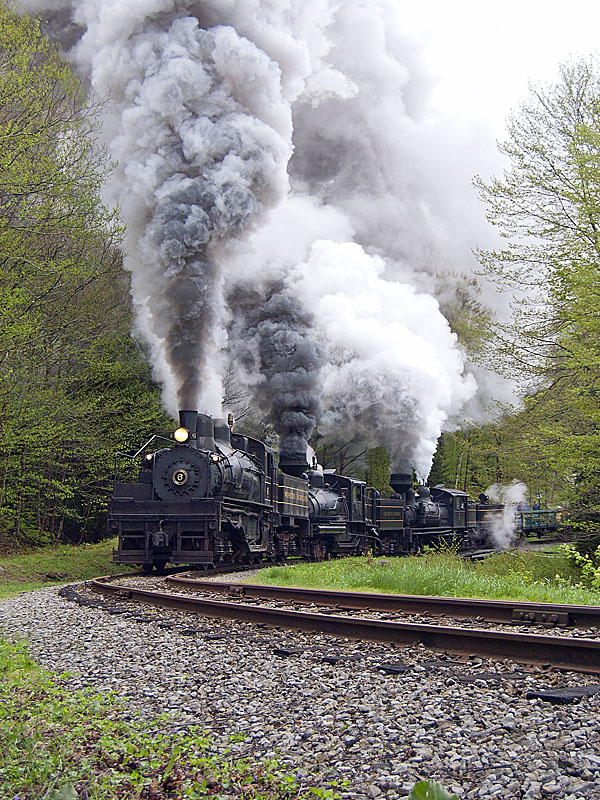
A: We get asked this question from time to time, and fortunately the answer remains unchanged: “In the days of steam, when helpers were used, these locomotives were on the front, and at times, middle and end of the trains. The lead engine or helper engine controlled the brakes for the train.
“Engineers on those locomotives had to be able to communicate both day and night and around curves when the various engines were not in sight of each other; thus whistle signals were used to make sure all the brakes were applied and released uniformly. It was up to the engineer on the helper engine to use a series of whistle signals to tell the other engineers when he was applying and releasing the train brakes. The engineers on the individual engines used their own independent brakes according to the whistle signals they received.
“Although the need for whistle or horn communication died out with the advance of single crews on m.u.’ed diesel locomotive consists, the signals are still used in tourist and heritage operations. — Martin E. Hansen, steam operator and historian, Bend, Ore.”
(Answer originally published in August 2014)