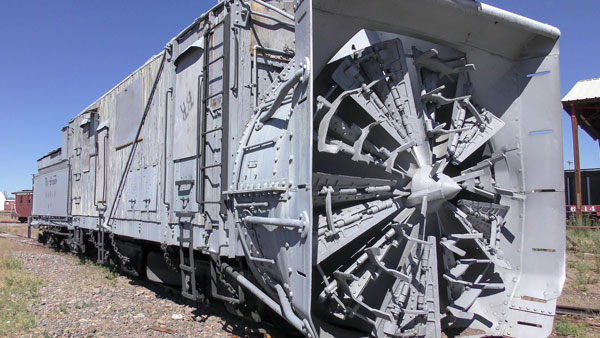
ANTONITO, Colo. — Cumbres & Toltec Scenic Railroad moved its rotary snowplow OY in preparation for its 50th anniversary of the operations in 2020. In June, the railroad moved it from Chama, N.M., to Antonito, Colo., for rehabilitation. The goal is for OY to once again clear snow on the 64-mile track between Chama and Antonito, a duty which it has not performed since 1997. The rotary plow is poised to operate as part of a photo excursion train on Feb. 29 and March 1, 2020. The excursion is sold out, with more than 500 people on the waiting list.
American Locomotive Co. built rotary plow OY in 1923 and delivered it to the Denver & Rio Grande Western Railroad. The tender was from an old D&RGW steam locomotive. OY was stationed in Alamosa for use on the eastern portion of the Cumbres Pass while her sister plow, OM, was stationed in Chama.
“If this thing has 90 days of service on it since it was built in 1923, I’d be very surprised,” says Stathi Pappas, director of special projects for the C&TS. “We are very fortunate because there really isn’t a whole lot of work that really needs to be done to make it operable, just a lot of cosmetic work, and of course, doing the boiler inspection. Since this is a piece of work equipment, we have spoken with the Federal Railroad Administration about what they feel comfortable with. Even though we don’t have to completely strip this boiler down, we’ve still done our due diligence to make sure that it is safe and suitable for service. Amazingly, this pressure vessel is at blueprint spec for thickness. With so few days of service and having been stored dry all the time, it is in incredibly good shape.”
Temporary plywood covers the window and door openings, while workers build new windows and doors. The existing roof has failed, contributing to carbody deterioration, so a new soldered seam roof will be installed, providing about a hundred years of protection.
Even though the rotary plow is basically a locomotive in a boxcar, it isn’t self-propelled. At least one steam locomotive has to push the plow. Steam generated in the boiler operates front-facing cylinders that drive a jackshaft. The jackshaft has a big bull gear that turns the rotary shaft. The engineer sits on the engineer’s side of the boiler, just like in a steam locomotive, while a fireman feeds the boiler. One or two people in the wheelhouse communicate with the engineer and the pusher locomotive via whistle signals. There’s also an electric telegraph with an annunciator back to the engineer and fireman.
“You had tool racks built into this because when you are going out fighting snow on the pass, it might be a day’s job, it may be a week’s job, or it may be a two-week job,” Pappas says. “It’s more like being on a ship at sea than it is being on a railroad heading for a terminal. You didn’t know how far you were going to get, and you needed to be ready for just about everything. It came with its own cook car, it came with its own sleeping accommodations, it came with its own auxiliary water cars, and it came with its own drop-bottom gondolas that had coal. The rotary train was meant to go out and do battle as long as it took to get the job done.”