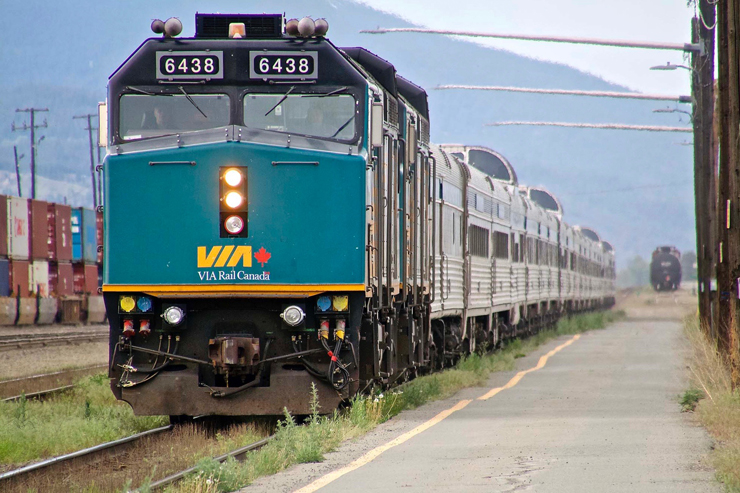
VANCOUVER, British Columbia — VIA Rail Canada’s revised schedule for its trancontinental Canadian is meeting with mixed success.
In lengthening and adjusting the schedule at the end of April [see “VIA’s summer shuffle,” July TRAINS], VIA sought to ensure that the company’s flagship would pass through the Canadian Rockies in daylight, even if subjected to hours-long delays by construction and infrastructure improvements of host railroad Canadian National.
So, from the day that the new schedule took effect at the beginning of May, Trains News Wire has tracked each twice-weekly cross-country Canadian — as well as the weekly short-turn Vancouver-Edmonton, Alberta, round-trip — to see how the train performs with so much slack in the schedule.
Here are some early takeaways:
Mountains in daylight? Success! While en-route delays routinely averaged about 4 hours over at least a portion of the route, every train managed to avoid darkness on the route’s peak segment west of Jasper, Alta. That included westbound No. 1, departing Toronto June 9, that was delayed about 24 hours by a forest fire near Capreol, Ont. Though it departed Jasper over 31 hours late, it benefitted from summer’s long days. On the other hand, 15 of 21 westbound trains through June 19 left Jasper on time or within an hour of the scheduled 9:30 a.m. departure. Eastbound Jasper arrivals scheduled for 10 a.m. ranged from an hour early to 8 hours late (for the June 14 departure delayed by the day-late train noted above), but those travelers got to see more of the route from Kamloops usually seen in sunlight only by Rocky Mountaineer tourists.
Winnipeg and Edmonton suffer: Unfortunately, on-performance compared with the schedule resembles an accordion, with the biggest variation at intermediate stations. Here are some staggering examples:
Winnipeg eastbound:
Scheduled arrival: 10:00 p.m.
Actual range: 8:46 p.m. to 7:01 a.m.
Arrivals between midnight and 7 a.m.: 10 of 15.
Edmonton westbound:
Scheduled departure: 12:01 a.m.
Actual range: 12:01 am to 8:25 a.m.
Departures between 1 a.m. to 5 a.m., train No. 1: 6 of 15.
This unpredictability has substantially diminished the train’s utility for providing transportation to communities along the route. At Saskatoon, Sask., for instance, the eastbound train is supposed to leave at 6:57 a.m,. but actual departures during the period have ranged from 7:24 a.m. to 6:05 p.m.
Early Vancouver arrival: For travelers deciding which direction to ride, keep in mind that VIA’s desire for dependability makes the Vancouver scheduled arrival at 8:00 a.m. a “worst case scenario,” meaning that arriving sleeping car passengers don’t have the benefit of waking up on a moving train. VIA says people can stay on board until the scheduled arrival time, but here’s the actual range of arrivals for train No. 1 from Toronto and No. 3 from Edmonton:
Trains arriving:
Before 6 a.m.: 12
Between 6-8 a.m.: 4
Between 8-10 a.m.: 3
After 10 a.m.: 2
Trains News Wire will continue to monitor the Canadian’s performance through the summer.