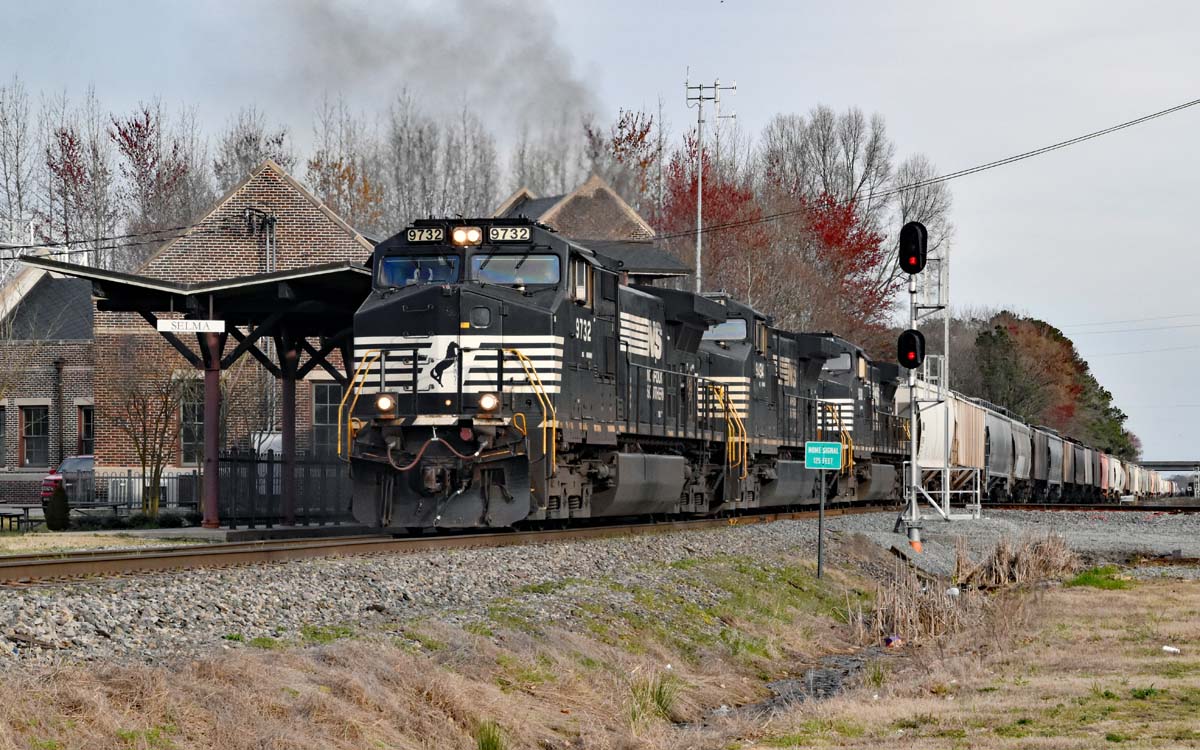
The railroad’s operating income fell 2%, to $996 million, as revenue declined 4%, to $2.84 billion. Earnings per share declined 1%, to $2.49, well below Wall Street analyst expectations of $2.62 per share, according to I/B/E/S.
NS reported a record low third quarter operating ratio of 64.9%, a half-point improvement from last year’s third quarter. The railroad will miss its target of a 1-point reduction in the operating ratio this year, partly due to the impact of one-time items, but still expects the key efficiency measure to improve for the year.
NS remains confident it will reach its 60% operating ratio goal for 2021, however, through a combination of cost-cutting, efficiency gains, and revenue growth, CEO Jim Squires told investors and analysts on the railroad’s earnings call.
Overall traffic volume slumped 6% for the quarter, with merchandise down 4%, intermodal down 5%, and coal off by 15%. Revenue per unit climbed in all three business segments as NS continued to raise rates, says Chief Marketing Officer Alan Shaw.
NS said its key operating metrics all improved for the quarter as trains moved faster and spent less time in yards. Average train speed was 16% higher than a year ago, while average terminal dwell improved 32%, says Chief Operating Officer Mike Wheeler.
On-time performance improved to a record level after six straight quarters of improvement, NS said, although executives did not provide specifics.
They also did not provide specifics on various service and productivity metrics beyond saying the railroad was on track to meet targets outlined at its investor day earlier this year.
NS in August began a second phase of operational changes under its TOP21 operating plan, which is based on the principles of Precision Scheduled Railroading. The first phase, which was launched July 1, consolidated trains and increased the use of distributed power.
NS is now rolling out twice as many trains with distributed power and blending more intermodal, bulk, and carload traffic to move tonnage on longer but fewer trains. The number of train starts and recrews per day has declined 11%.
As volume declined in the quarter and operational changes took hold, NS reduced its active locomotive fleet by 22% and its number of train and engine crews by 13% to a new record low for the company.
Overall employment at NS at yearend should total around 23,300 people, a reduction of 3,200 positions compared to the end of 2018, Chief Financial Officer Cindy Earhart says.
At the beginning of the year NS had envisioned job reductions of only 500 positions in 2019.
Wall Street analysts asked why the NS operating ratio has not declined as quickly as CSX Transportation and Union Pacific, both of which have also adopted Precision Scheduled Railroading operating models.
Squires says NS continues to push as hard as it can on costs, efficiency, and revenue growth and is controlling what it can in a declining volume environment.
He also says NS is working on improving its fuel efficiency, which lags the other Class I railroads.