

Paul D. Schneider, 64, died peacefully on Feb. 15, 2019, at the Rehabilitation Center on La Brea, in the Los Angeles neighborhood of Fairfax, where he had been living for several years while battling complications of diabetes. He was a prolific railroad author, former Trains staff member, and award-winning video producer.
Over more than 40 years, Schneider established a reputation as a singular and uncompromising voice in railroad media, rooted in a deep love of trains and diesel locomotives as well as his experiences as an employee of the Burlington Northern.
Schneider was born in Hamilton, Ontario, and as a youngster grew attached to the trains of Toronto, Hamilton & Buffalo; Canadian National; and Canadian Pacific. He developed a similar allegiance to American railroads – especially the Milwaukee Road – when he moved with his family to Milwaukee as a teenager.
After high school, Schneider made extensive cross-country trips by hopping freights across much of the continental U.S., taking copious notes on his adventures and honing his skills as a photographer.
Eventually Schneider found work on BN as an operator in the Pacific Northwest, working in various locations until transferring to the railroad’s busy Union Avenue interlocking tower near Chicago Union Station. That experience led to one of his breakthrough articles, “What’s the Problem Up There, Union?” published in Trains in October 1981 with his own on-the-job photographs.
The story was as irreverent as it was informative, filled with the Schneider’s trademark brashness. “Union Avenue is an interlocking plant that looks like it was laid out by a drunken baboon with a blunt crayon,” he wrote.
Schneider scored again in the March 1983 issue with “In the Violet Hour,” a touching, bittersweet account of the Chicago, Rock Island & Pacific at death’s door, again illustrated with his own photographs. Both stories were included in the Kalmbach Books anthology Great American Railroad Stories, published in 2014 and including selections from nearly 75 years of Trains. The only other author with two stories in the book was David P. Morgan.
As a freelance writer, Schneider contributed to a number of publications, including CTC Board, Modern Railroads, and Passenger Train Journal. That experience helped him land what he described as his “dream job,” a 1990-1991 stint as an associate editor at Trains and the short-lived Trains Illustrated. Alas, the closing of the latter eliminated his position.
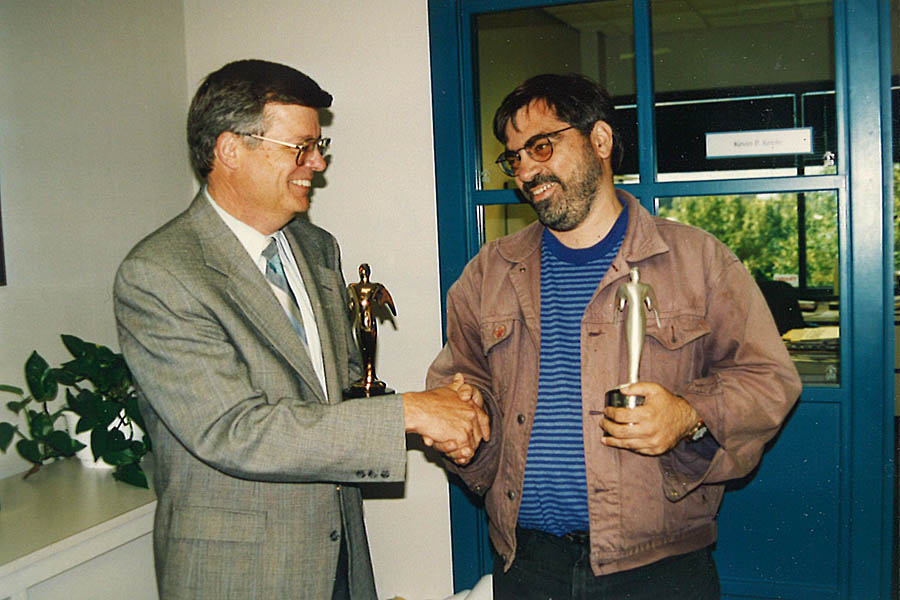
As a video producer, Schneider was the very definition of an auteur, handling not only all the direction and script writing, but also most of the photography. His images were bold and dramatic, made all the more astonishing by the limitations of his eyesight, damaged significantly by his diabetes. His chief collaborators on the series were Milwaukee-based video editor Barry Mainwood and sound editor Ray Fister.
Schneider also authored two railroad books, both growing out of his deep interest in locomotives. The first was Burlington Northern Diesel Locomotives: Three Decades of BN Power, published by Kalmbach in 1993; he followed up in 2001 with GM’s Geeps: The General Purpose Diesel, also from Kalmbach.
Through the past nearly 20 years Schneider had been living in Los Angeles, where he moved to get more involved in filmmaking. His self-financed first film, “Kill Another Day,” later retitled “Blood and Roses,” was released in 2003 but reached only a limited audience via film festivals and occasional screenings. He also produced a self-published novel version of the screenplay.
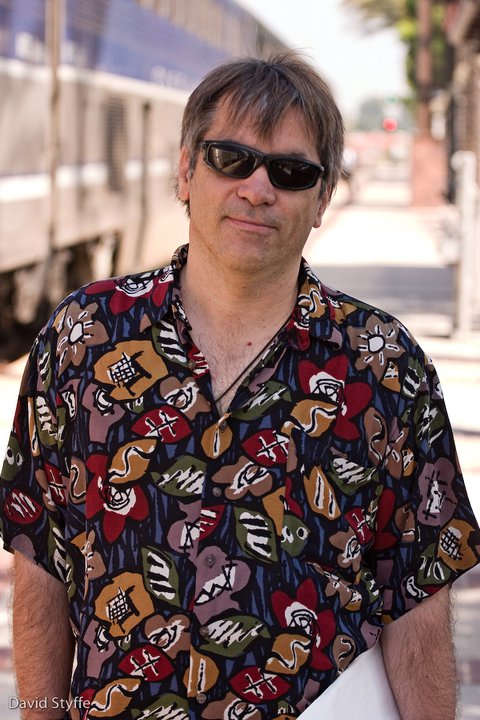
During this period he also served for a year as the editor of CTC Board Railroads Illustrated, working with David Styffe, the noted railroad photographer and graphic designer.
Schneider often posed as the provocateur, asking tough questions of his audience and expecting the same in return. Nowhere was that more in evidence than with the Observation Car discussion group, which he created in 1999 on Yahoo and which still exists today as a forum for conversations about railroad photography and writing. The group also has a Facebook page. One of the phrases it uses to describe itself is pure Schneider: “There are no sacred cows.”
Somehow, Schneider managed to stir in others some of the same intensity he brought to all his various interests, as his friend and occasional collaborator Greg J. McDonnell recalls.
“Paul was as complex as he was passionate about the things we loved and shared – art, music, film, photography, pop culture, or even just plain culture,” McDonnell says. “He was unwavering in following his dreams, and wore his passions on his sleeve. And in doing so he was no more or less imperfect than any of us.”