





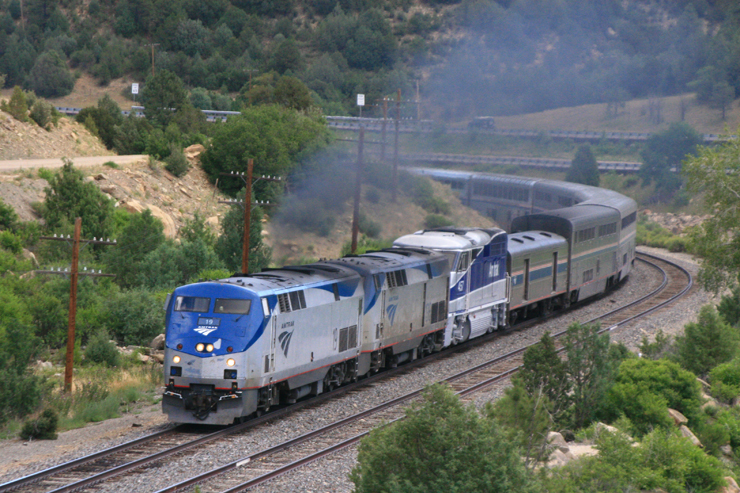
The study, conducted by researchers from the University of Southern Mississippi with assistance from James Zumwalt, the passenger association’s director of policy research, says those losses stem from cancelled operating spending, fewer visitors and visitor spending, and higher travel costs for families along the route. It also estimated there would be an additional $64 million in losses across the three states in pollution controls, highway fatalities, highway maintenance, and foregone trips. It also says the negative effects would hit the areas along the Chief route which already are home to the lowest median household income.
“Regular and frequent train service has proved to be an economic engine for communities large and small time and again,” Jim Mathews, president of the Rail Passengers Association, said in a press release accompanying publication of the study. “This study illustrates not only the damage that would have come from Amtrak’s proposed ‘bus bridge’ for the Chief, but also the real ‘return on investment’ for robust rail funding in both urban and rural communities nationwide. … The bus bridge is not a realistic option for Amtrak passengers and surrounding communities. It would create longer travel times and a financial loss for the region. It will be critical for lawmakers to take this study into consideration when developing a surface-transportation bill reauthorization in 2019.”
The full study, including a detailed look at its methodology, is available here.






Aaron “Get rid of Anderson! problem solved.” No, Aaron, get rid of Anderson, you would have a failing LD network with high (and increasing) fixed costs to run a train network that in 48 years no one has been able to successfully run. You would have a flat-lined LD network that no one has been able to make relevant to America’s travel needs.
Aaron, get rid of Anderson! and you would have better food on trains that have no future whatsoever.
Get Rid of Anderson! problem solved.
if Amtrak would put all the money into their trains instead of these assine studies they could probably run the
Chief, Super Chief , El Capitan, San Francisco Chief and the Texas Chief……
Why not just run the route between Kansas City and Belen vis the transcon and be done with the nonsense of keeping the Southwest Chief on its current route?
Gentlemen: I don’t trust “economic impact” studies.. These studies can show anything the preparers want to show, or are paid to show. As a whole, economic impact studies don’t factor in opportunity costs: if Amtrak LDs were taken off the timetable, could the annual expenditure (revenue plus subsidy) of these trains be put to some use which would have an economic impact of its own.
The question is economic impact, not the wisdom of the choice. If Amtrak’s annual budget (revenue plus subsidy) were to be poured into annual rebuilding of airports, that may or may not be a good idea but the economic impact probably would be similar to running trains.
If lack of train service in the American west had an economic impact, then the aggregate economic impact to those states would wipe them off the map. Of all the possible city pairs in the American west, only a tiny fraction have rail service. That rail service tends to be somewhat spotty.
Charles: Really, did the Heritage Foundation say that? On this forum a certain amount of hyperbole is welcome – I do that myself – but at some point hyperbole jumps the shark. The Heritage Foundation is entitled to its point of view and probably has researched the numbers more accurately than the cited RPA study.
Has anyone calculated the cost to AMTRAK for the busses, drivers, rest areas for the drivers, tolls, if any and so-forth. I feel it should be – forget the bus bridge!!
I agree, Paul. But an organization is needed to counter “studies” by folks like the Heritage Foundation et al that show that eliminating Amtrak will erase the national debt.
“Regular and frequent train service has proved to be an economic engine for communities large and small time and again,”
One train a day calling at many locations in the middle of the night is regular. But it would be a stretch to call it frequent.
Does anyone believe that a report by the Rail Passengers Association is the output of an independent, objective appraisal organization? RPA has a dog in the hunt; it is an advocacy group.
And kill the Southwest Chief.
I don’t want to see it go, but if the Chief is such an economic engine, then the states should be able to put up the needed dough on their own to make it viable. Put your money where your mouth (or studies) are.
Charles Landey,
I do believe the Heritage Foundation did make a statement close to that after one of their studies, not that it would erase the deficit entirely, but it would make a significant dent. Keep this in mind when looking at Amtrak and the budget…it’s .01 percent(closer to .001 actually) of the entire Federal budget year in and year out…that insignificant amount of money can’t do anything…which is the reason Amtrak is in the state it’s in. Fixing up those airport like you’re mentioning…those locations used subsidized services to make air travel reasonable, that’s something else that was to be eliminated from the budget…you can’t have your cake and eat it too. Pick one or the other, I would say that Amtrak would make more economic and environmental sense than subsidized airline service.
BRADEN and Stephen – The southern transcon (at a time it wasn’t nearly the railroad it is now) was the original NARP proposal for what soon became Amtrak. Not the route via Raton.
Stephen.. BNSF presented the opportunity to Amtrak years ago. They turned it down.