

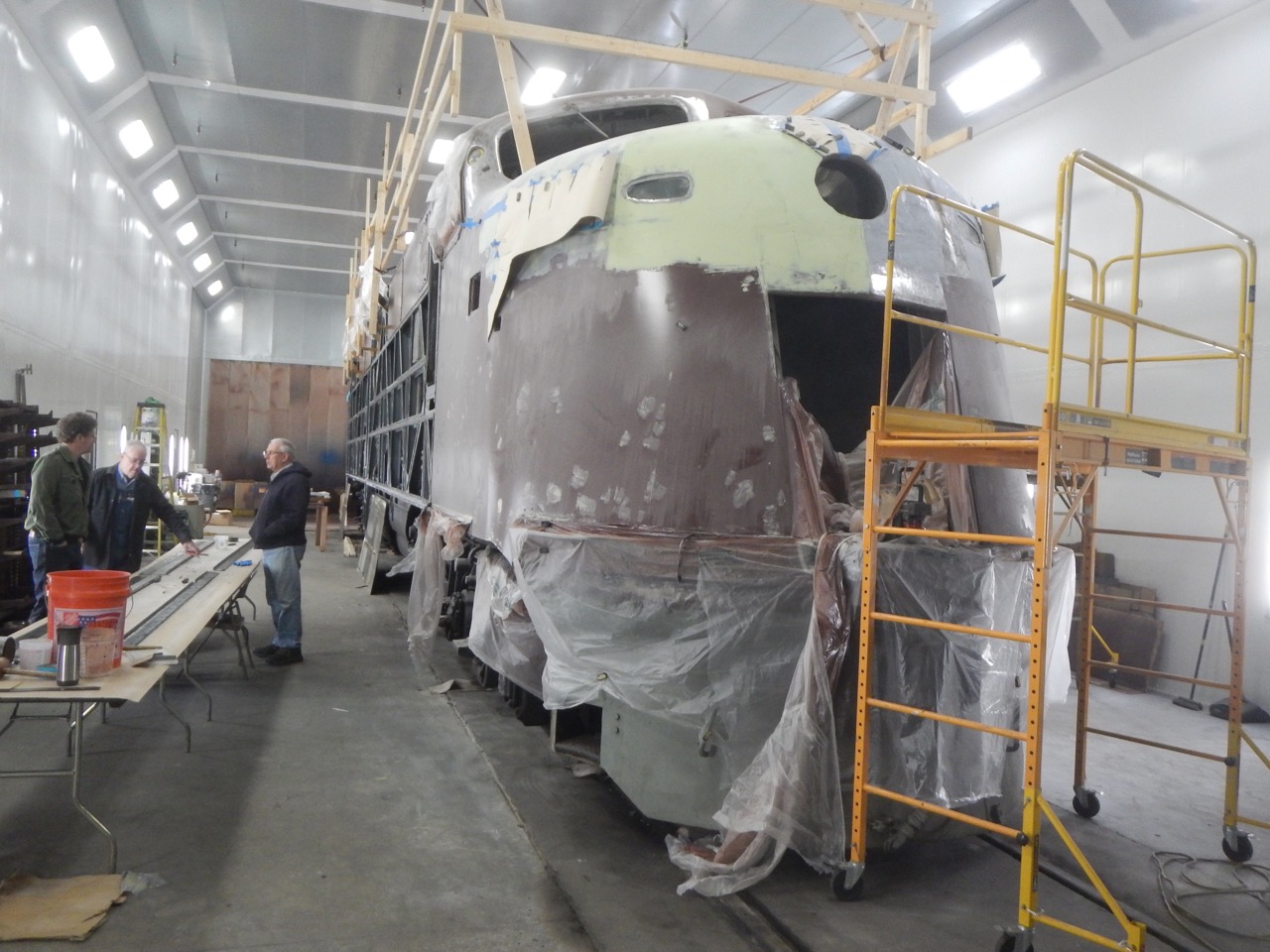
When it emerges from the shop, it will sport original details later removed. According to Jamie Partridge, restoration shop manager, a composite replica of the original pilot, which featured a cowling over a retracting front coupler, and a long gone stainless steel ornamental device that wrapped around the leading edge of the hood will be included, along with stainless steel trim around the doors and windows.
At some point in the unit’s service life, the original sheeting on the body was replaced with aluminum, and the resulting electrolytic reaction with the steel frame members caused the sheeting to crumble from the inside out, Partridge pointed out. All the sheeting on both sides of the locomotive has been removed, and new sheeting is being prime painted on both sides before installation. The steel framing was needle scaled and treated with rust preventative paint. In addition, cushioning strips have been glued to the frame to insulate the sheets from the framing.
While seeking original paint, Partridge and his crew found on the rear of the locomotive, the original number 51-A in gold leaf, a detail that will be replicated. The original colors — royal blue, medium gray, and a pale yellow gold — have been analyzed and matching modern formulations found.
The restoration of No. 51, while not an operational restoration, is one of the most important projects in railway preservation today, since museum visitors will see all the original details of the locomotive that overcame the steam locomotive just as people saw it when it was delivered in 1937.