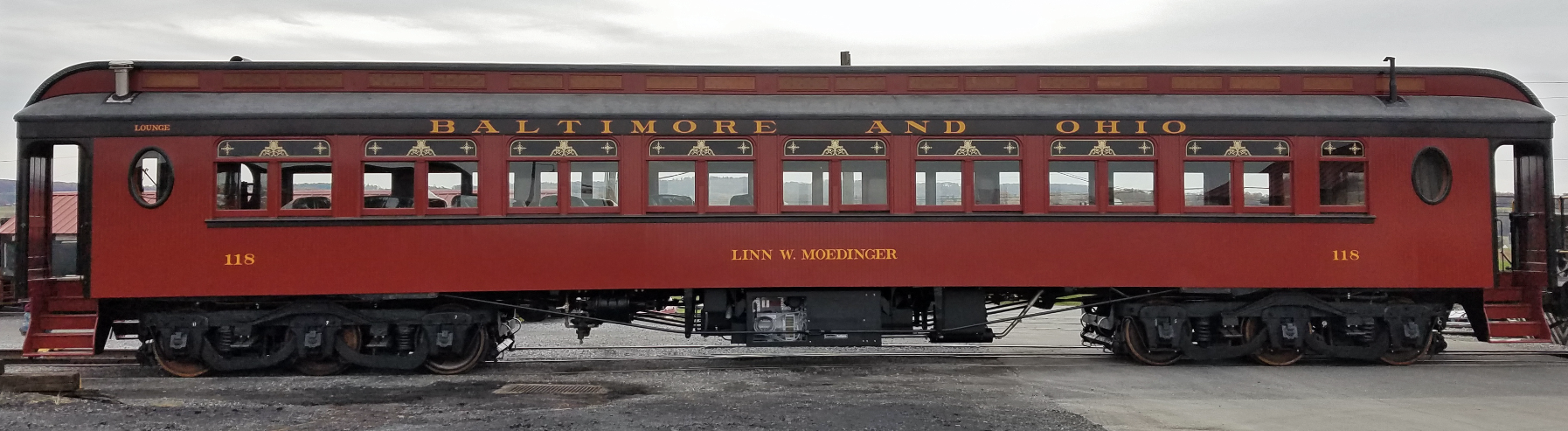
Named Linn W. Moedinger for the railroad’s retiring CEO, Strasburg car No. 118 was originally built by American Car and Foundry in 1911 for the B&O. Although the original number has never been determined, evidence uncovered by the railroad’s restoration workers led them to believe the original number may have been 4281.
It later cascaded down in retirement to work train service as X-4111. The car was acquired by the Wanamaker, Kempton & Southern steam excursion line for $300 in June 1966 and then used as a museum exhibit car named Somerset for the B&O yard it was rescued from in Somerset, Pa. It served over the years as a museum car and then a circus diorama display car, but was later used as storage for company items.
The car was acquired by the Strasburg in June 1990 in unrestored, gutted condition in trade for C&O insulated box car 5504, formerly used by the owners of Canadian Pacific Royal Hudson 4-8-4 No. 2839 and outfitted with shelving, to be used by the Wanamaker for storage and photo freights. Strasburg immediately “cocooned” the B&O car in bright red metal siding with rubber roof, air gaps, and grated air vents, and it sat in the Strasburg’s storage lines for fifteen years until restoration began in mid-2015.
Restoration included complete removal and replacement in kind of the deteriorated side frames, replication of stained-glass clerestory windows, rebuilding of the sills and ends, and a new interior with brass light fixtures. In all, the railroad has invested more than 20,000 man-hours and $700,000 in the restoration.