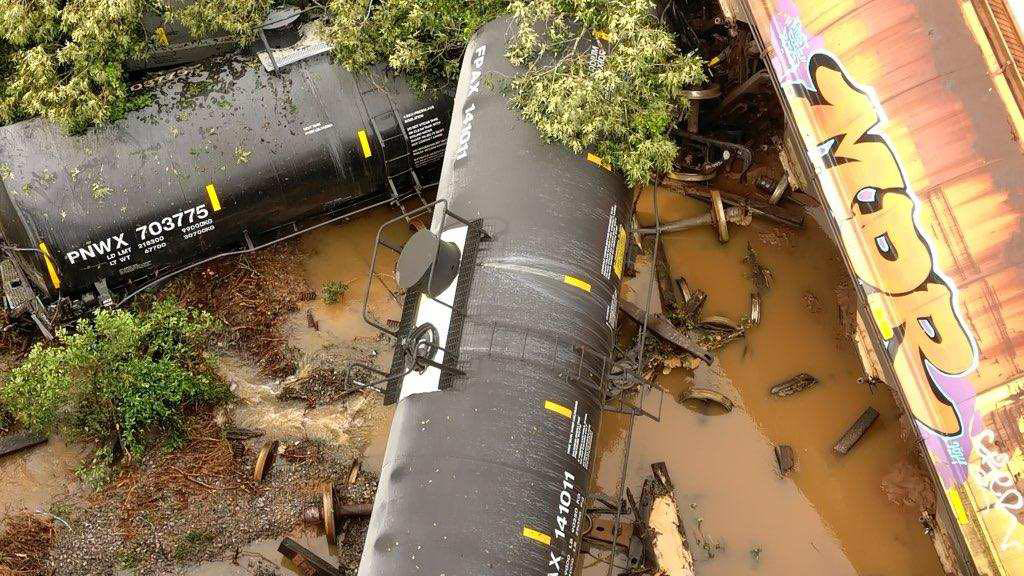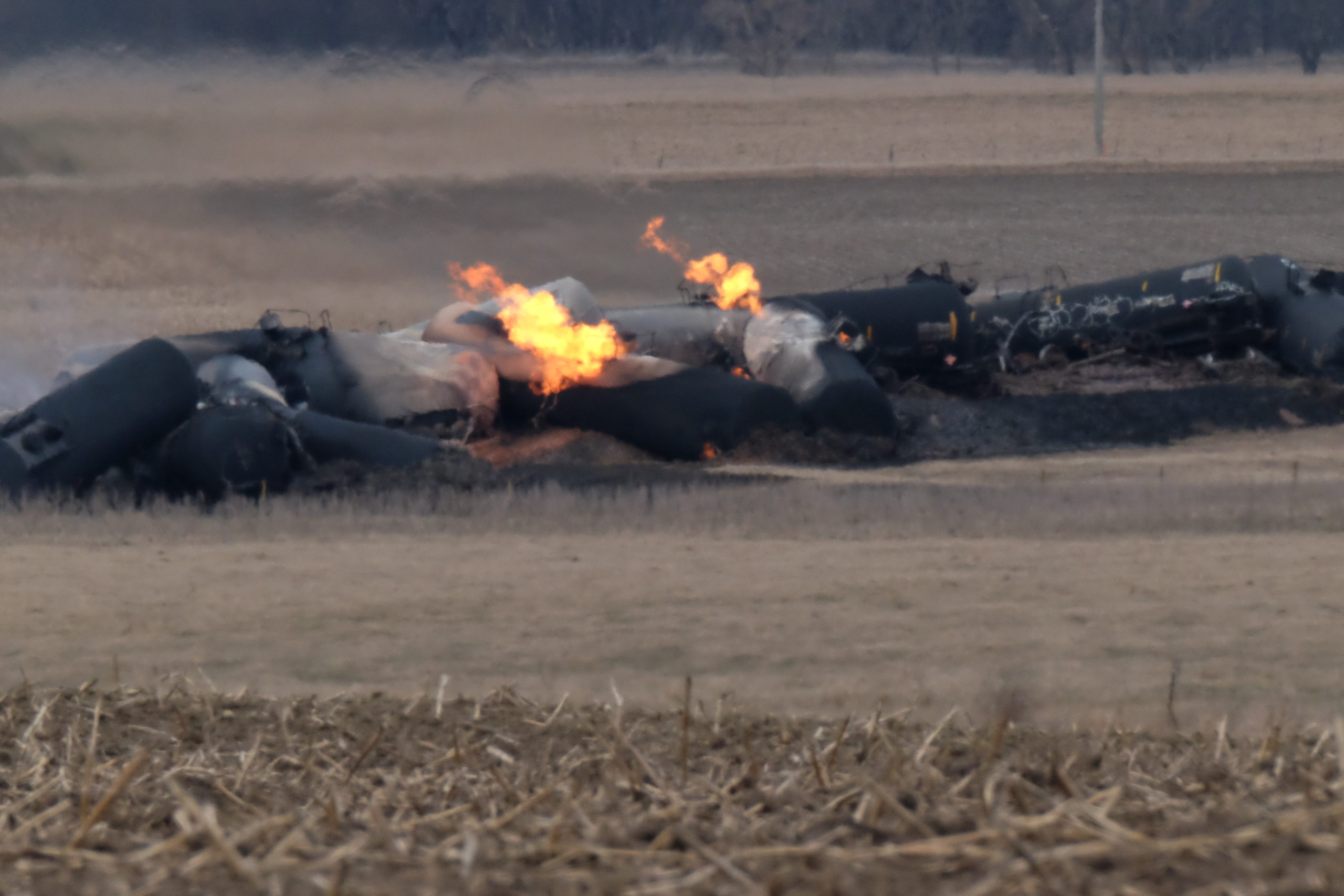
NTSB officials met Tuesday to discuss its findings regarding the 20-car derailment of a Union Pacific train near Graettinger, Iowa, on March 10, 2017. In that derailment, 14 cars released nearly 322,000 gallons of denatured ethanol, causing a fire.
Of top concern to the NTSB and its staff are the maintenance and safety conditions of UP tracks, what the Federal Railroad Administration is doing to make sure tracks are in good condition, and the status of the flammable liquid fleet that is required to meet new Department of Transportation safety standards by May 2023.
In his opening remarks, NTSB Chairman Robert Sumwalt said that railroads are supposed to look for and fix unsafe conditions while federal oversight ensures the railroads do what they’re supposed to do.
“After the accident, Union Pacific undertook an impressive program of corrective actions,” Sumwalt said. But the flurry of activity “hints at the inadequacy of UP’s maintenance and inspection program pre-accident.”
Investigators showed a 3D digital recreation of the derailment, informed by data recovered from locomotive event recorders and external video. The video illustrated the moments leading up to and then the immediate aftermath of the derailment. According to Dr. Erik Mueller, a materials research engineer for the NTSB, the train likely derailed from a broken rail leading over the Jack Creek bridge. The investigators believe the rail, on the south side of the track, snapped sometime between the fourth and 20th tank cars. They attribute the failure to a poor track maintenance and inspection program and lax federal oversight.
In the list of 16 findings, the NTSB made particular note that while UP did regular track inspection, as required, it made repairs that improved track conditions only back to minimum levels suitable for operation, and this led to a cascade of deteriorating track conditions.
Senior Accident Investigator Joe Gordon said UP, prompted by a derailment in Mosier, Ore., agreed to comply with an agreement with the Federal Railroad Administration to inspect the tracks near the Estherville subdivision twice weekly starting in December 2016, three months before the accident.
“FRA inspections showed marginal cross tie conditions going as far back as March 2015,” Gordon said. In August 2016, the FRA emphasized the risk due to the transport of ethanol on the line. FRA inspectors again noted marginal tie conditions again in December. Records reviewed showed that from July 2016 through March 2017, crosstie conditions remained defective or marginal.
The safety investigation also found the FRA did not use the powers at its disposal, civil penalties in particular, to ensure UP kept the Estherville subdivision repaired to FRA safety standards. The investigators recommended that FRA provide additional training to track inspectors on track safety standards and provide guidance regarding enforcement options.
All of the tank cars involved in the derailment were built to DOT-111 standards. While 11 of the cars were breached, if the cars had been built to the new DOT-117 specifications, breaches on six of the cars could have been mitigated, reducing the amount of spilled ethanol. New tank cars are now built to the 117 standard, while existing 111 cars must be upgraded to the standard by May 1, 2023. None of the cars in the Graettinger derailment had been retrofitted.
NTSB members expressed concern the May 2023 deadline to retrofit the flammable liquid fleet, some 11,700 tank cars throughout the United States, could not be met.
The board reiterated a recommendation that milestones be scheduled over a 5-year period for replacement or retrofitting of DOT-111 and CPC-1232 tank cars.
In an interesting addendum, safety board members discussed the properties of the alcohol the train hauled: non-potable denatured ethanol. Denatured ethanol has chemicals added to it to make it dangerous to drink, often methanol. Once treated, it can be sold as fuel without being subject to alcohol and liquor taxes. In the Graettinger derailment, the pure ethanol was released but not burned, which investigators believe may have been one reason why the fire damage was less than in similar accidents involving denatured ethanol.
Vice Chairman Bruce Landsberg wryly observed that Prohibition ended in 1933, and there’s little evidence to support the notion that thieves are siphoning potable ethanol from tank cars.
As such, the NTSB asked the Pipeline and Hazardous Materials Safety Administration to conduct a study about the characteristics of denatured and pure ethanol and the possible benefits of transporting pure ethanol without volatile denaturants.