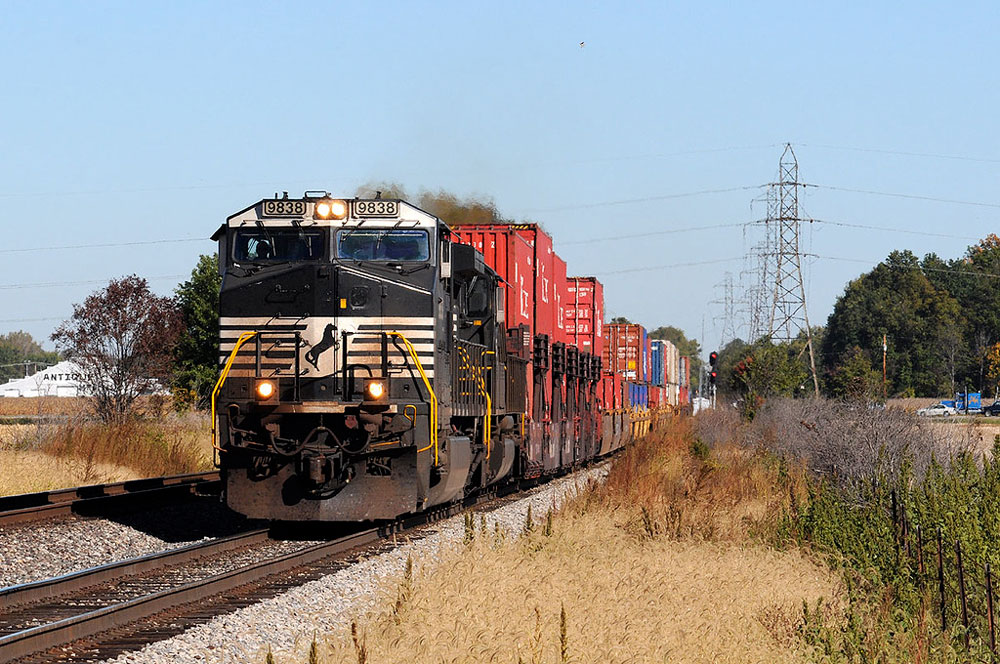
ATLANTA — Norfolk Southern executives today outlined steps they will take over the next six months to improve operations and service while wringing out $250 million in costs.
NS is under pressure to show improvements amid a proxy battle with activist investor Ancora Holdings, which has been critical of the railroad’s lagging financial and operational performance.
Ancora aims to gain control of the NS board and name former UPS executive Jim Barber Jr. as CEO and former CSX operations boss Jamie Boychuk as chief operating officer. Shareholders will vote on the dueling visions of Norfolk Southern’s future during the company’s May 9 annual meeting.
“We are on a transformational journey to a safer, more profitable railroad poised for growth, with strong execution from an experienced leadership team,” CEO Alan Shaw told investors and analysts on the railroad’s earnings call this morning.
Shaw said he hired Canadian Pacific Kansas City and former Canadian National executive John Orr as chief operating officer to accelerate operational changes based on principles of Precision Scheduled Railroading. The goal is to deliver productivity improvements that will help reduce the operating ratio by 4 or 5 points in the second half of the year and ultimately to below 60% in three or four years.
“Our strategy is designed to mirror the great success stories of the Canadian railroads, who have recognized that PSR is about more than tearing a railroad down to its studs and slashing costs regardless of the fallout,” Shaw says.
Shaw pointed to the success that current NS board member Claude Mongeau had while he was chief executive at Canadian National.
“A PSR operating model, when part of a customer-focused, balanced strategy, can deliver top tier revenue growth and a sub-60 O.R.,” Shaw says. “John Orr was an integral part of Claude’s leadership team at CN and thus a perfect fit for Norfolk Southern as we turbocharge productivity in pursuit of industry competitive margins and top tier earnings growth.”
In Orr’s first 30 days at the railroad, NS has:
- Taken 200 locomotives out of the active fleet through a combination of putting them in storage or sending them to other railroads to balance horsepower hours.
- Improved terminal dwell by 8%
- Improved car velocity by 8%
- Reduced the number of recrews by 22%
- Reduced the number of crew starts by 35 per day
- Eliminated terminal imbalances
- Reduced unnecessary car handlings
- Engaged customers who have excessive car inventory
“Everything’s on the table. Everything’s being scrutinized,” Orr says.
Norfolk Southern’s operational problems are largely rooted in its terminals, Orr says.
Over the next six months, NS will increase blocking of merchandise cars at origin, more closely match horsepower and train tonnage, drive out excess costs, and restructure the train and terminal operating plan.
Six-month key operational targets include storing an additional 300 locomotives, reducing merchandise carload handlings by 10%, improving through dwell by 20%, boosting car velocity by 17%, and reducing scheduled crew starts by 4%. The result of all this, NS projects, will be $250 million in productivity savings and improved profit margins.
Service recovery costs — which have dogged the railroad since the disastrous Feb. 3, 2023, hazardous materials derailment in East Palestine, Ohio — should be eliminated by the end of the quarter or beginning of the third quarter as the railroad runs faster and more efficiently, Chief Financial Officer Mark George says.
NS had previously expected employment levels to be flat this year. But productivity improvements should enable the railroad to reduce its workforce by 2% through attrition.
Key operations and service metrics — including car miles per day, terminal dwell, average train speed, and locomotive productivity — all improved compared to the fourth quarter. And in the first three weeks of April intermodal trip plan compliance was 91%, up from 86% in the first quarter, while merchandise trip plan compliance was 81%, up from 76% in the first quarter.
The improved service will help NS regain merchandise traffic that had been lost to trucks or CSX during the railroad’s post-East Palestine service problems, Chief Marketing Officer Ed Elkins says.
In the first quarter, overall volume was up 4% thanks to an 8% increase in intermodal traffic. Merchandise volume was flat, while coal business was down 4%.
The 53 intermodal lanes that NS eliminated in earlier this month were all very low density origin-destination pairs with limited growth opportunities, Elkins says. While they amounted to 15% of the railroad’s intermodal lanes, they totaled just 1% of NS intermodal revenue, he says.
Adjusted for the impact of costs related to East Palestine, the elimination of 300 management jobs, and the proxy battle, NS operating income declined 18%, to $904 million, as revenue declined 4%, to $3 billion. Earnings per share declined 25%, to $2.49. The operating ratio was 69.9%.
Absent the adjustments for one-time items — which include the $600 million settlement agreement related to the East Palestine class action lawsuit — the operating ratio was 92.9%.
Share this article