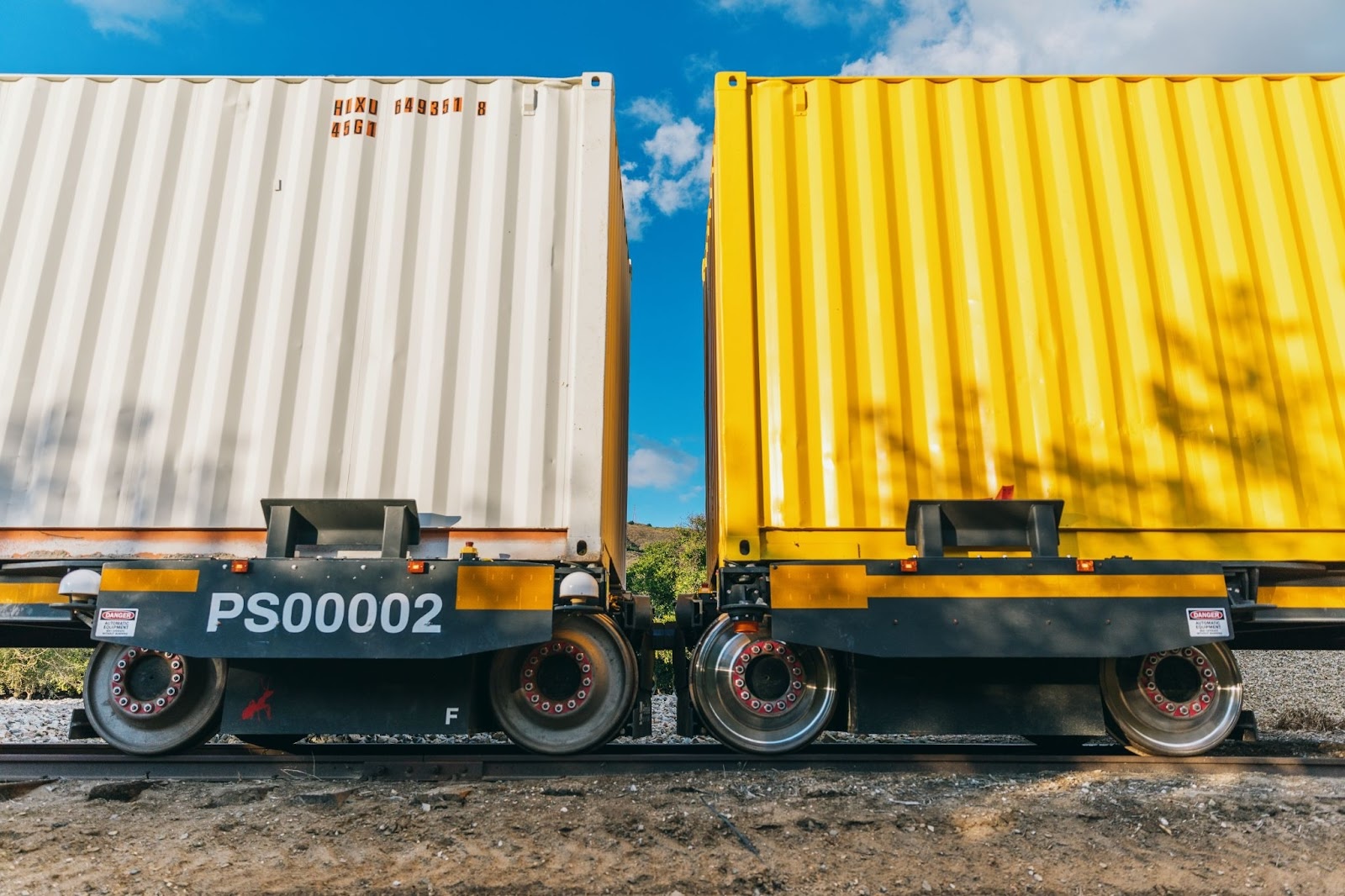
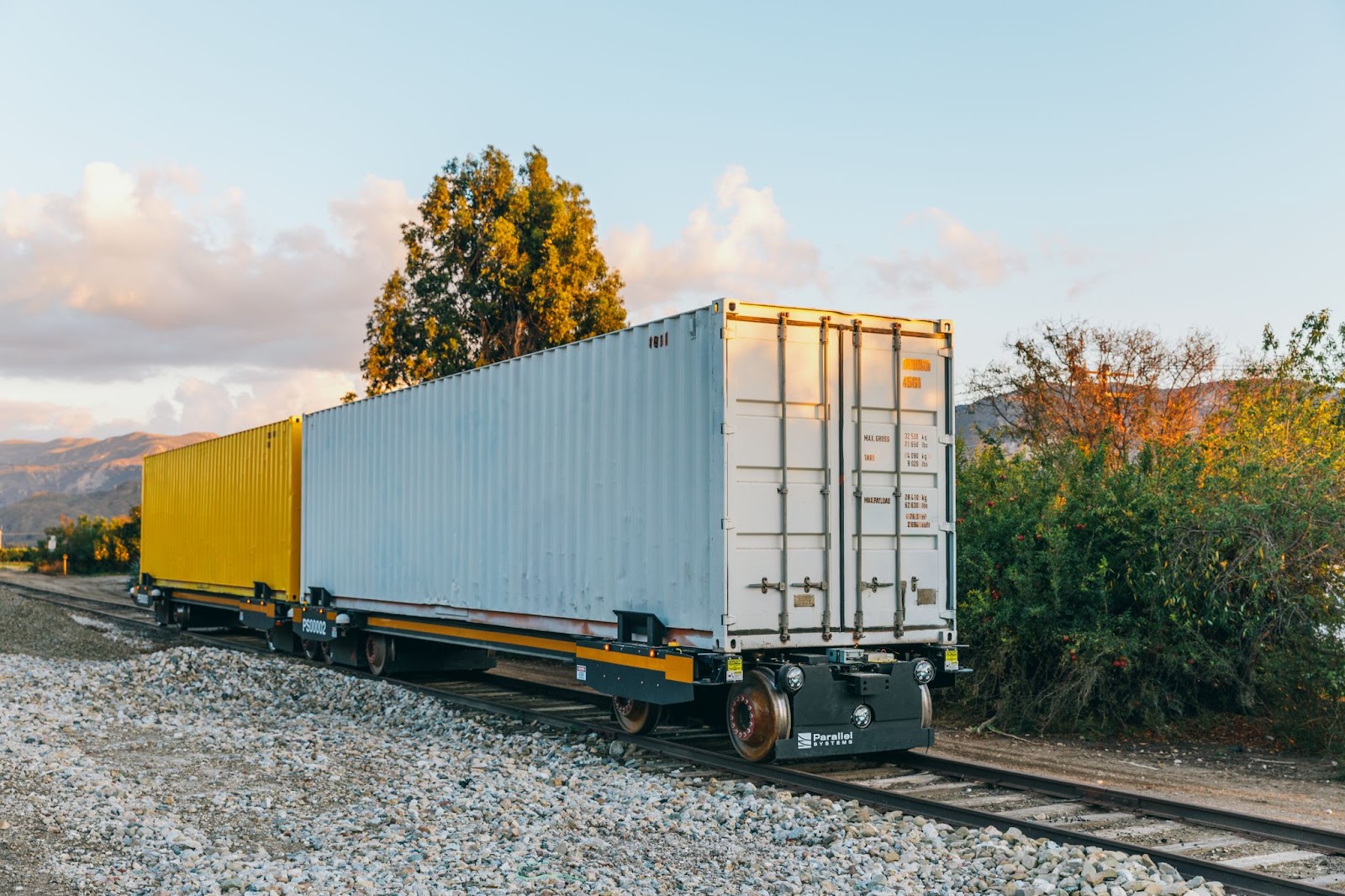
LOS ANGELES — Parallel Systems today for the first time demonstrated the platooning capability of the autonomous, battery-electric container cars that it is developing for short-haul intermodal service.
The self-propelled cars lack traditional Janney railroad couplers. Instead, they can operate in platoons through bumper-to-bumper contact and coordinating tractive effort among all of the cars in the consist. Because the cars use electric brakes, building platoons is fully automatic because there’s no need to couple air hoses.
Parallel demonstrated the technology on its Southern California test track. The cars can travel in platoons of up to 50 cars, which improves aerodynamics while making better use of railroad capacity.
“Our platoon testing began in October 2023, and the performance has been consistent with our modeling and simulations, which is exciting right out of the gate,” Matt Soule, Parallel’s co-founder and CEO, said in a statement. “The vehicles have remained connected according to plan, allowing us to plan expanded platoon testing with increased speeds, greater number of vehicles, and braking. Introducing platooning will help the rail industry address a range of critical challenges, including sorting and routing freight more quickly and keeping railroad crossings open for roadway and pedestrian traffic.”
Parallel says its platooning technology could one day eliminate the need for yards because the railcars can attach and detach independently from platoons, allowing railroads to sort freight anywhere along the network where there is a switch.
The Department of Energy recognized Parallel as a high-potential, high-impact energy saving technology when it awarded the company approximately $4.5 million as part of its Advanced Research Projects Agency-Energy initiative. The purpose of the award is to test how well Parallel’s zero-emissions rail vehicles integrate with real-world railroad operations and to evaluate supply chain resilience and reduction in energy usage, and associated emissions.
In August, Parallel and two Genesee & Wyoming short lines filed a waiver request with the Federal Railroad Administration that would, if approved, permit testing of the equipment in Georgia.
FRA spokesman Warren Flatau says the agency hopes to publish a decision on the waiver request in the next few weeks.
“We have been actively providing technical assistance and regulatory insight to Parallel Systems over the last several years. We are reviewing the August Georgia Central Railway and Heart of Georgia Railroad submission … requesting temporary suspension of locomotive and operating practices regulations in order to perform the tests planned for 2024 in the Heart of Georgia,” Flatau says.
Note: Updated at 9 a.m. Central on Dec. 21 with comment from FRA.
Share this article