WASHINGTON — Amtrak reduced the huge financial shortfall it experienced during the COVID-19 pandemic with its results in fiscal 2022, earning $1.78 billion in gross ticket revenues while carrying 22.9 million passengers, according to a route-specific recap obtained by Trains News Wire.
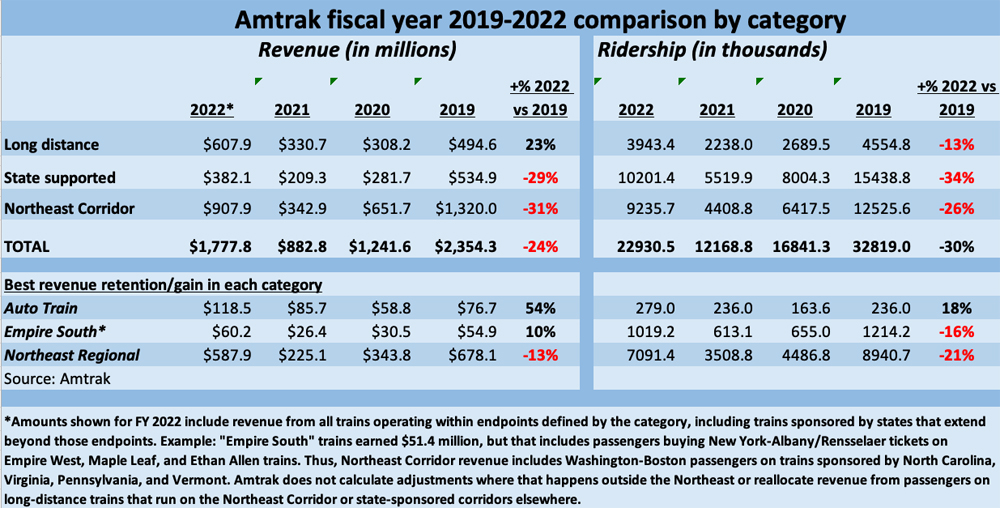
Most noteworthy in yearly comparisons by service category, shown in the table below, is that revenue on the long-distance network in 2022 was up by $113 million, or 23%, over 2019, the last “normal,” or pre-pandemic year. In contrast, both Northeast Corridor and state-supported service revenue fell by about 30%.
Auto Train, high prices boost long-distance income
Much of the long-distance gain was achieved by Auto Train’s continued stellar performance. The daily overnighter carrying travelers and their cars between Lorton, Va., and Sanford, Fla., benefited from high gas and rental-car prices most of the year. The train had enough coach and sleeping-car capacity to address pent-up travel demand at different price points, but eventually many departures sold out at high fare levels.
Though reduced somewhat by equipment and personnel shortages that plagued the rest of Amtrak’s network [see “Addressing Amtrak’s Capacity Crisis,” Trains Magazine, December 2022], each Auto Train usually operated with four coaches and as many as eight sleeping cars. It is also the only train marketed separately in advertising, social media, and at the Amtrak website.
High prices driven by reduced availability played a significant role in the long-distance category’s revenue strength: Compared with 2019, per-passenger revenue was up nearly 34% in 2022 (Auto Train was +30%), compared with +2% for state-supported trains and -6.8% in combined Acela and Northeast Regional patronage.
Positive trends on several corridors
Along with the general return of more daily travel, ridership is increasing where Amtrak has numerous departures and sufficient capacity, giving it the chance to offer a variety of fares to reflect the seats available on specific trains. In the Northeast, premium-priced Acelas continue to attract fewer passengers than in the same months in 2019, but revenue per rider on Northeast Regional trains was up about 9% in August and September. Expect the momentum to continue as the Thanksgiving rush approaches.
Intercity state-supported routes of longer distances continue to outpace shorter corridors such as the Hiawatha, Keystone, and Capitol Corridor operations, which have been historically dependent on daily commuters. Bucking that scenario is Maine’s Downeaster, where revenue is up 4% and ridership is off only 4% in September after both were down double digits for the full year. A huge swing has also recently occurred in North Carolina and Virginia, where the Piedmonts, Carolinian, and regionals off the Northeast Corridor serving Roanoke, Norfolk, and Newport News, Va., all had good summer months.
Another success story is the Ethan Allen, whose extension to Burlington, Vt., created a promotable buzz. While aided over a portion of its route by the continued absence of the Adirondack, ridership for the daily round trip from New York City, stopping in Rutland, Vt., was up 50% in August and 92% in September over 2019. Passenger counts and revenue were also impacted south of Albany-Rensselaer, where ticket sales were credited to Empire South service (as explained in the table’s notes). Insufficient equipment resulted in frequent sellouts on that busy corridor, which led state-supported routes in revenue.
Long-distance ridership hit by capacity issues
Long-distance revenue gains mask the negative impact on ridership caused by Amtrak’s inability or unwillingness to provide capacity on trains outside the Northeast corridor. But the table below shows how Superliner-equipped trains, other than Auto Train, fared in 2022 compared to pre-pandemic 2019.
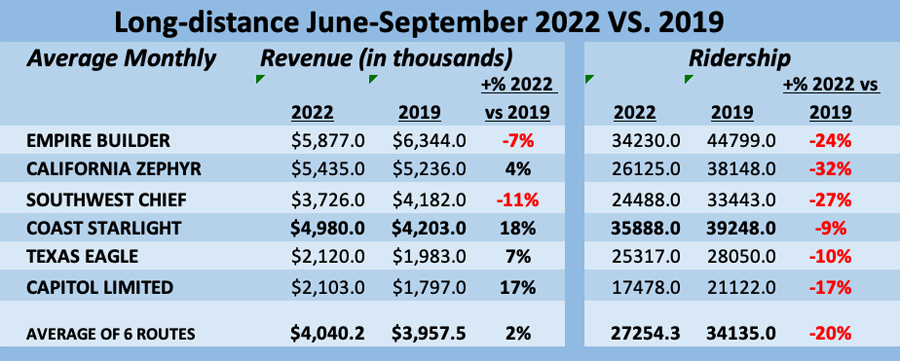
From a strictly financial standpoint, where the object is to maximize yield and minimize costs, Amtrak management can argue it is doing a better job squeezing more revenue out of fewer passengers. This change appears to be baked in to future operating scenarios in fiscal 2023. Trains News Wire has learned from a group attempting to book an excursion next July that, as was the case in 2022, a second Chicago-Seattle Empire Builder sleeping car is not being offered. The train also operated with only one Chicago-Seattle coach in 2022.
Coach and sleeper sellouts (or high fares) regularly occurred on most of these trains for at least some segments. This discouraged bookings, which are already dependent on having a once-per-day train match a traveler’s schedule.
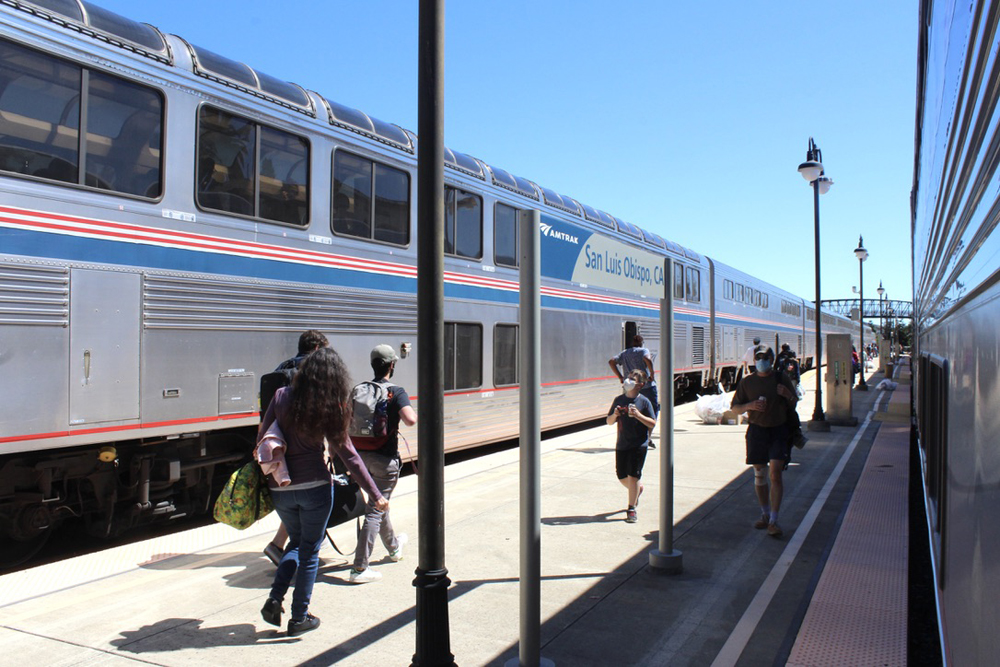
But the Coast Starlight, operating with more coaches (including a business-class car) and sleeping car space than the other inter-regional trains, suffered the least drop in ridership while generating more revenue.
These fiscal year-end results can be interpreted many different ways. On the surface, it is tempting to pit Auto Train’s performance against the rest of the long-distance network.
But the numbers show that sufficient capacity is crucial to the national network, leading to revenue and ridership growth, as is the case on the Northeast Corridor. Amtrak can offer both high frequencies where it controls the tracks and a unique ability to provide mobility between urban and rural destinations that are otherwise largely unserved. The fiscal results provide enough evidence that overcoming the company’s current equipment and personnel challenges will help Amtrak reach its full potential.
Share this article