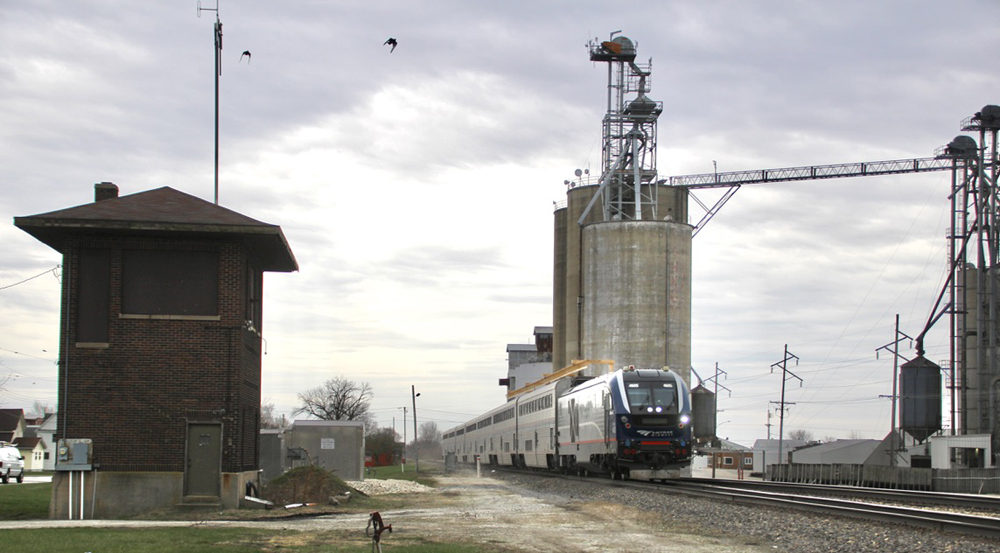
WASHINGTON — Amtrak is proposing that, in extreme examples of routes with poor on-time performance, it would be allowed to take over dispatching from host railroad Canadian National as part of a new operating agreement with CN.
In asking the Surface Transportation Board to set terms of a new agreement with CN, the passenger railroad proposes new methods to determine whether the host railroad receives incentive payments or pays penalties for the performance of passenger trains it handles. Amtrak says its proposal would increase CN’s incentives to “deliver all of Amtrak’s passengers to their destination on time, but does not inordinately penalize CN for delays that it did not cause.”
The terms proposed by Amtrak to determine whether CN has earned a payment or penalty would use a formula including “customer on-time performance,” passenger-miles traveled on CN, and host-railroad delays per 10,000 train-miles.
The dispatching proposal is part of a series of measures Amtrak advances to address prolonged timekeeping issues.
Friday’s 497-page filing with the STB — which does not include several appendices of details on the current CN-Amtrak agreement, redacted as confidential — is the latest step in a disagreement dating to 2013, when Amtrak asked the board to establish contract terms because the two parties were unable to reach agreement. Even after a 2019 STB decision in which the board offered its views on aspects of the dispute and ordered mediation [see “STB urges mediation …,” Trains News Wire, Aug. 13, 2019], there has not been a settlement. As a result, Amtrak trains on CN continue to operate under a 2011 contract the STB required to remain in effect on an “interim basis.”
The Amtrak filing also reflects 2020 rules issued by the Federal Railroad Administration on metrics to determine host-railroad performance in handling Amtrak trains. The “customer on-time performance” metric established in those rules weighs on-time performance based on the number of passengers using specific stations, so that on-time performance at heavily used stations, such as endpoints, are more significant than less-used intermediate stops [see “FRA publishes final rule …,” Trains News Wire, Nov. 16, 2020].
Measures of performance
The FRA’s on-time performance standard measures the number of passengers who reach their destination no later than 15 minutes after scheduled arrival, and sets 80% over two consecutive quarters as the minimum acceptable standard. But the Amtrak filing says it realizes that this “is not a perfect measure of CN’s performance on any of the routes, particularly those where there are other host railroads that host the lion’s share of the track-miles.” So it proposes that incentives would increase as the number of passenger-miles on a route increase, and as the number of delays attributable to CN per 10,000 train miles decrease. These measures, it says, would give the host railroad incentives to help Amtrak expand ridership, “primarily through good on-time performance,” and to minimize delays within its control.
Amtrak’s formula would set a “ridership factor” — a quarterly figure based on CN incentives earned in 2019, the last year of pre-pandemic operation — which would be used to determine incentives or penalties based on both the on-time performance and host-railroad delays for each route. The formula would multiply the ridership factor by the customer on-time performance and a “delay adjustment factor” based on the number of minutes of delays for which CN is responsible.
Amtrak says it has determined that trains meet the 80% on-time standard when host-railroad delays are between 900 and 924 minutes per quarter. When those delays are under 900 minutes, incentives would increase; above 924 minutes, penalties would begin to accrue.
The filing uses both 2019 data and hypothetical information to show how these calculations would work. In an example using the City of New Orleans — an all-CN route where the railroad earned an average of $518,996 per quarter in incentives in 2019 — a quarter in which the train hit 85% customer on-time performance with 600 minutes of host-railroad delays would earn incentives of $512,301.18. One which on-time performance was 75% and CN-caused delays totaled 950 minutes would result in a penalty of $157,227.98.
Dispatching the focus of remedial action
Amtrak proposes three tiers “concrete remedial action” in case of sustained poor performance.
— The first tier would require CN to report details of host-railroad caused delays including how the delay could have been prevented, if the dispatcher involved was counseled, and what corrective actions were taken to avoid a repeat of the issue. Amtrak says this focuses on dispatching practices “for good reason — whether a host railroad is giving Amtrak the statutory preference to which it is retired is directly related to a host’s dispatching practices.”
— The second tier — invoked when delays on a route attributed to CN exceed 924 minutes per 10,000 train-miles for two consecutive quarters — would allow a representatives of Amtrak, its Inspector General, or the STB to sit alongside CN dispatchers on that route, and that CN would need Amtrak’s prior approval for non-emergency maintenance work expected to impact Amtrak’s on-time performance.
— The third tier — when such delays occur on a route for four consecutive quarters — would allow Amtrak to take over dispatching, either directly or through a third party, for two years or until the delay figure has been below 924 minutes per 10,000 train-miles for 12 consecutive months.
Amtrak seeks a seven-year term for the new agreement and says it would not be practical to apply it retroactively to the years when the two sides have been operating under the contract that expired in 2013. The exception is an existing agreement dating to 2011 that Amtrak has an obligation to reimburse certain costs incurred by CN.
Share this article