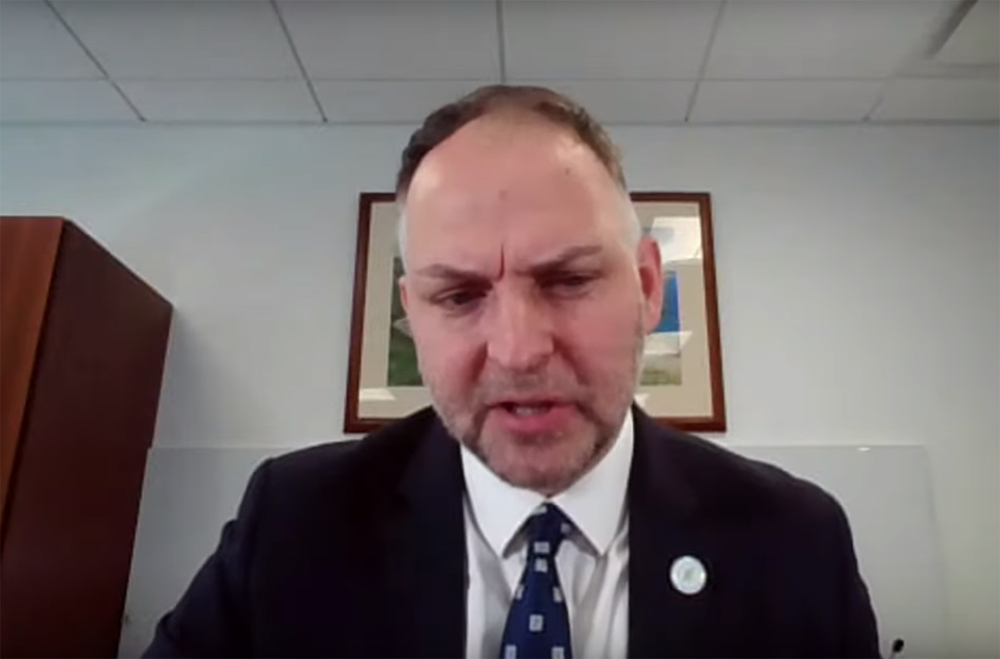
 WASHINGTON — Amtrak President Stephen Gardner’s presentation Thursday at a House committee hearing included justification for potential service cuts, related to the passenger railroad’s COVID-19 vaccine requirement, that may be announced next week.
Gardner was taking part in the House Transportation and Infrastructure Committee Rail Subcommittee hearing, “Leveraging Infrastructure and Jobs Act: Plans for Expanding Intercity Passenger Rail.” Also testifying were heads of agencies or regional commissions representing the Northeast Corridor, California, and the Southeast, who discussed operating realities and prospects for expansion in their respective regions.
In the document accompanying his opening remarks, Gardiner says, “Amtrak must comply with the federal mandate effective Jan, 4, 2022 that employees of government contractors be fully vaccinated.” The mandate, however, was overturned by a federal judge on Tuesday and has been challenged in court by Amtrak’s operating unions, and the impact frequency-reduction plans remains to be seen. No lawmaker asked for clarification during the hearing.
“This will likely necessitate temporary frequency reductions, primarily for our long-distance services,” Gardner said in the statement, “…because of the relatively small crew bases at intermediate points along multi-day long-distance routes where conductors and engineers report to work. At some of these crew bases across our network, we have a relatively high percentage of unvaccinated employees. If those employees chose to not get vaccinated by the deadline we will not have sufficient trained staff to support current service frequency on affected routes.” That deadline was Wednesday, Dec. 8 [see “Amtrak limits Track Friday sale, service reductions possible in January as unions file suit,” Trains News Wire, Nov. 29, 2021].
The statement adds, “We are currently determining what service reductions will be necessary and intend to communicate them publicly by next week in order to ensure that we can rebook customers to the remaining frequencies we feel confident we can fully staff. Our goal, of course, will be to have as few impacts to service as possible … and we will be prepared to reinstate frequencies as soon as the number of available employees permits.” In remarks at the hearing, Gardner said Amtrak would “proactively reduce” service in January but would “plan to restore daily service by March.”
Other significant testimony
In other aspects of Thursday’s hearing:
— Julie White, North Carolina’s deputy secretary of multimodal transportation and chairwoman of the Southeast Corridor Commission, stressed how important Jobs Act funding would be to restore a direct route between Richmond, Va., and Raleigh, N.C., on CSX’s abandoned S-Line right-of-way. Piecemeal funding has paid for almost 25 years of studies, and more recently, land acquisition, but not construction. “Building this passenger route is a win-win for both passenger and freight because it takes trains off of the CSX line they are running on now,” she said.
— Donna DiMartino, manager of California’s LOSSAN corridor, reiterated her agency’s concern about Amtrak’s lack of cost transparency.
“When I asked Amtrak about the cost of an additional train to support our high ridership in the holiday season, Amtrak was not able to provide that information in a timely manner,” she said in response to a question from a California congresswoman. “We chose to run the train not understanding exactly what it would cost, and — this phrase was used earlier — that certainly is no way to run a railroad. We are hopeful that the cost formula update will help solve these issues in the future.”
— Knox Ross, chairman of the Southern Rail Commission, was asked by Georgia Rep. Hank Johnson (D) how he traveled to Washington. Ross said he had taken the Crescent from Meridian, Miss., and the train “was an hour and a half late at its first stop after leaving New Orleans on time.” In response to the concern of Rep. Steve Cohen (D-Tenn.) that there was no Amtrak service between Memphis and Nashville, Ross touted the benefits a multi-state commission can offer, and invited his state to join Louisiana, Mississippi, and Alabama in the SRC. The governors and state legislatures of all states would have to agree on such a partnership.
— A number of Republican lawmakers repeatedly asked whether Amtrak new route expansion would be profitable. Amtrak’s Gardner responded, “We don’t measure success by farebox recovery alone; our mission is to work with our state partners to create mobility.”
Other witnesses included California State Transportation Secretary David Kim and Kevin Corbett, NJ Transit CEO and chairman of the Northeast Corridor Commission. Recorded video of the almost 2½-hour hearing and links to witness testimony is available on the Transportation Committee’s website.
Share this article