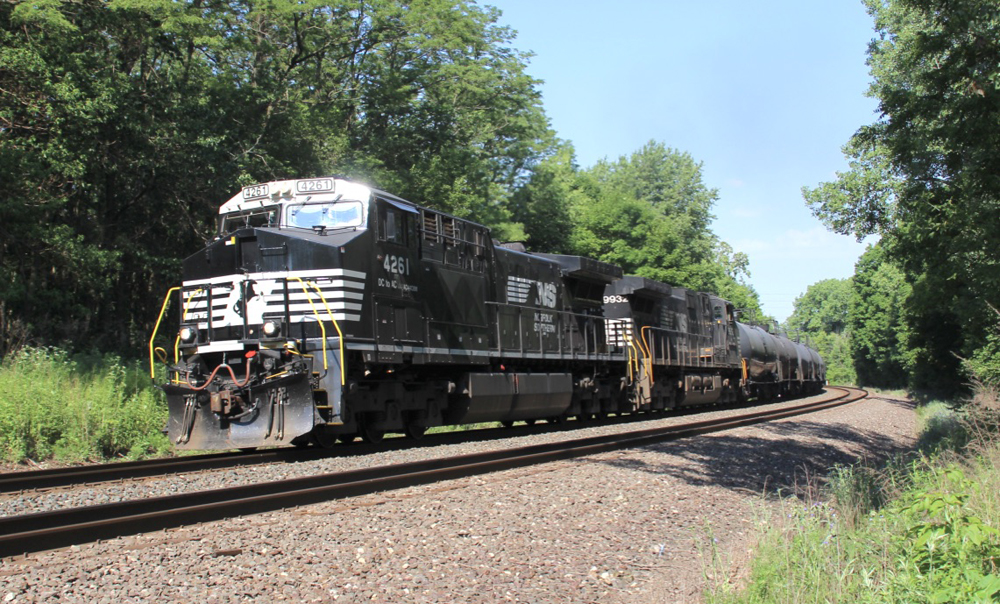
NASHVILLE — Norfolk Southern is doing all it can to solve its crew shortage problem and restore service to normal levels, executives said today.
NS has been hit hard by the double whammy of higher-than-expected attrition among its current train and engine crews and difficulty hiring conductor trainees in an extremely tight job market.
The railroad’s service has suffered as a result, with shipper complaints rising and the Surface Transportation Board seeking information about erratic transit times and deteriorating operating measures, including average train speed, terminal dwell, and number of trains held per day.
“We’ve got about a dozen locations on our network that have about 50% more attrition in the last seven months than we would have expected in a full year,” Chief Financial Officer Mark George told an investor conference this morning. “So our first order of business right now is really to replenish crews in those critical locations and do that as quickly as possible because we’ve got to get the momentum back on the network.”
Average train speed has declined 18% since Oct. 1, to 16.9 mph last week. That’s the lowest level in years.
NS is pulling five levers to solve the problem, George says.
First, NS has tripled its hiring rate since the first quarter and currently has more conductors in the training pipeline than at any time this year. “So we’ve got good momentum on the hiring side,” George says.
Second, NS aims to trim the lag time from hiring a conductor trainee to putting them into the active workforce. The railroad has compressed both the hiring timeline and the conductor training schedule.
Third, NS is working to stem attrition with retention and availability bonuses, as well as offering to buy back employees’ vacation days so they are available to work.
Fourth, the railroad is making operational changes to improve crew productivity. With average train length up 9% so far in the fourth quarter, NS is moving its tonnage on fewer but longer trains.
Finally, NS is using its “go teams” — train and engine employees who are willing to temporarily relocate — to alleviate crew shortages in key areas and is recruiting more employees to the go teams. Adjustments also have been made to crew districts, and in some cases NS is routing traffic around terminals that are particularly short of crews. This adds some roundabout routes to the network, but avoids having trains held for lack of crews.
“I want to be very, very clear … we are highly focused on getting our network fluid again, and moving with speed, and serving our customers,” George says. “The entire management team is focused on it and it is our highest priority.”
NS is caught up in the broader trend of people leaving their jobs for greener pastures, something a record 4.4 million Americans did in September, according to federal data.
“Norfolk Southern is a great place to work,” George says, citing high pay and good benefits. “But it’s an outdoor sport,” he notes, making it harder for railroads to compete for workers.
“People have a lot of options, and what we’re finding is that people are really making decisions to leave or not to join … largely based on lifestyle,” George says.
When seeking conductors, NS now finds itself in competition with Amazon warehouses, trucking, and housing construction.
“In this post-COVID world, people are choosing different ways to live their life, and work-life balance is part of that. So that’s really what we’re dealing with,” George says.
Weak traffic trends at NS are partly due to congestion, Chief Marketing Officer Alan Shaw says. Overall volume is down 4% since Oct. 1, with intermodal declining the most at 7%.
“Our network fluidity is impacting our volumes. There is no doubt it did in November, and I fully expect it to in December,” Shaw says.
Demand is strong, particularly for intermodal service amid a lack of trucking capacity, Shaw says. But that’s offset by labor and capacity shortfalls at warehouses, which have resulted in extended street times for chassis, which in turn has created a chassis shortage. NS is on track to receive 1,100 chassis by the end of the month and has more on order for next year, Shaw says.
If there’s any silver lining to the capacity issues, it is that trucking capacity is expected to remain tight next year. Shaw recently met with a trucking company in Pittsburgh that has 500 rigs but only 400 drivers, and wants to add 60 tractors to its fleet next year but will only receive 20 due to the global shortage of computer chips used in vehicles.
George and Shaw spoke with analyst Justin Long at the Stephens Annual Investment Conference.
Share this article