

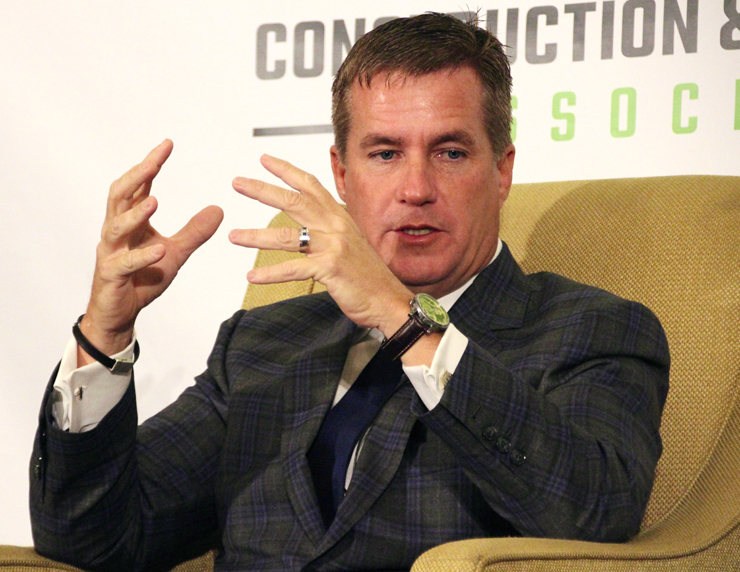
CALGARY, Alberta — Canadian Pacific CEO Keith Creel says there’s no reason to sweeten his railroad’s $29 billion offer for Kansas City Southern because Canadian National’s dueling $33.7 billion bid is so anti-competitive that it would never make it out of the starting gate.
Kansas City Southern’s board is considering CN’s unsolicited offer, which was announced Tuesday, a month after CP and KCS unveiled their agreement to combine into the first railroad that would serve Canada, the U.S., and Mexico.
“We’re not considering changing anything with our bid,” Creel told investors and analysts today on the railroad’s first-quarter earnings call.
Creel did leave open the possibility that could change in the unlikely event that the KCS board selects CN’s offer. But he said CP’s deal with KCS was ironclad — and CN’s was so fraught with regulatory risk that it was “unattainable,” a “fantasy,” and “fool’s gold.”
The crux of the matter, Creel says, is that U.S. regulators would never allow CN to put KCS into a voting trust as a first step toward a merger. Combining the overlapping CN and KCS networks wouldn’t pass the Surface Transportation Board’s public interest test for voting trusts, Creel argues.
 And that means KCS shareholders would never get the “eye-opening” $325 per share that CN is offering. “You never get to the value,” Creel says. “It’s worth zero.”
Creel began the webcast by speaking for nearly 25 minutes, touting the benefits of a CP-KCS merger and criticizing CN’s unfriendly bid for the smallest Class I railroad. He rattled off a number of “undeniable truths” about both potential deals.
CP is the only potential suitor for KCS that has widespread shipper support, could gain regulatory approval, boost competition, and create a balanced North American rail system, Creel says.
CN’s proposal, he says, is anti-competitive because it reduces shipper options in more than 100 locations across the CP and KCS systems. CN maintains that it only overlaps with KCS in a handful of locations in the 65 miles between Baton Rouge and New Orleans. “C’mon, man, that’s not the truth,” Creel says, noting that CN competes with CP and KCS from Edmonton, Alberta, all the way to Mobile, Ala.
A CN-KCS combination would affect customers across the board — including automakers, energy, forest products, intermodal, and agricultural shippers — by eliminating CP’s friendly connection with KCS at their Joint Agency Yard in Kansas City, Mo., the only place their networks connect, Creel says.
Among customers feeling the impact: ExxonMobil’s propane plant in Edmonton would see its competitive options reduced to the U.S. and Mexico. Shippers in Superior, Wis., who today can choose among CP, CN, BNSF Railway, and Union Pacific to reach the Gulf Coast would lose the CP-KCS routing option. And grain producers in the Upper Midwest would miss out on new CP-KCS single-line service to the Gulf Coast.
A CN-KCS combination also would give CN a virtual monopoly on forest and energy products that originate in Canada and move to the Gulf Coast and Mexico, while CN also would dominate service to Ford and General Motors assembly plants, CP claims.
Creel was highly critical of CN for interfering in CP’s friendly deal with KCS and said CN didn’t do its homework. “They either don’t know how much damage this proposed combination could create, or worse yet they do and they prefer not to share the truth,” Creel says.
Share this article