

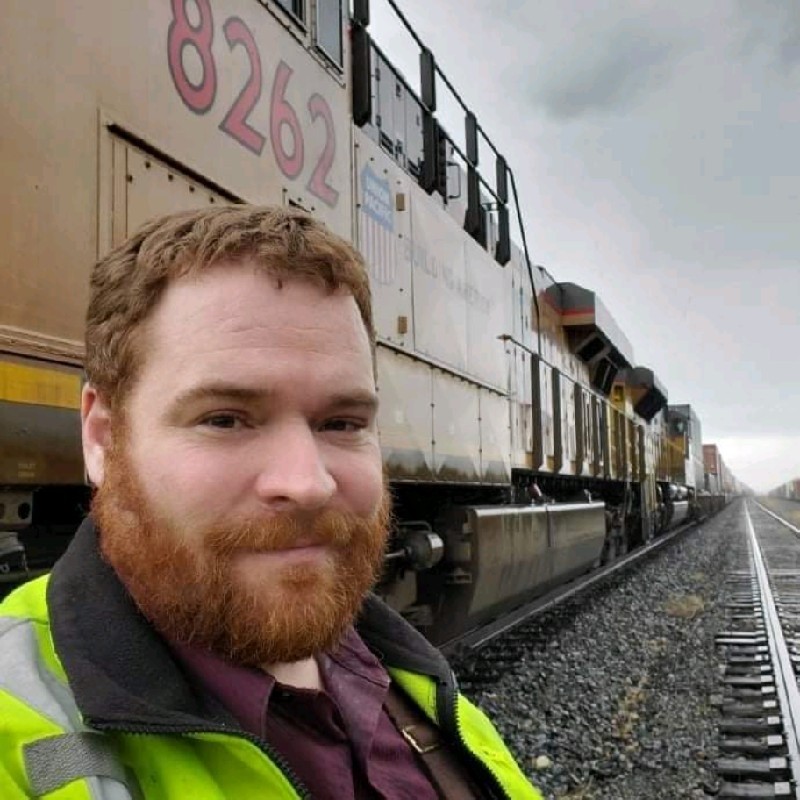
WASHINGTON — When veteran Union Pacific locomotive engineer Michael Lindsey II looks at the industry he loves, he doesn’t like what he sees.
So he has become outspoken on issues ranging from crew shortages and ongoing service problems to labor contracts and railroad regulation. He’s written two letters to the Surface Transportation Board this year. And Lindsey’s encouragement of other railroaders to join him in speaking out prompted an unusual burst of letters to the STB from rank-and-file operating people.
“As for what motivated me to write to the STB, it was a long time coming,” says Lindsey, who is based in Pocatello, Idaho. In 17 years with UP, he has made numerous proposals to headquarters that would improve operations and efficiency on his stretch of railroad between Green River, Wyo., and Nampa, Idaho.
“I care about the industry immensely and tried my hardest to help implement plans that would improve my industry. A few were implemented,” he says, including detailed recommendations on passing sidings and fuel conservation.
But the railroading business has changed in recent years.
“Several years ago I started to notice a disturbing trend where the railroad was spending far more on share buybacks than actual capital improvements,” Lindsey says. “It became kind of a learning obsession as I learned more and more about the industry and its finances.”
All of the publicly traded railroads have stepped up their share buyback programs in recent years. The railroads are far from alone in gobbling up their own shares: The majority of large companies use the practice as a way to boost earnings per share.
Lindsey took his concerns straight to the top by calling CEO Lance Fritz and then-Chief Financial Officer Rob Knight on their cell phones. Lindsey says they took his calls and they talked for 30 minutes or so.
“Then in a town hall meeting in Pocatello, I called them out in front of the superintendent and the entire service unit on their share buyback program. I accused them of burning our working capital to enrich themselves and put our railroad in a weaker state in future years,” Lindsey says of a meeting held five or six years ago. “So far I’ve been right.”
Fritz has defended UP’s share buyback program. The cash the railroad generates first goes to pay expenses like wages and fuel, and then to maintaining and expanding the network. After that, some of what’s left over is returned to shareholders.
Meanwhile, changes to tax laws in 2017 meant that train crews could no longer deduct the cost of meals purchased at their away-from-home terminals, which Lindsey says has hurt crews’ wallets. “I started to sound the alarm with my fellow employees, but of course that never really amounted to much,” he says. “But through COVID, and [Precision Scheduled Railroading] and the destruction of our seniority and deterioration in working conditions I became more and more compelled to start speaking out.”
That prompted his first letter to the STB, an April missive outlining why he thought railroads are having a tough time retaining and hiring crews. That letter, and the attention it received, opened a spigot. Around the time of the STB’s rail service hearings in April, more than three dozen ballast-level employees wrote the board.
Union leaders routinely comment on matters such as mergers, line spinoffs, and labor protection issues. But STB Chairman Martin J. Oberman and former chairman Daniel Elliott II, who served on the board from 2009-2017, say they couldn’t recall ever hearing from rank-and-file workers before.
The letters from BNSF Railway, CSX Transportation, Norfolk Southern, and UP railroaders raised a laundry list of concerns: BNSF’s controversial Hi-Viz attendance policy, ever longer trains, throttle and speed restrictions, TripOptimizer, low horsepower/ton ratios, more time spent away from home, fatigue, health issues, layoffs and attrition, safety, low morale, and the lack of a new contract and raises since 2019.
The board even heard from the wives of some railroaders, including one who said her husband was disciplined after leaving work in mid shift when their infant daughter had been taken to the emergency room with breathing problems. (Trains News Wire rounded up the letters, WHICH YOU CAN READ HERE.)
Last month, Lindsey wrote to the STB to lament the number of misrouted cars on a manifest train he operated, the North Platte, Neb.-Hinkle, Ore., symbol MNPHK. It’s a service issue that’s not captured in the performance metrics railroads file with the board every week.
“When I made my most recent submission about the MNPHK, I shared it again online and made a call for railroaders all around the country to share their own letters with train lists documenting operational failures,” Lindsey says. “So, yes, I would hope others would join in.”
Rail labor has the STB’s ear
Testimony from union officials, along with points raised in railroaders’ letters, shaped the STB’s order requiring Class I railroads to submit service recovery plans. The board asked the railroads to explain throttle and speed restrictions, their use of energy management systems like TripOptimizer, and reductions in horsepower/ton ratios – all points labor raised during the two days of hearings and in individual letters to the board.

Oberman, in an interview with News Wire last week, says input from rail labor has helped the board better understand what’s happening on the rail network.
“As a general proposition, I have always encouraged input from every source,” Oberman says. “The more information we get — the more we learn about what’s going on — the better.”
The board welcomes additional feedback from railroad workers. “I have always been very sympathetic to labor,” Oberman says, dating back to 1975 when he began a 12-year stint as an alderman in Chicago’s City Council.
But Oberman warned against sharing information that could be considered proprietary.
“I would urge people who want to communicate with us to be careful. Because when things get sent to us, generally we have an obligation to make them public,” Oberman says, noting the board also is obligated to protect commercially sensitive information about railroads and their customers. “They shouldn’t, and we shouldn’t, make things public that are prohibited.”
Lindsey’s misrouted car letter — which contained train consist information — ran afoul of this rule. The letter was posted on the board’s website, but later was removed from the directory of filings while the STB weighed whether it should be public. Links to the document still worked, but ultimately the letter was removed entirely from public view.
Yet the STB under Oberman aims to be a place where rail labor can be heard. Longtime STB staffers told Oberman since the April hearings that they don’t remember the board having a forum where labor was invited to speak.
“That’s kind of shocking when you think about it,” Oberman says, noting the massive wave of job losses in the industry since 2017. “Particularly over the last six or seven years labor has been at the heart of what’s wrong with the industry — and it has been since they started laying off those 45,000 people.”
Oberman says it’s frustrating that the board has very little direct authority regarding labor matters. “I have said to the railroads … “Listen, I don’t care how many people you have working for the railroad, as long as you have service that’s acceptable.’ And then I almost always say, ‘I don’t think you can have service that’s acceptable with the number of people you have working there,’ ” he says.
Share this article